
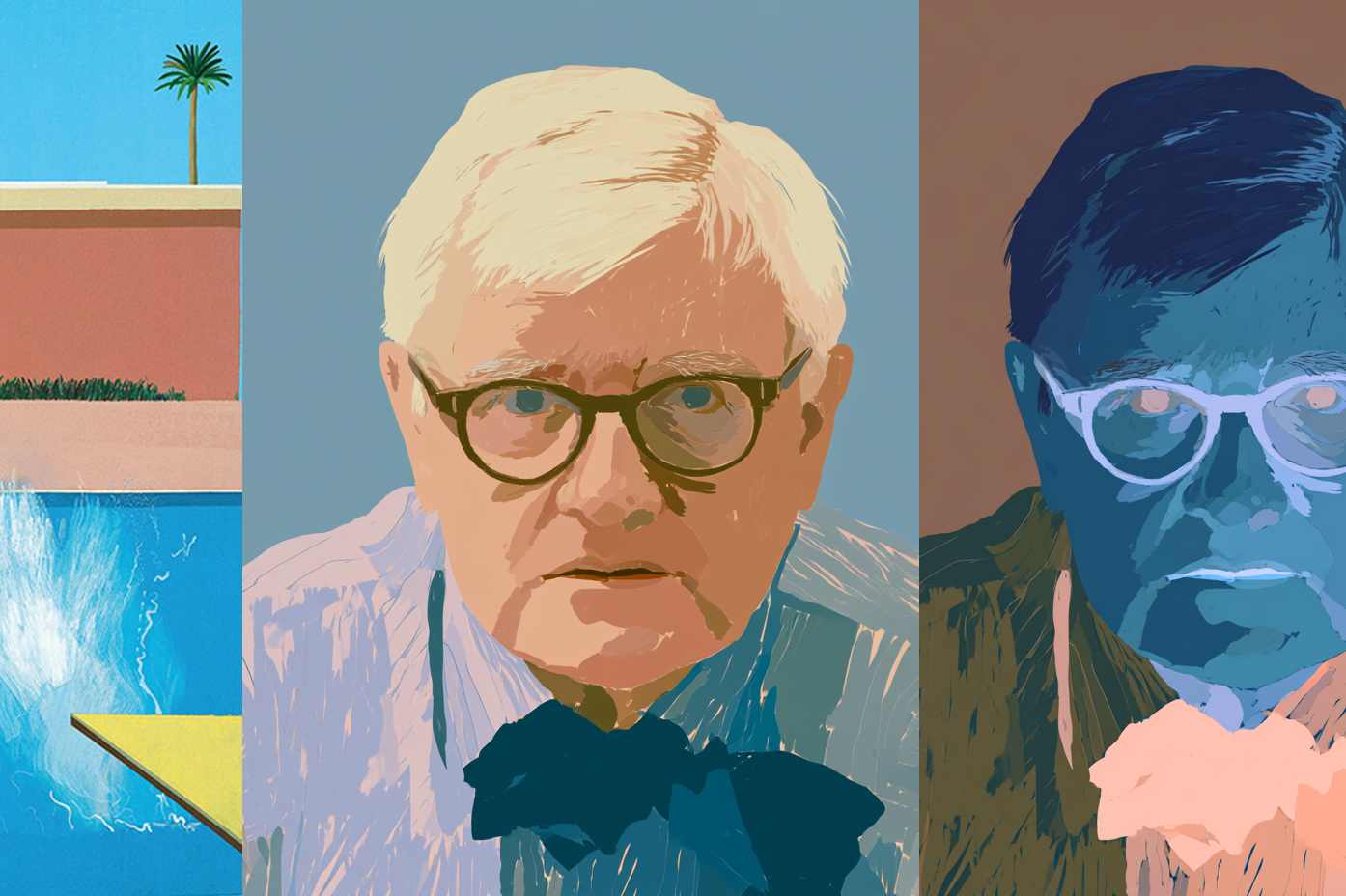
Hockney Code. Double Portrait (Courtesy: Alex Chevalkov).
When a great artist dies, the fashion industry does what it does best: it rushes to explain how deeply it always loved them. And in David Hockney’s case, that is almost true.
Hockney became one of the most influential fashion designers of the twentieth and twenty-first centuries without ever designing a single collection.
In fact, fashion borrowed more from Hockney than it did from many of its most celebrated couturiers. Meanwhile, well into his late eighties, Hockney himself remained one of the most stylish figures in the art world.
Imagine contemporary fashion stripped of everything he gave it over the past six decades: its cult of color, its aesthetic of pleasure, its intellectual eccentricity, its permission to be elegant without taking elegance too seriously, its ability to become instantly recognizable without relying on logos, and its understanding that a personality can itself become a work of art.
It is impossible to imagine.
These are precisely the qualities that underpin the visual language of many of today’s leading fashion houses. David Hockney never designed clothes for the runway. He did something far more important: he created a visual language that fashion continues to speak to this day—and not fashion alone.
Most artists influence art. Some influence culture. Only a handful change the way we see the world. Hockney belonged to that rare category.
Ironically, his influence on fashion is almost always explained too superficially. People point to the brilliant colors, the swimming pools, California, striped ties, round glasses, cardigans, and eccentric socks. All of that is true. But that’s only the surface.
And Hockney, as we know, was far too great an artist to be reduced to the packaging—even if he did package himself better than that of most luxury brands. His greatest gift to fashion was not color.
It was joy.
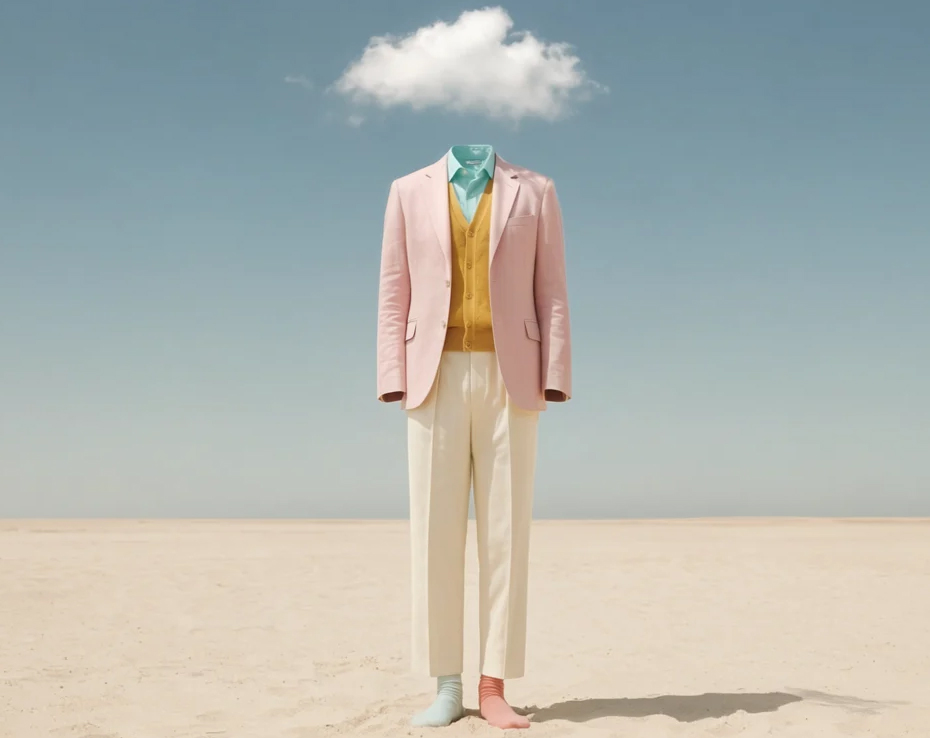
Hockney Code: Color. Joy. Light. (Courtesy: Alex Chevalkov).
After the Second World War, serious art increasingly spoke the language of anxiety, skepticism, and intellectual analysis. Artists were expected to expose, challenge, deconstruct, suffer—or at least appear to possess a profound understanding of the tragedy of the modern condition.
Against that backdrop, Hockney almost seemed dangerous.
He painted friends.
He painted sunlight.
He painted swimming pools.
He painted blossoming trees.
He painted the pleasure of being alive.
And he approached that pleasure with such seriousness that joy itself unexpectedly became the subject of great art.
Today, this feels almost self-evident. In the 1960s and 1970s, it was nothing short of revolutionary. Hockney demonstrated that joy need not be synonymous with decoration, and that brilliant color need not be frivolous. That is precisely why his work entered fashion so effortlessly. Fashion has always loved pleasure. It has simply been reluctant to admit that pleasure is its true engine. Instead, it dresses desire in theories, seasonal concepts, press releases, and endless “reinterpretations of the archive.”
Hockney was more honest. He simply presented a world in which light, the body, color, water, and the gaze possessed value in and of themselves.
Virtually the entire contemporary resort aesthetic—from Versace and Missoni to Jacquemus and Loewe—exists within a visual territory that Hockney helped open. Not because these designers literally copied his swimming pools. But because they inherited something far more important: the permission to be both cerebral and joyful.
Hockney also transformed the very notion of good taste.
For decades, good taste aspired to restraint. Preferably gray. Preferably black. Expensive, but never ostentatious. Above all, it should never betray too much pleasure in one’s own appearance. Hockney, it seems, never received that memo.
Yellow cardigans.
Brilliant socks.
Plaid jackets.
Striped ties.
Round spectacles.
Silver hair bordering on platinum blonde.
He looked simultaneously like a professor and a pop star.
Which is precisely why he could never be mistaken for anyone else. Today, marketers would call this a powerful personal brand. But Hockney never set out to build a brand. He simply remained so consistently himself that, over time, he became a visual icon
What fashion truly loved about Hockney, however, was never Hockney himself.
It loved using Hockney.
Those are two very different things.
For decades, designers have repeatedly reached into his artistic wardrobe, borrowing a color here, a mood there, a swimming pool, a striped tie. Some appropriated his California light. Others, his distinctly British eccentricity. Still others embraced his very notion of intellectual dandyism.
Paul Smith has spent much of his career in conversation with Hockney—not simply through color, but through a uniquely British kind of freedom, where impeccable manners unexpectedly pair with brilliantly colored socks.
Christopher Bailey, during Burberry’s finest years, worked from a similar code: British style liberated from museum dust and suddenly released into the sunlight.
Jonathan Anderson, whose reinvention of Loewe transformed the house into a beacon of intellectual fashion—and who now stands at the forefront of Dior—works within a remarkably similar framework: his is a world where intelligence does not compete with pleasure, and where an object can be strange, desirable, and culturally precise all at once.
Even Jacquemus, for all his Mediterranean sensibility, owes more to Hockney than may first appear. His endless summer, celebration of simple pleasures, expanses of saturated color, and cult of sun-drenched space all inhabit the same visual universe.
Yet the most interesting point is this:
Almost none of these designers copied Hockney literally.
They borrowed not his forms.
They borrowed permission.
Permission to embrace color, to be intellectually sophisticated without succumbing to snobbery, to love beauty without apology. That is why Hockney’s influence on fashion ultimately runs deeper than that of many designers.
A designer may change the silhouette of a season. Hockney changed the emotional climate of several generations.
That is a far greater achievement.
Fashion imagery has long since ceased to be simply beautiful photographs of clothes. Today, it constructs entire spaces of presence. The camera no longer merely records a garment; it creates mood, temperature, and a relationship between the body and the world.
In that sense, Hockney anticipated much of what later became standard in fashion photography: the intimacy of the frame, the flatness of color, the peculiar closeness of objects, and the sense that an image does not document reality so much as reconstruct it.
He was never a fashion photographer. Yet many fashion photographers became his heirs. And it seems that half of today’s influencers spend their lives accidentally trying to produce a photograph that looks like a Hockney painting.
In his later years, Hockney embraced digital painting with remarkable enthusiasm. He worked on an iPad. He experimented with new technologies. Hockney never stopped asking questions. Nor did he ever stop being surprised.
Perhaps that is why, at eighty-eight, David Hockney seemed younger than most fashion houses. Many brands today resemble beautifully restored museums. Everything is expensive. Everything is impeccably in place. Everything is correct. Almost nothing surprises.
Hockney devoted his entire life to the opposite. He did not preserve the past. He kept looking. More importantly, he kept seeing.
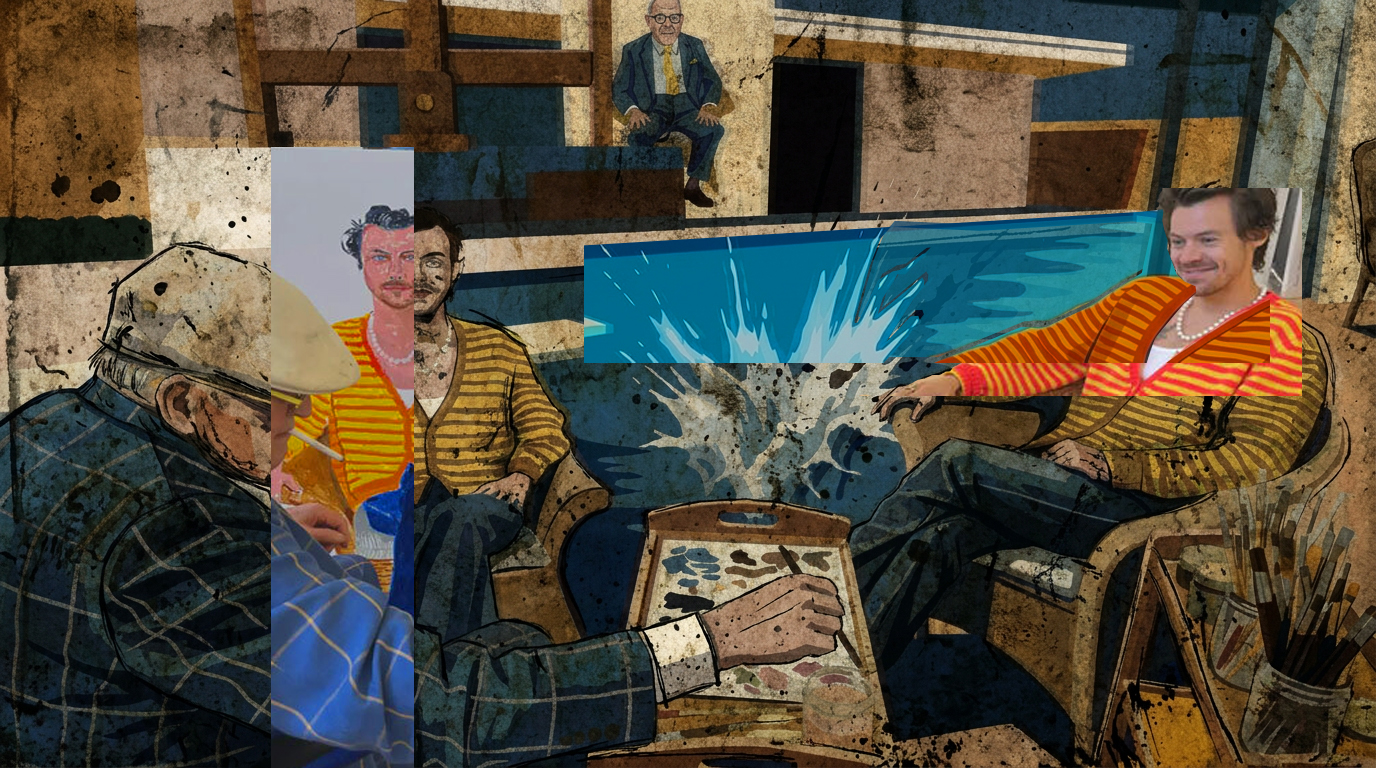
Portraits. (Courtesy: Alex Chevalkov).
There is something fitting in the fact that one of Hockney’s late subjects was Harry Styles.
At first glance, it seems like the perfect meeting of two contemporary celebrities: a great artist painting a pop star beloved by the fashion world. An ideal story for the press, museums, and social media alike.
But the reality is considerably more interesting.
Harry Styles has long since become one of fashion’s favorite objects. He is routinely used as evidence of progress, freedom, the new masculine wardrobe, gender fluidity, and a dozen other attractive theories.
Yet something strange happens when he appears in a Hockney portrait.
Fashion disappears.
The person remains.
Hockney seems to strip away every marketing layer, every stylistic construction, every piece of social-media noise. Before us is no longer a pop star or a style icon, but simply a young man under the attentive gaze of an artist.
What Hockney’s portrait of Harry Styles offers is a remarkably precise reminder of what contemporary fashion lacks most today.
Personality.
Not branding. Not positioning. Not strategy.
Personality. True style cannot be engineered by a marketing department. It emerges where there is character, conviction, and energy.
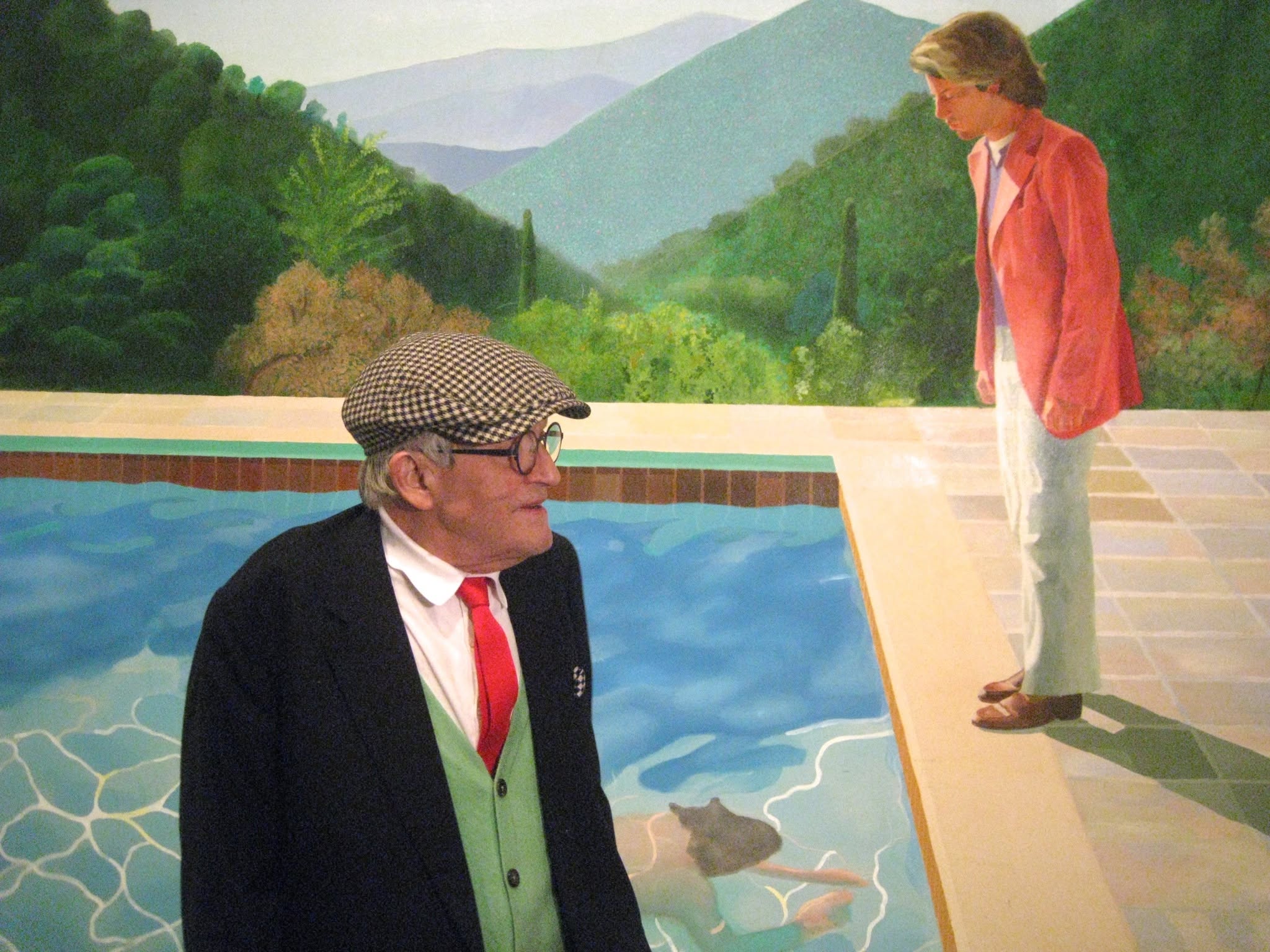
David Hockney, photographed by Jill Krementz on June 12, 2017, at the Met’s retrospective of his work, standing in front of his painting Portrait of an Artist (Pool with Two Figures).
That is why, in an era of endless creative-director reshuffles, Hockney quietly points us toward a far more important question:
Does the person occupying that chair actually have something to say to the world?
Because fashion’s future has never truly been born from the archives. It always arrives from somewhere else.
Sometimes from a swimming pool in Los Angeles.
Sometimes from a painter in a yellow cardigan who simply refused to grow old with everyone else—and possessed the one thing that cannot be directly copied: freedom of seeing.
Designers create clothes. Artists create images. But the greatest artists create entirely new ways of seeing the world.
David Hockney belonged to that rare company.
What remains is A Bigger Splash.


0 Comments