

Adrian Ghenie, Untitled, 2025. Oil on canvas. (Photo: Vladimir Dudchenko).
It’s minus 5 °C (41 °F), but feels like minus 15 °C (5 °F) according to the weather report. Two o’clock in the afternoon, U Bülowstaße: sun shining through the clouds, sunglasses on, black ice underfoot. The best grilled chicken in town so far is at Alzad; you wait 10 minutes, then get an all-in-one wrap, French fries, and sauce. The joint is an empty room with plastic chairs; Qur’an verses are being sung on the flat-screen TV, and a video menu with animated flames blazes above the counter. 6.50 euros (about $7.60).
Gallery district on Potsdamerstraße, old West Berlin. It’s the last day of many exhibitions, in certain venues, new ones have already started, while some galleries haven’t yet reopened after the holidays. Sex workers are patrolling on Frobenstraße as always. The Heidi Gallery has either closed or is undergoing a major rebuild. Piles of rubbish are on the pavement in front of its glass walls. Around the corner is the socially oriented KOW Gallery. Exhibited is Sophie Gogl with paintings of a wolf in sheep’s clothing, complete with brand-patterned wallpaper: a story about our hypocritical consumer society.
Across the street is Galerie Molitor. A hollowed-out three-storey space, from the minus first to the plus first floors, with metal walkways built inside. A budget version of the international Sprüth Magers gallery. Emanuel de Carvalho has created an exhibition after attending a lecture by the French philosopher Catherine Malabou, complete with a text that could be cast in bronze as a foreboding example. It goes on about the influence of the latest results of optical-neurological research on continental philosophy. One stifles an urge to laugh hysterically. The exhibition is actually good (like almost everything seen in this gallery so far). It’s brutal, with rusty metal structures and brown and grey paintings that fit into the industrial interior. Also, this is the moment when yours truly realizes that he hates visual art that tries to make one read or listen to philosophical essays in the first place.

Emanuel de Carvalho, Untitled, 2025. Matt polished stainless steel (Photo: V. Dudchenko).
Recently, one much like this has been seen at Neugerrimschneider, but up to 11: Ho Tzu Nyen has done a multi-media show about the meetings of the Kyoto School of Philosophy during World War II in a small restaurant, where participants attempt to justify Japan’s actions in China and in the Pacific area in general. The videos are multi-layered, and you have to put on VR glasses and headphones in a special meditation room, then either sit, stand, or lie on one side or the other, so you can listen to one opinion or the other. Some of the meeting participants ended up in jail, some were secretly consulting the Imperial Japanese Navy, etc. Envision Russia’s war-mongering, far-right philosopher Alexander Dugin and his entourage, reimagined 83 years later as contemporary art. There are references to kamikaze and some half-baked links to the militaristic aesthetics of manga, but overall, it’s just awful.
Many local galleries do not open doors, even though you stomp around and ring the bell for a decent time, and the lights are on inside. Oh well.
Mercator Höfe is a hub within the district. Judin Gallery specialises in painting exhibitions with a strong queer slant. In this case, it’s Alexander Basil, Error 404. A clearly autobiographical series about a girl who grew up and transformed herself into a gay man resembling the young Vladimir Lenin, thus delivering an unexpected, hilarious side effect.
Max Hetzler shows the Brazilian-German Janaina Tschäpe (pronounced “Yanaina Chepe” in German). Herein, yours truly realizes that he hates paintings. The eternal question: is there such a thing as non-decorative abstraction? Imagine Katharina Grosse without her boldness, trying to squeeze in Cy Twombly’s graphic scribbles. Highly ornamental, a method upon method.

Janaina Tschäpe, Into the blue, 2025. Oil and oil stick on linen, in 2 parts (Photo: V. Dudchenko).
Also here is the international Kristin Hjellergjerde gallery with a group exhibition. She’s wild in general, which is not a bad thing. Plan B occupied this same location before moving to Karl-Marx-Allee. Now there’s a show about space (in the interstellar sense); in particular, Roman Manikhin is present with stories about close encounters of the third kind, executed in his characteristic manner. Roman has been given a separate display case to the side of the entrance — in summer it would be great, like a separate exhibition near the smoking area, but now you can walk right past it without noticing. Shame.

Roman Manikhin, Go Home, Space Folks—This Forest’s Taken, 2025. Wood, acrylic, spray paint (Courtesy: the artist).
In the same place, the Munich-Berlin Walter Stroms Galerie is showing a collection of abstract works, mostly new and mostly by mid-career artists, but looking roughly like local classics from the 60s and 70s. Gregor Hildebrandt (b. 1974), Márton Nemes (b. 1986), Steven Aalders (b. 1959), Viola Bittl (b. 1980), Caro Jost (b. 1965), Gerold Miller (b. 1961).

Gerold Miller, set 531, 2018. Painted stainless steel (Photo: V. Dudchenko).
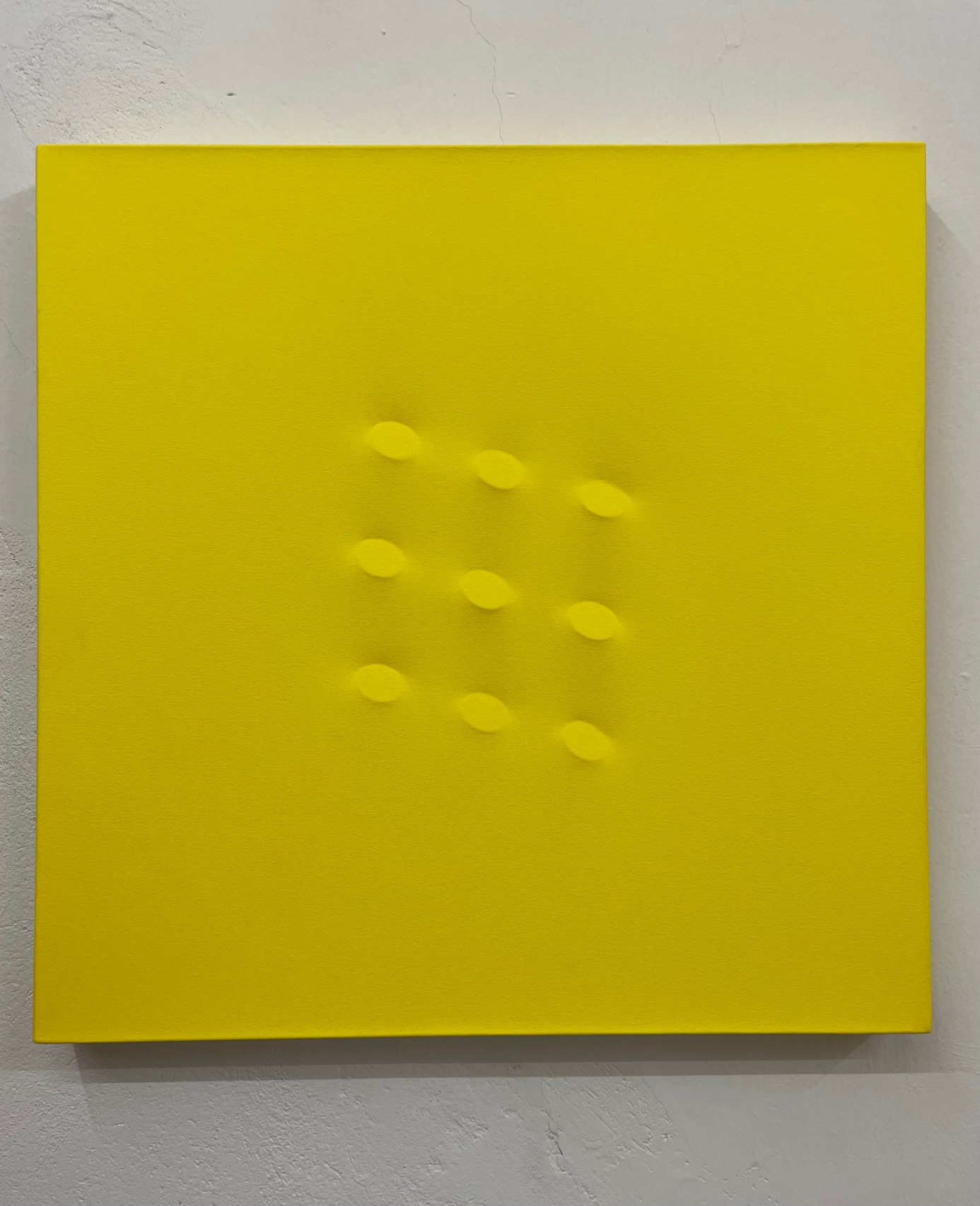
Turi Simeti, Quadrato su quadrato giallo, 2018. Acrylic on relief canvas (Photo: V. Dudchenko).
Change of course, back to Tankestelle: that is the former modernist petrol station, renovated jointly by the local Judin and New York’s Pace galleries. A bamboo grove, carp in ponds (not visible now), a bookshop, a café. Excellent cheesecake; the language spoken is English. This exhibition is organized by Judin; if you follow Pace, you would have no idea that anything is going on. There is no dedicated website or Instagram account for the space—no central platform listing exhibitions, the café, or the bookshop. Given the scale of the investment, the absence of a joint social media presence is puzzling. The famous Romanian Adrian Ghenie. Monstrous anthropomorphic structures eating chips at McDonald’s and staring at their phones. Okay, seems like yours truly still likes some paintings.
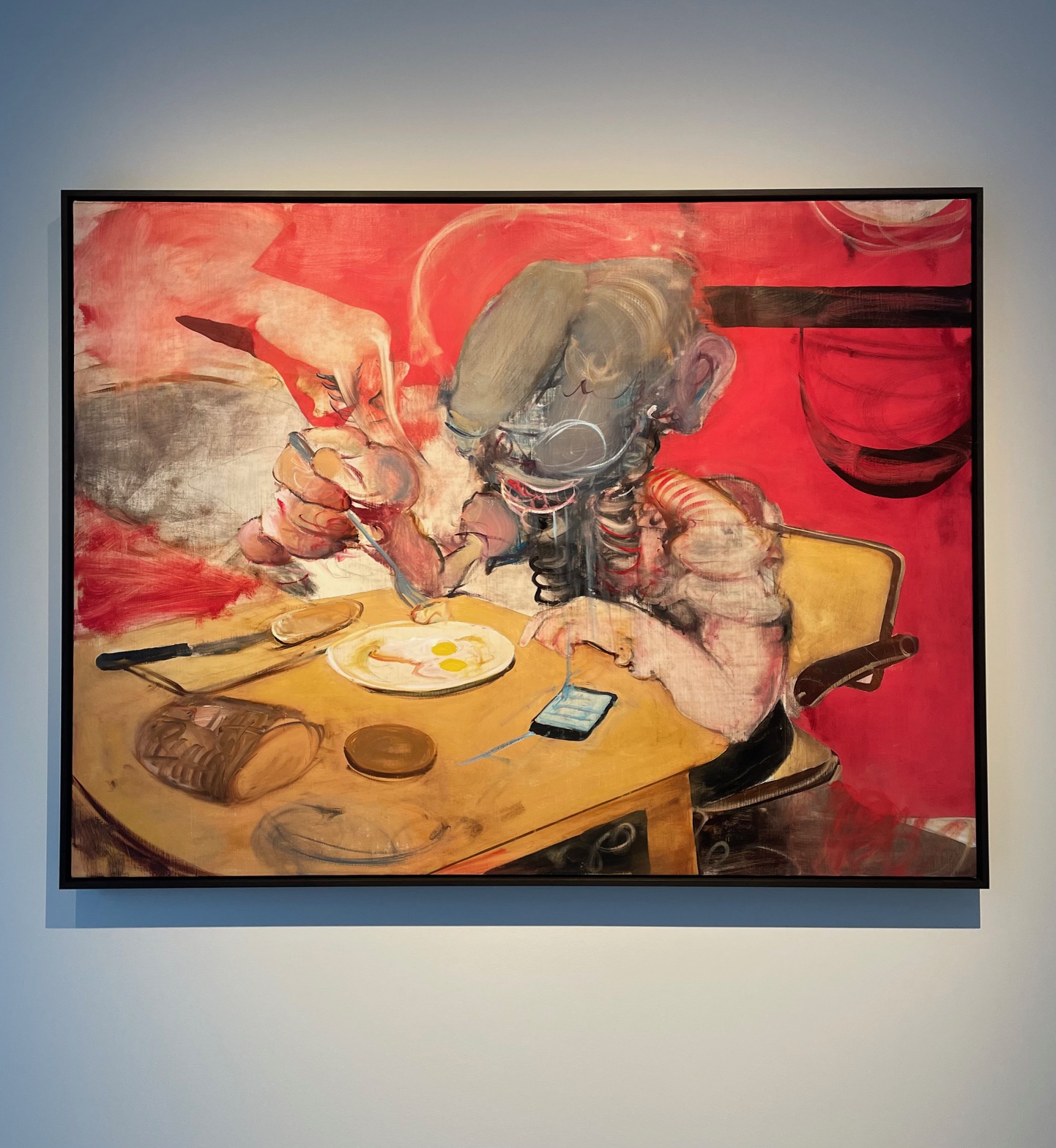
Adrian Ghenie, The Breakfast, 2025. Oil on canvas. (Photo: Vladimir Dudchenko).
And quickly zoom on to Alexanderplatz, the ugliest square in the world. But now the sun is setting, a murder of crows is circling between the skyscrapers under construction, and it even looks okay. Center, East Berlin’s part of it. That’s where Karl-Marx-Allee, formerly Stalin-Allee, begins – some 90 meters wide, it was cut through Berlin’s war-torn rubble to resemble Moscow’s new prospects. People are busy shopping for portable gas burners at a local tourist store, following massive power outages in the city’s South-West, due to an anarchist attack.
The Romanian Plan B Galeria moved here a couple of years ago and is now hosting a retrospective exhibition to mark its twentieth anniversary. Adrian Ghenie, one of the founders, is also on display here, along with many other Romanian artists.
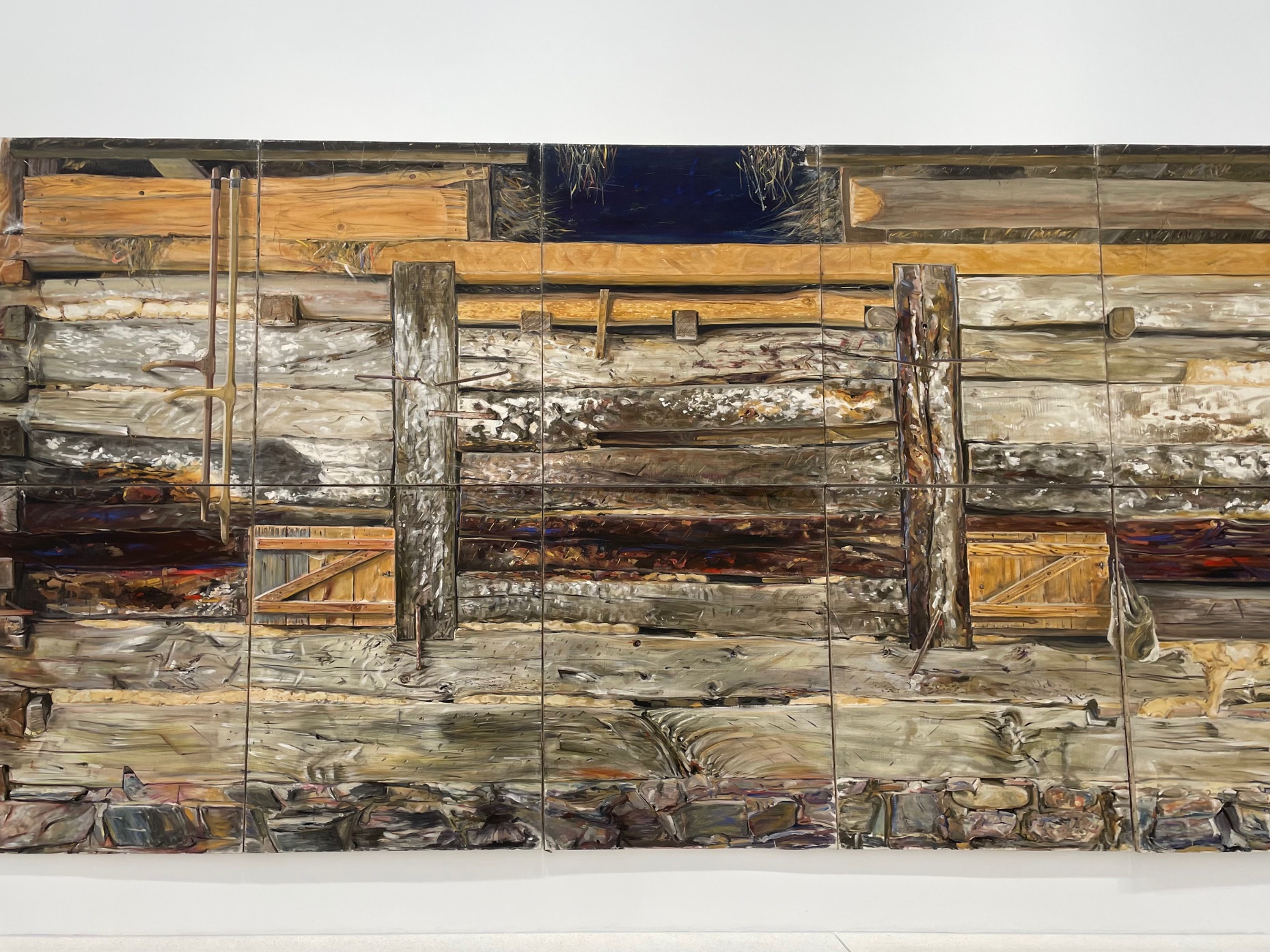
Gheorghe Ilea, The Barn, 1998. Mixed media on canvas. (Photo: Vladimir Dudchenko).
Capitain Petzel (a joint venture of Cologne’s Galerie Gisela Capitain and New York’s Petzel Gallery) operates nearby in a Soviet-style, modernist glass-box exhibition space. The former “Kunst im Heim” gallery of the GDR, it was built in 1964 to house a display of fine and applied arts from the countries of the Eastern Bloc. Inside is a birch forest with scattered birch pills underfoot: a merciless grove by Martin Kippenberger (1991). Damien Hirst, that we deserve here.

Martin Kippenberger, Jetzt geh ich in den Birkenwald, denn meine Pillen wirken bald, 1991. 29 artificial birches (rolls of cardboard and plastic, black and white offset print), metal stands, wooden pills. (Photo: Vladimir Dudchenko).
There are other good things, too; it’s a large group exhibition that just opened. Monika Sosnowska’s bent rebar, concrete, and fiberglass sculptures, Mike Kelley’s black-and-white paintings, Urban Zellweger’s coloured pizza boxes. A separate micro-hall dedicated to the important German conceptualist artist Hanne Darboven. Samuel Beckett’s video mumbles from the floor below.

Hanne Darboven, Homage an meinen Vater, 1988. Installation detail (Photo: Vladimir Dudchenko).
Further down the same avenue used to sit Peres Projects, an international gallery showcasing a bunch of good artists, but it went bankrupt in April 2025.
That’s how it goes.


0 Comments