
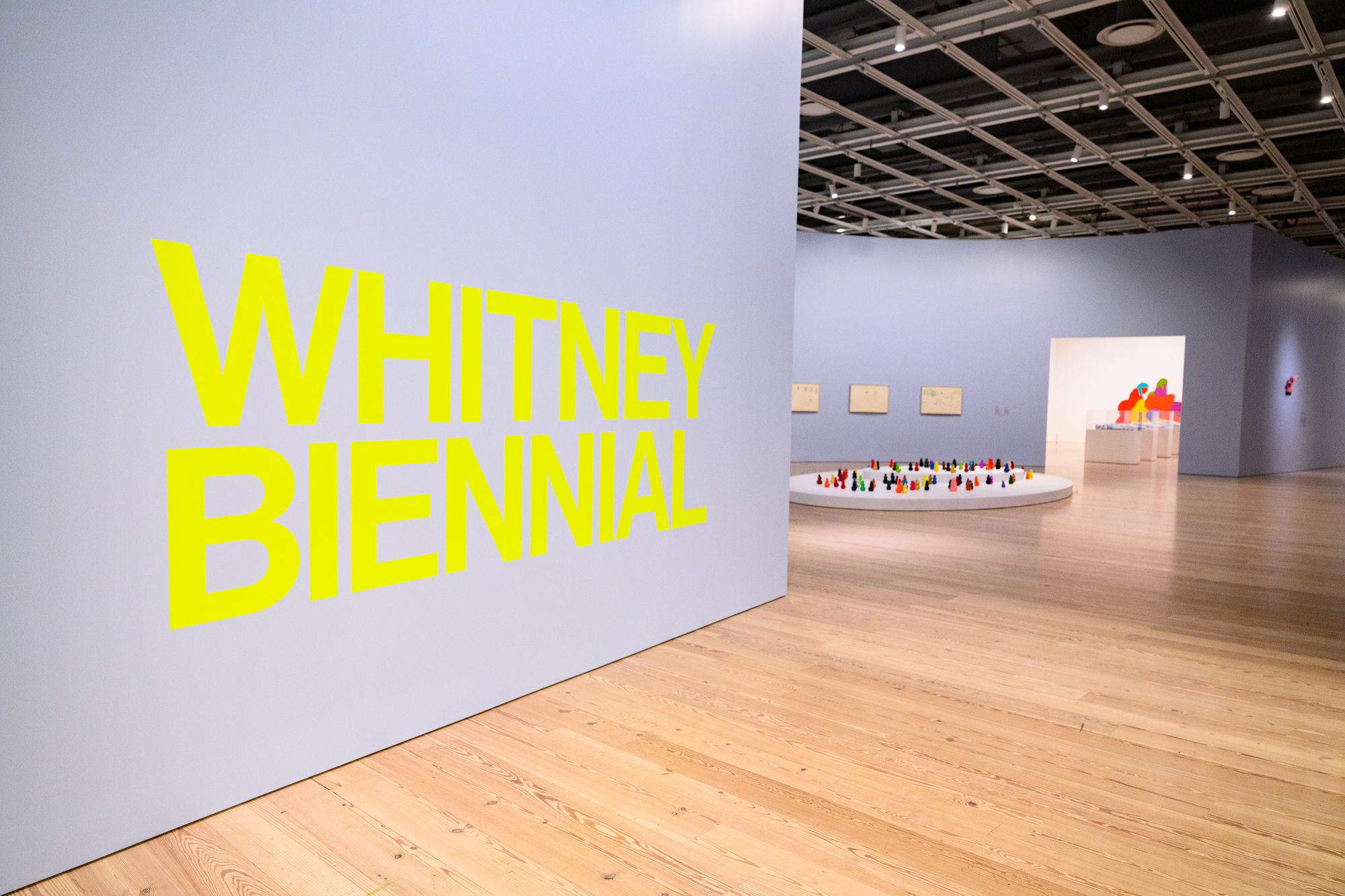
Installation view of Whitney Biennial 2026 (photo: Darian DiCanno/BFA.com).
Those who go into the latest Whitney Biennial looking for a common theme or organizing principle may come away disappointed. Coherence doesn’t appear to have been the aim of Marcela Guerrero and Drew Sawyer, the curators of this 82nd edition of the legendary survey of American contemporary art. Instead, they’ve organized the works by this year’s 56 chosen artists in ways that suggest momentary connections but cumulatively create a feeling of inchoate mess. Perhaps that all-over-the-place feeling, though, is the point, one that especially resonates in the year of “America’s 250th birthday,” i.e., the 250th anniversary of the signing of the Declaration of Independence.
The question of what’s considered “American” is hardly a new one; if anything, it’s the driving force behind the Whitney Biennial as a whole. But given the current presidential administration’s rollback of progressive social gains in a desire to return to an old-fashioned, sanitized—read: whitewashed—vision of America’s past, it’s incumbent upon artists and curators to remind us not only of the cultural diversity of which this country is capable, but the freedom of thought and expression that is the hallmark of both the Declaration of Independence and the Constitution.
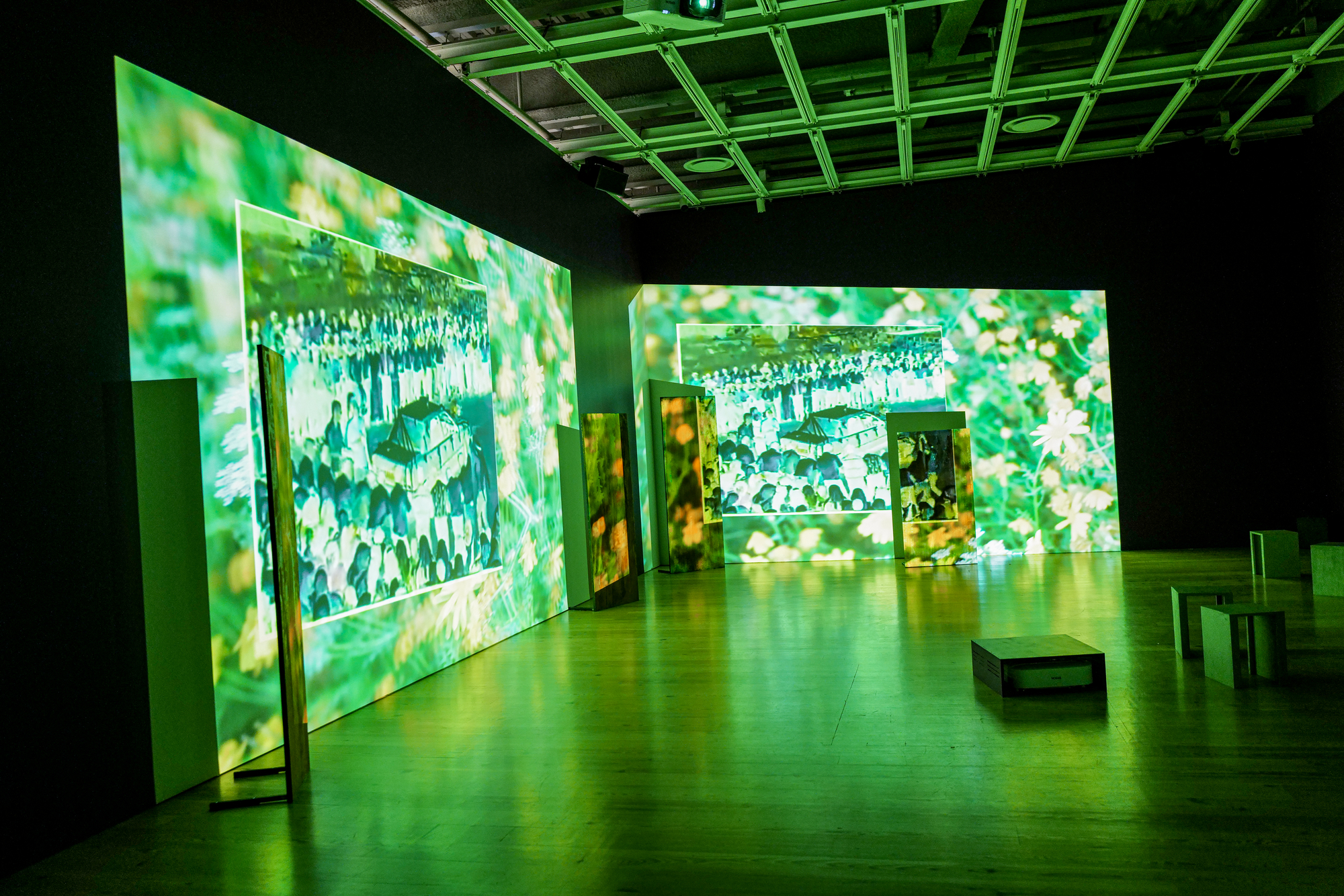
Installation view of Basel Abbas & Ruanne Abu-Rahme, Until we became fire and fire us, 2023-ongoing. Multichannel high-definition video, color, and sound, 32 min.; steel panels; custom seating; sublimation prints on chiffon and polyester; and digital prints on metal. (Photo: Jason Lowrie/BFA.com.)
Cultural diversity is behind arguably the most noteworthy aspect of this year’s exhibition: the inclusion of international artists from countries affected by U.S. actions. Palestinian duo Basel Abbas and Ruanne Abu-Rahme’s haunting three-channel video installation, titled Until we became fire and fire us, pulses with melancholy over how much has been lost in their home country amid the nation’s ongoing conflict with Israel. Artist Aki Onda has staged a version of Filipino composer and ethnomusicologist José Maceda’s Ugnayan, written for 20 radio stations, for the exhibit in an attempt to inculcate a sense of community amid an authoritarian present similar to our own. The biennial also features work by artists from Japan, Vietnam, Iraq, Afghanistan, and Iran, with some more direct in their critique of American imperialism than others.
Ugnayan, by the way, dates from 1974. His is not the only work at this year’s Whitney Biennial that isn’t technically new. Veteran visual and performance artist Pat Oleszko has revived her 1995 inflatable sculpture Blowhard for the exhibit. The massive, colorful sculpture of a clown blowing fire through a trumpet was originally displayed outdoors at the World Trade Center plaza; now it occupies about half of a display room on the Whitney’s fifth floor. Though Mariah Garnett’s video Songbook is new (2024), the film in part chronicles rehearsals for public performances of selections from The Diadem of Stars, an as-yet-unproduced opera written by her great-great-aunt, Ruth Lynda Deyo (1884-1960).
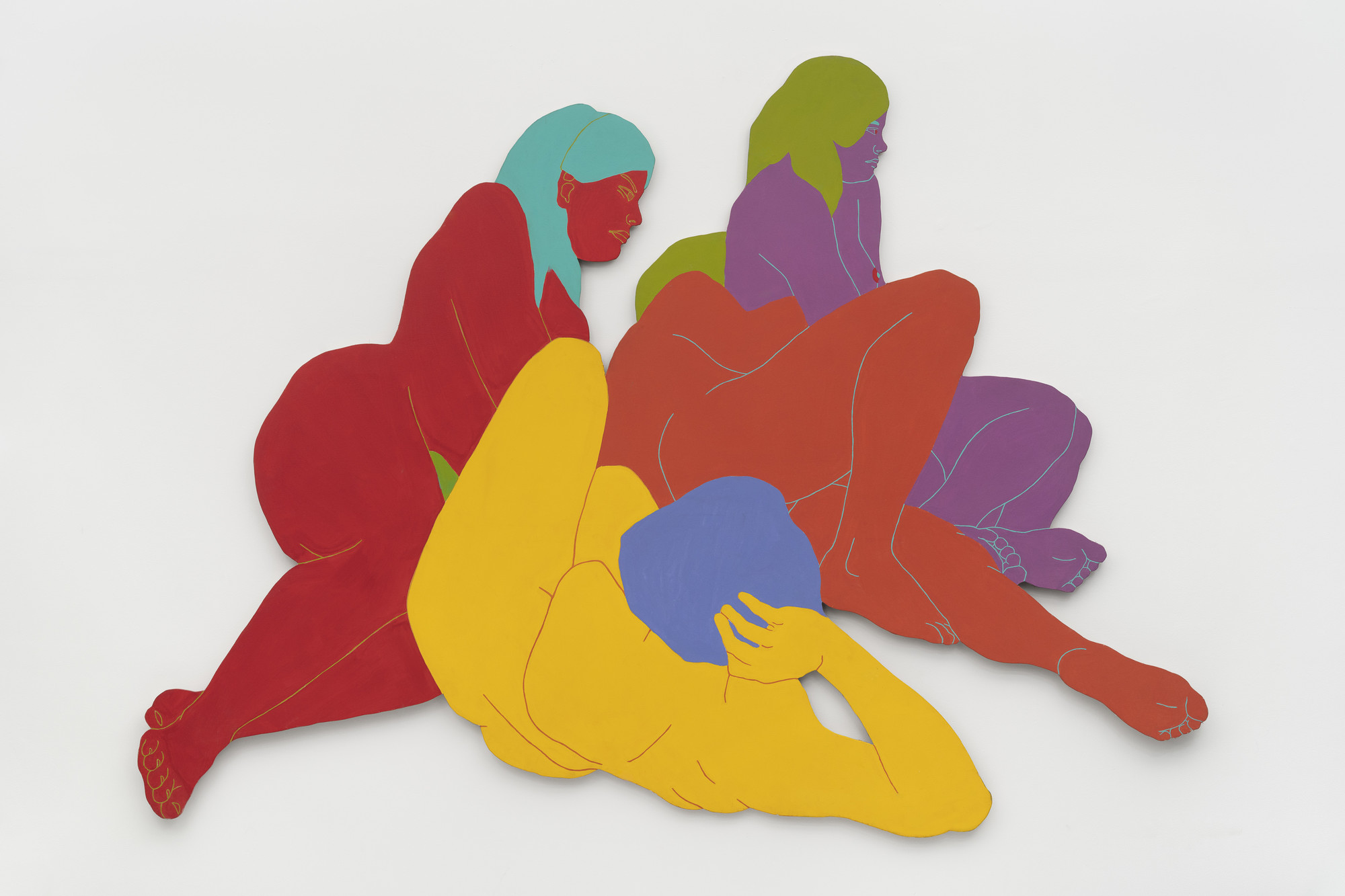
Carmen de Monteflores, Four Women, 1969. Acrylic on canvas. (Photo: Philip Maisel.)
Most striking among these older works are the two late-1960s paintings by Carmen de Monteflores featured alongside recent works by her daughter, Andrea Fraser. Fraser is known, among other things, for provocative performance pieces critiquing art-world insularity. And yet, to some degree, she’s using her renown to try to shine a belated light on the work of her mother, who set her own artistic career aside to raise her and her four siblings. (If this recent New York Times article suggests anything, Fraser’s guilt for her own perceived role in ending her mother’s career is fueling this push.) Based on the psychedelic, abstractly erotic Man and Woman Sitting and Four Women, De Monteflores may have an oeuvre worth rediscovering.
Make no mistake, though: There are plenty of intriguing contemporary works to discover at this year’s biennial. That ever-present pox that is artificial intelligence is the subject of a few of them, including CULTUS, Zach Blas’s grandiosely campy monument to the religious devotion many of our American tech-bro oligarchs have to AI (so grandiose that it occupies its own room on the Whitney’s first floor). In a more analog vein, Precious Okoyomon’s Everything wants to kill you and you should be afraid, a series that occupies most of the Whitney’s eighth floor, stitches bird wings onto stuffed dolls, creating an unsettling juxtaposition of innocence and violence. Even video games are represented this year, in the form of Leo Castañeda’s two Camoflux games, both of which have a pronounced environmental bent.
Environments are also visible in physical form throughout the show. Enzo Camacho and Ami Lien have created eye-catching altarpieces and other collages from natural materials like leaves, banana stalks, dried sugar cane, and beeswax. Though the late Native American artist Kimowan Metchewais didn’t use physical objects, the floral collages of his included in the Biennial are gorgeous nevertheless. And for his imposing fiber structure, titled Five of them were hers and she carved shelters with windows into the backs of their skulls, Malcolm Peacock fashions a redwood tree trunk out of synthetic hair braids. Two ripped-out book pages, one from Narrative of the Life of Frederick Douglass, the other from The Autobiography of Malcom X, further drive the Black connection home.
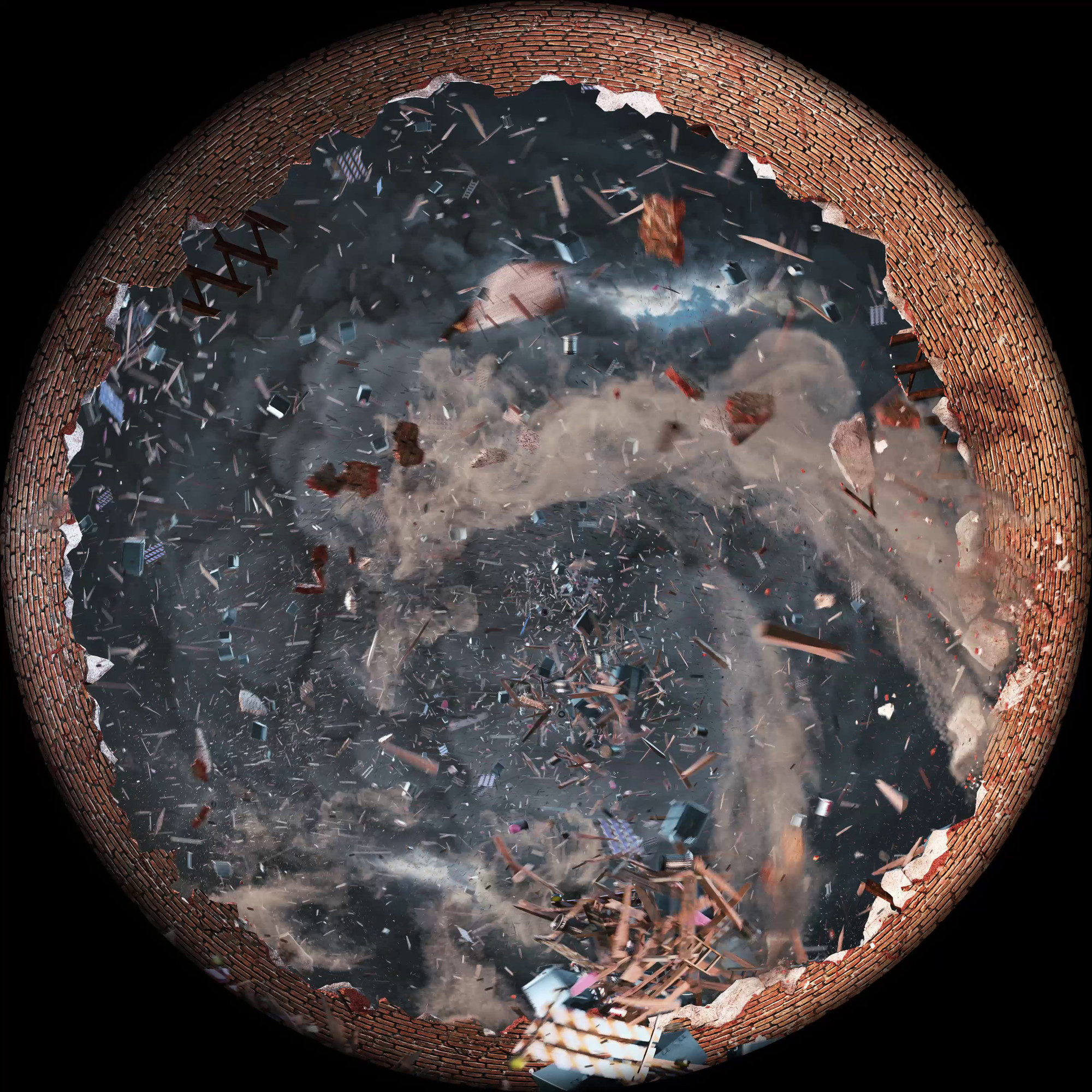
Michelle Lopez, still from Pandemonium, 2017-25. 360-degree animation, color, silent; 20 min. (Courtesy: the artist.)
As has often been the case with biennials past, some artists have used this platform to display work of social commentary, if not outright protest. Michelle Lopez’s video installation Pandemonium, occupying its own room on the sixth floor, features images of torn-up bits of the American flag, newspapers, and other detritus swirling around tornado-like in a planetarium-style curve. Of all the works that aim to evoke what it feels like to live in America today, Lopez’s work is the most eloquent. And Gabriela Ruiz’s Homo Machina uses a multidisciplinary sculpture that embraces bright colors, Windows-era digital images, surveillance footage, and 3D prints in an exuberant attempt to transcend the dehumanizing effects of technology.
Unexpectedly, the works I remember the most from this year’s Whitney Biennial are the collages created by Agosto Machado, “altars” made out of hoarded objects that not only memorialize specific friends and cultural figures but altogether add up to a poignant portrait of the bygone 1960s, ’70s, and ’80s New York counterculture. But an upside to an exhibition like this one that casts its net far and wide without worrying overmuch about coherence is that there’s something to dazzle just about anybody.
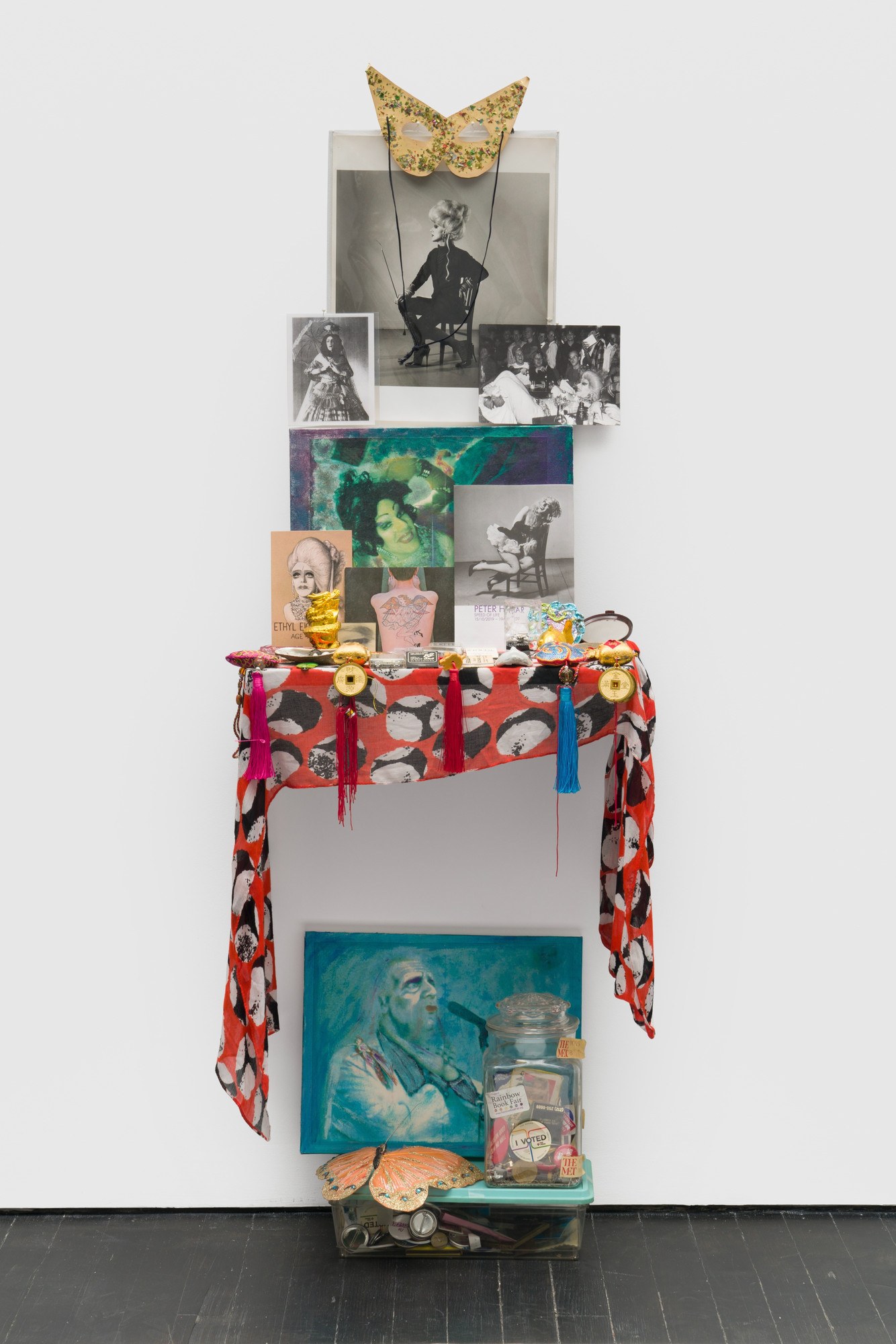
Agosto Machado, Ethyl (Altar), 2024. Jewelry, matchbooks, pins, and textile; plastic, metal, and ceramic objects; postcards, photographs, exhibition booklet, handmade feather butterfly, mask with glitter, coins, makeup compact; pearl, shell, glass, and plastic containers with additional ephemera; and original artworks by Peter Hujar, Thomas Lanigan-Schmidt, and Uzi Parnes. (Courtesy: the artist).


0 Comments