
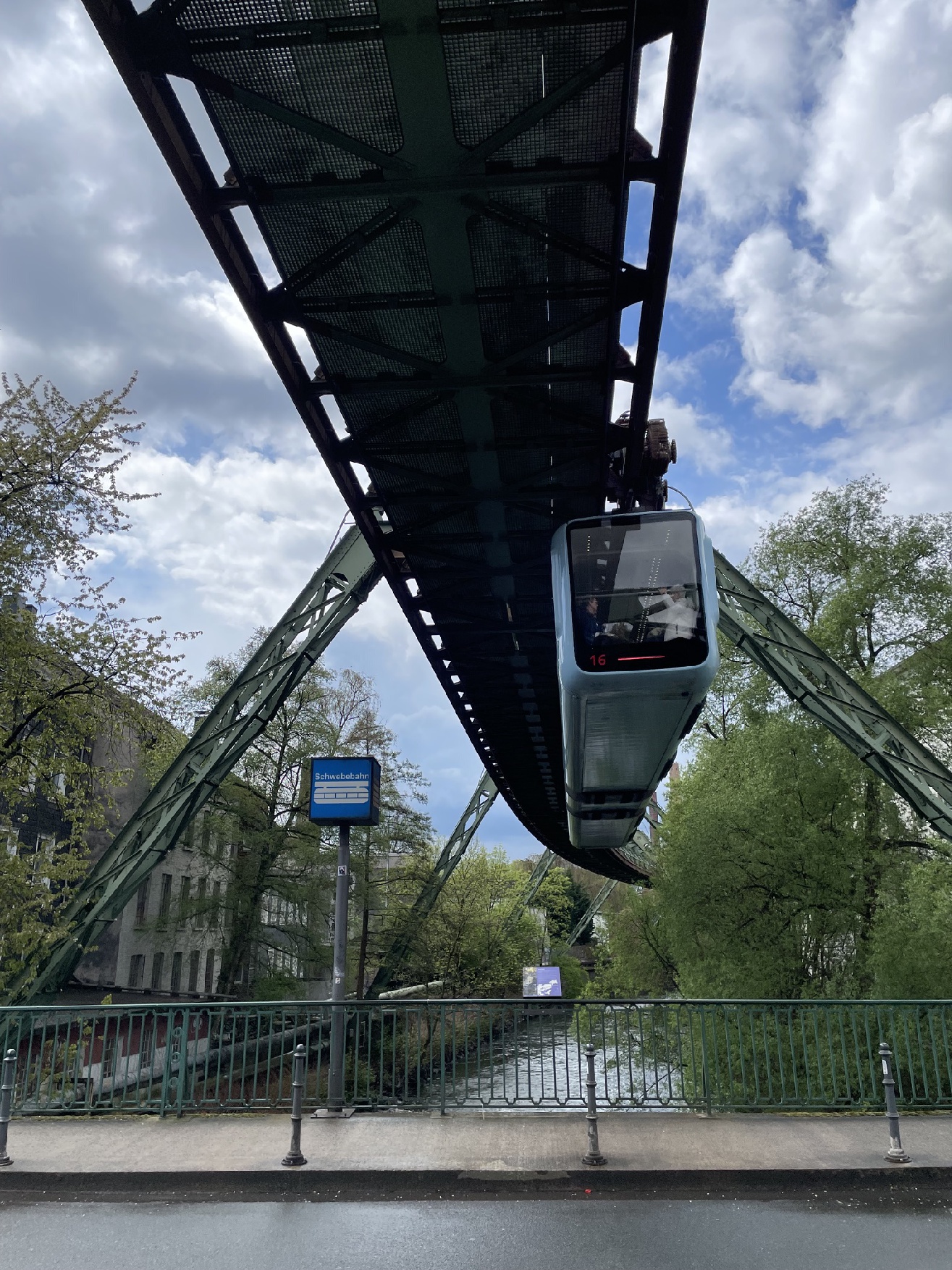
Wuppertal, Schwebebahn. (Photo: Vladimir Dudchenko).
Wuppertal is a town at the heart of the historical industrial area of the Ruhr, situated in a valley of the river Wupper (as the name implies). Metal pillars are striding both banks, supporting the local suspended railway, Schwebebahn, with trains running above the water. Blue cars are new, and the infrastructure and suspension mechanisms are visually out of the era of steam optimism. This picturesque replacement for your normal underground will undergo massive renovations starting in 2026, with work estimated to take five years.
And there is a sculpture park on a hill.
Tony Cragg (b. 1949), the British-German sculptor, has bought out an estate here with the intention of turning it into a permanent display of his own works; it opened in 2008. One thing led to another, and now there are about sixty pieces by contemporary artists under the open sky, plus three steel-and-glass exhibition halls. The latter are intended for special exhibitions, and currently they’re hosting Rebecca Horn (1944-2024). Her work alone is totally worth the visit.
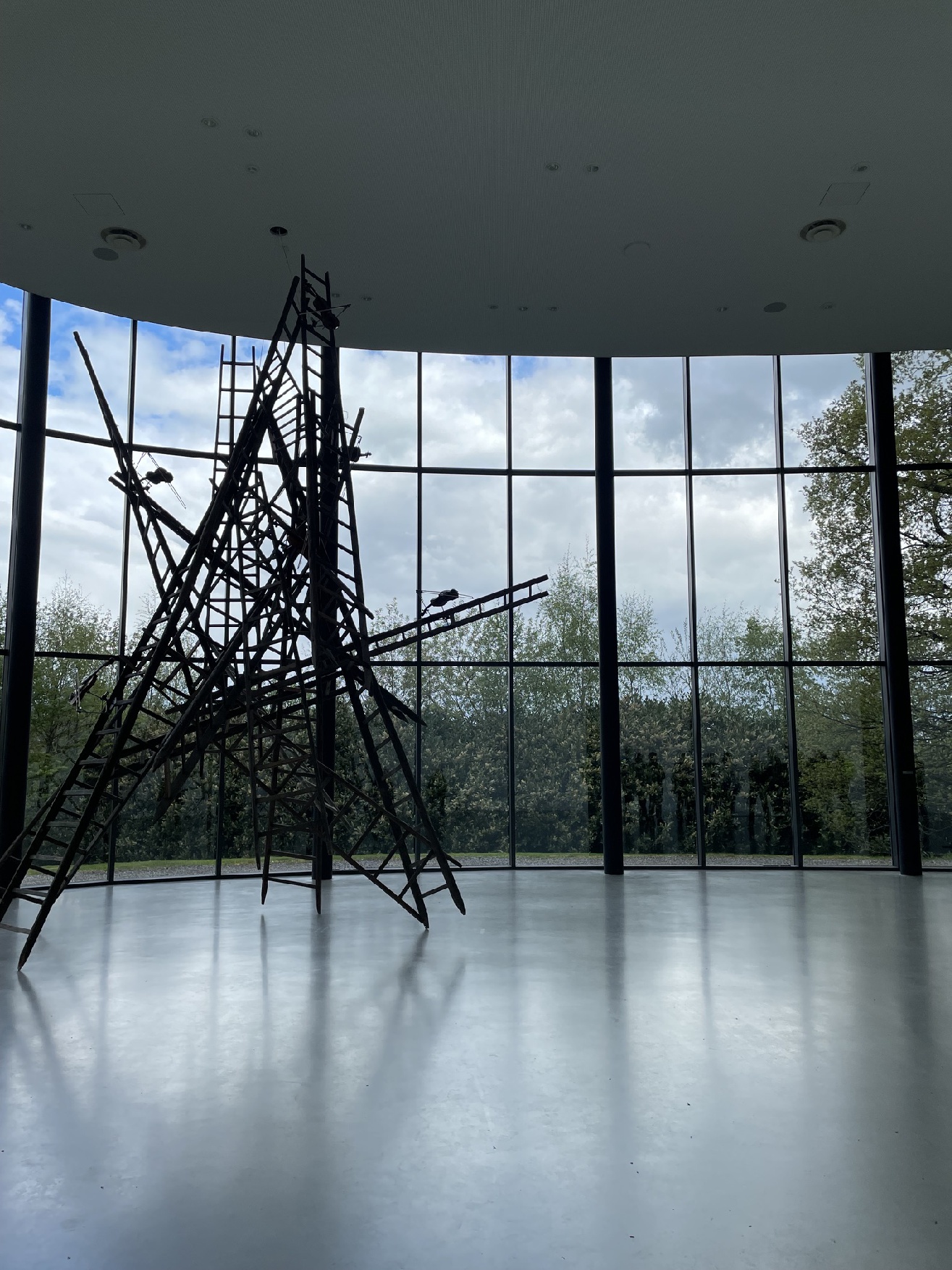
Rebecca Horn, Tower of the Nameless. Installation view (Photo: Vladimir Dudchenko).
On the other hand, Cragg’s highly recognizable ‘flowing column’ sculptures are sort of an everyday sight in Germany; one can spot his Mean Average (2014) in the Remigiusplatz in Bonn, The Becoming (2018) by the parliamentary Marie-Elisabeth-Lüders-Haus in Berlin, and of course, there’s also a polished metal structure titled I’m Alive in Wuppertal itself. Luxury hotels sport smaller indoor variations, or else they are highlighted at art fairs’ special projects. It all makes it easy to discount Cragg as an internationally approved abstract-sculpture author, expensive and prudently meaningless.
And then this happens: you have driven up here specifically to see the Rebecca Horn exhibition, have left the car at one of the guest parking lots, walked the winding forest road up the hill, and then you encounter Cragg’s Bulb (2000) in among trees, followed at the next turn by To the Knee (2008) and then Ferryman (2001). Suddenly, it all just makes sense!
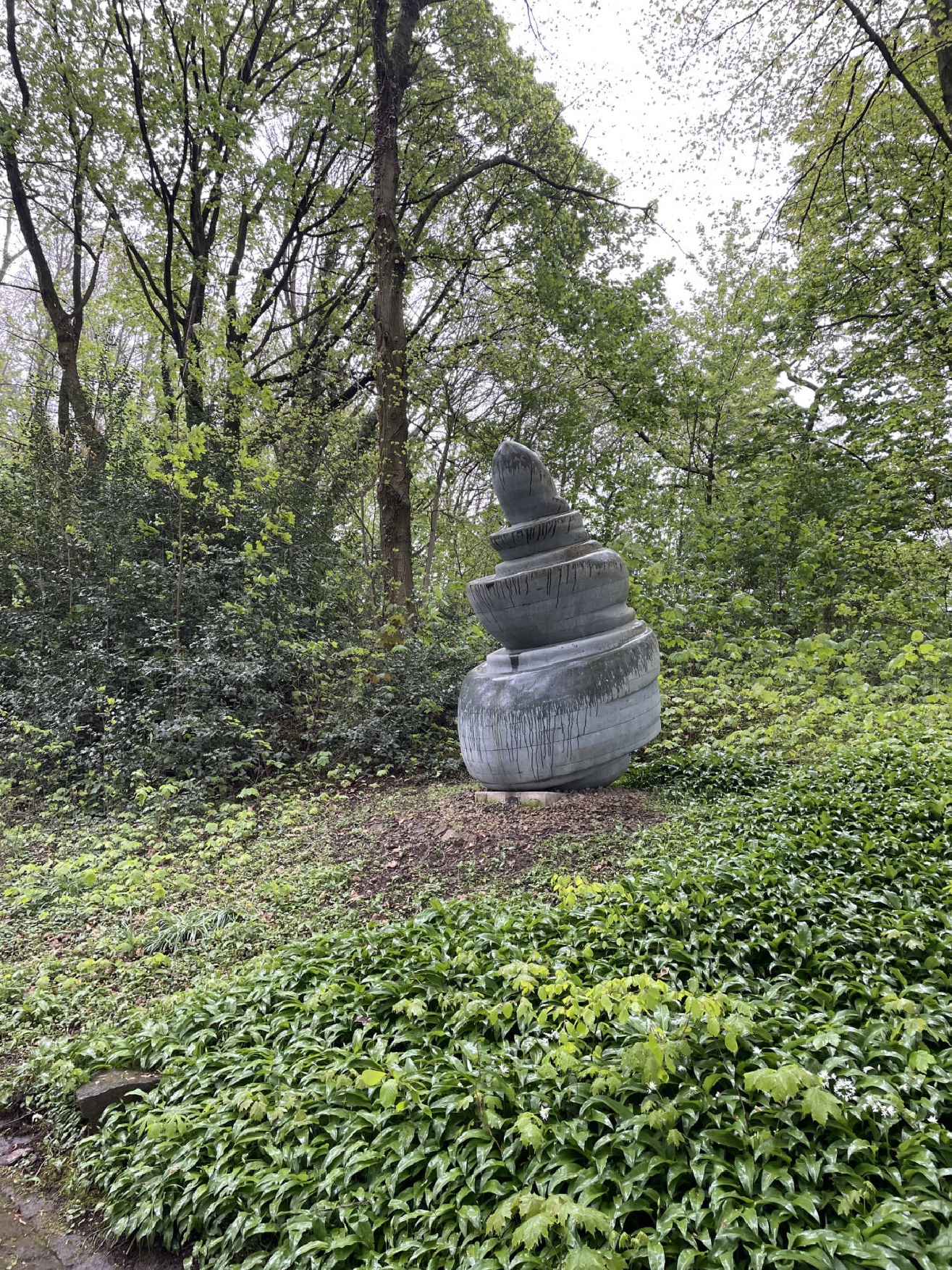
Tony Cragg, Bulb, 2000. Anröchter Stone (Photo: Vladimir Dudchenko).
Placed in a park, his oeuvre suddenly exposes itself as if through a different lens. Rebecca Horn is awesome, but the biggest experience is the park itself. A constellation of works by contemporary authors is scattered around the premises. The who’s who within the field: Joan Miro, Heinz Mack, Ulrich Rückriem. Joseph Beuys. Henry Moore. Predominantly, Cragg himself demonstrates the widest range of attitudes. Hauntology in action: debris of an extraterrestrial civilization along the winding paths, the site of a crash landing or a roadside picnic, long since overgrown with trees. For a skeptical spectator who had never loved Craig, it becomes clear how his works should have been shown all along.
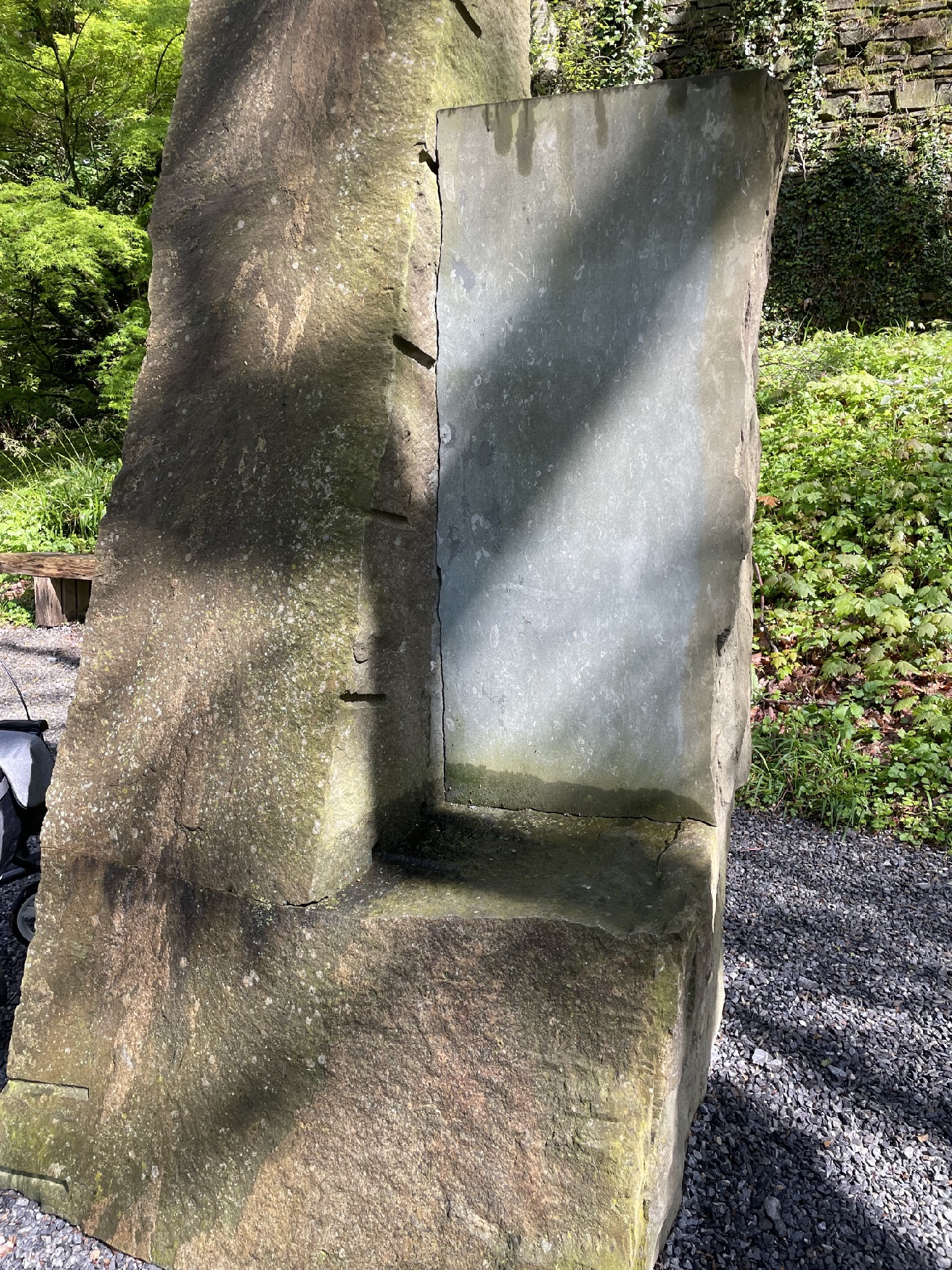
Ulrich Rückriem, Untitled (Pyramide), 1988. Anröchter Dolomit (Photo: Vladimir Dudchenko).
That is where fascination leads to research. Interestingly enough, Tony Cragg has gone a long way in outdoor exhibiting. After school, he worked as a technician at the British Rubber Producers Research Association before starting his art education. He settled in Wuppertal in 1977, when the town was turning post-industrial, offering cheap studio spaces; Cragg’s then-wife was German, too. And Cragg was fascinated with the serious tradition of contemporary sculpture in Germany at the time.
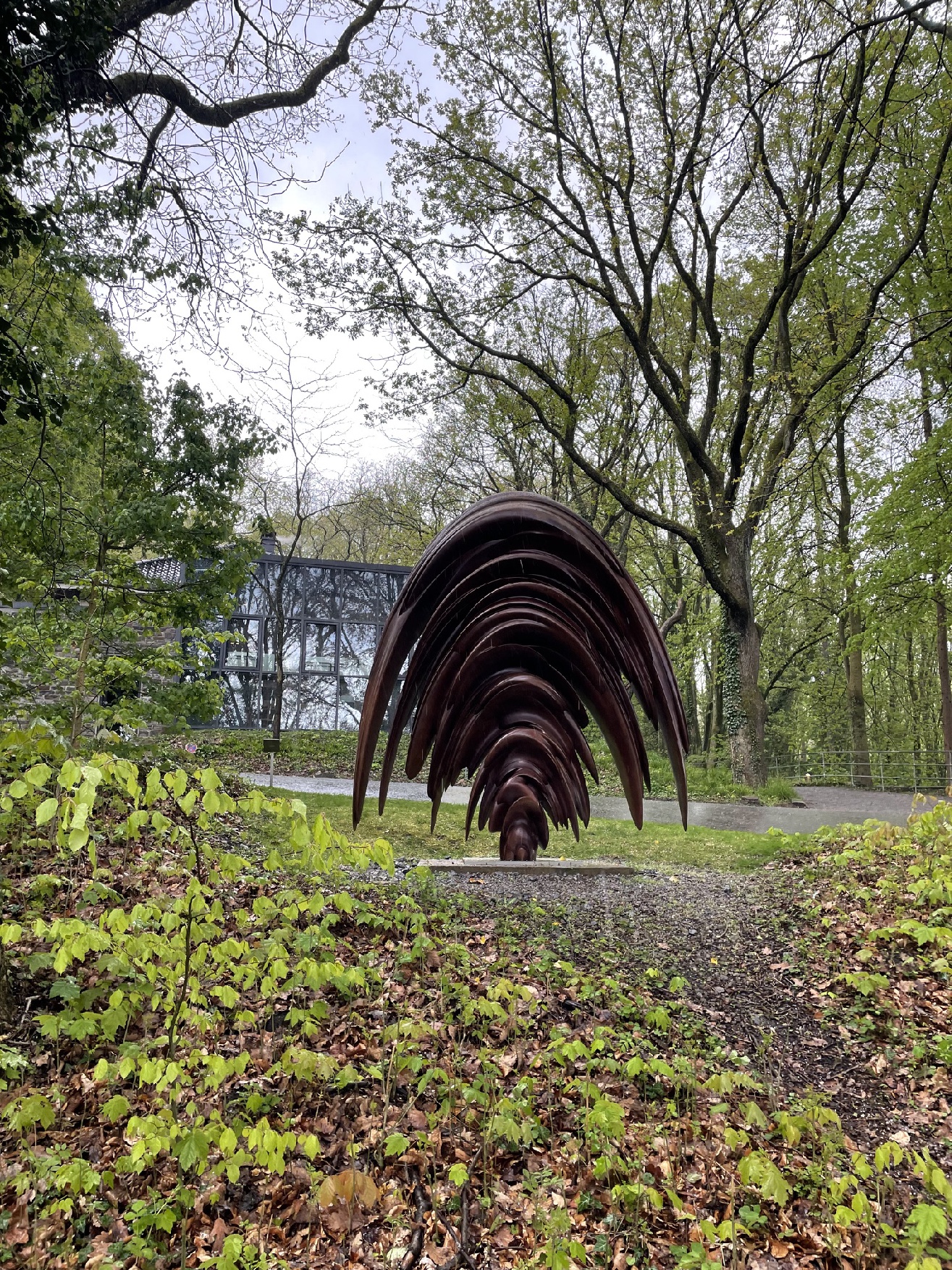
Tony Cragg, Spring, 2016. Bronze (Photo: Vladimir Dudchenko).
That is around then that he started using plastic fragments continuously in search of new forms.
Only a bunch of his earlier works have survived; one of them is Stack (1975). An assemblage of found objects, flotsam and shards: obscene materials like driftwood, cinder blocks, and metal canisters, laid out into a rigid geometrical structure resembling a geological strata sample (now, Tate Contemporary).
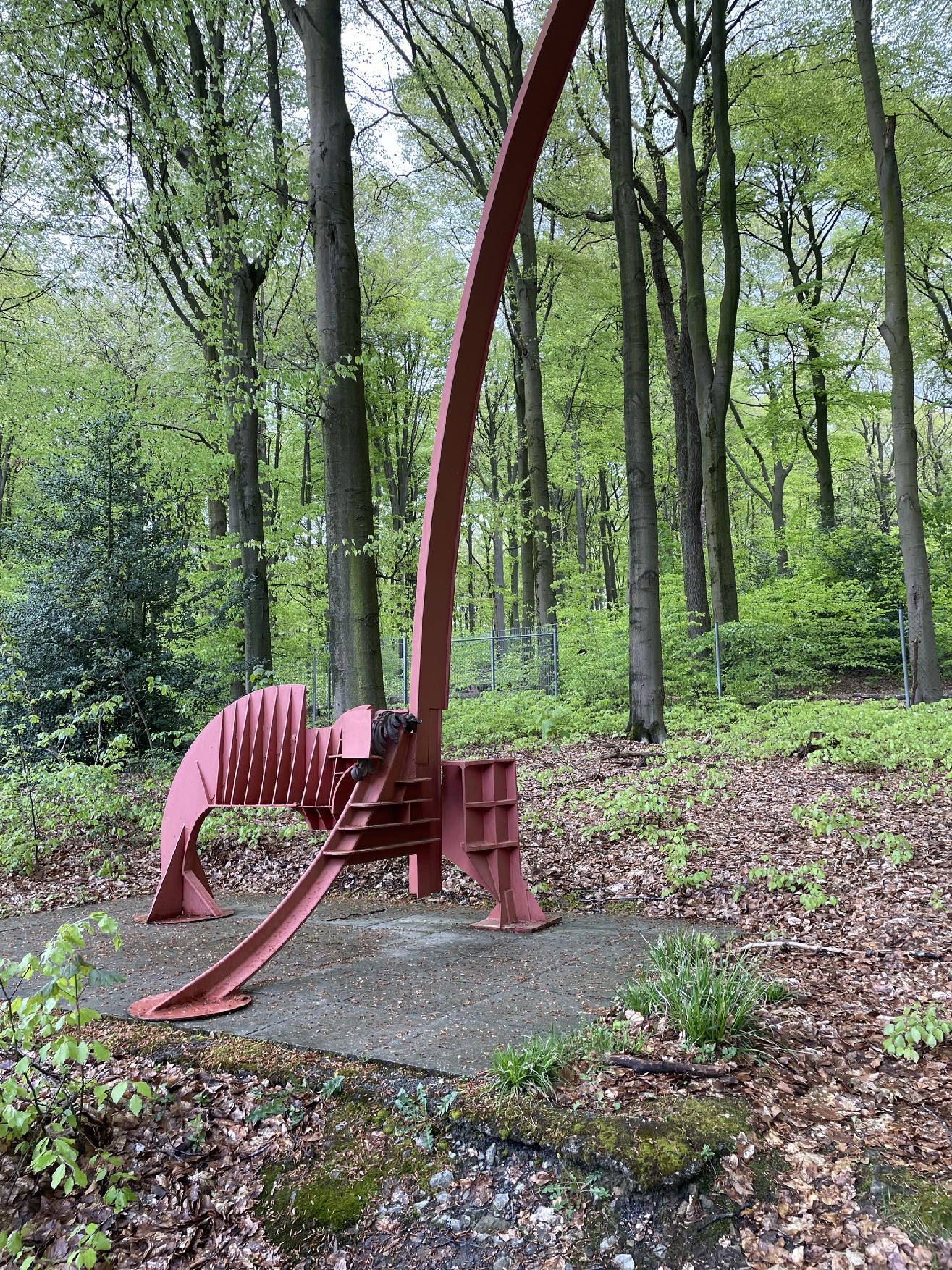
Bernhard Luginbühl, Pegasus, 1967. Iron. (Photo: Vladimir Dudchenko).
He actually produced five Stacks between 1975 and 1985, his policy at the time being not to preserve installations, but to re-use materials.
For Cragg, relationships of a part and the whole were always important, as in Axehead (1982), with the form of a bronze age axe laid out in found wood, metal and plastic, including discarded pieces of furniture – or as in the seminal Britain Seen From the North (1981), representing the outline of the British Isles lying horizontally, complete with a spectator human-sized figure, all done with scraps of plastic and other found materials.
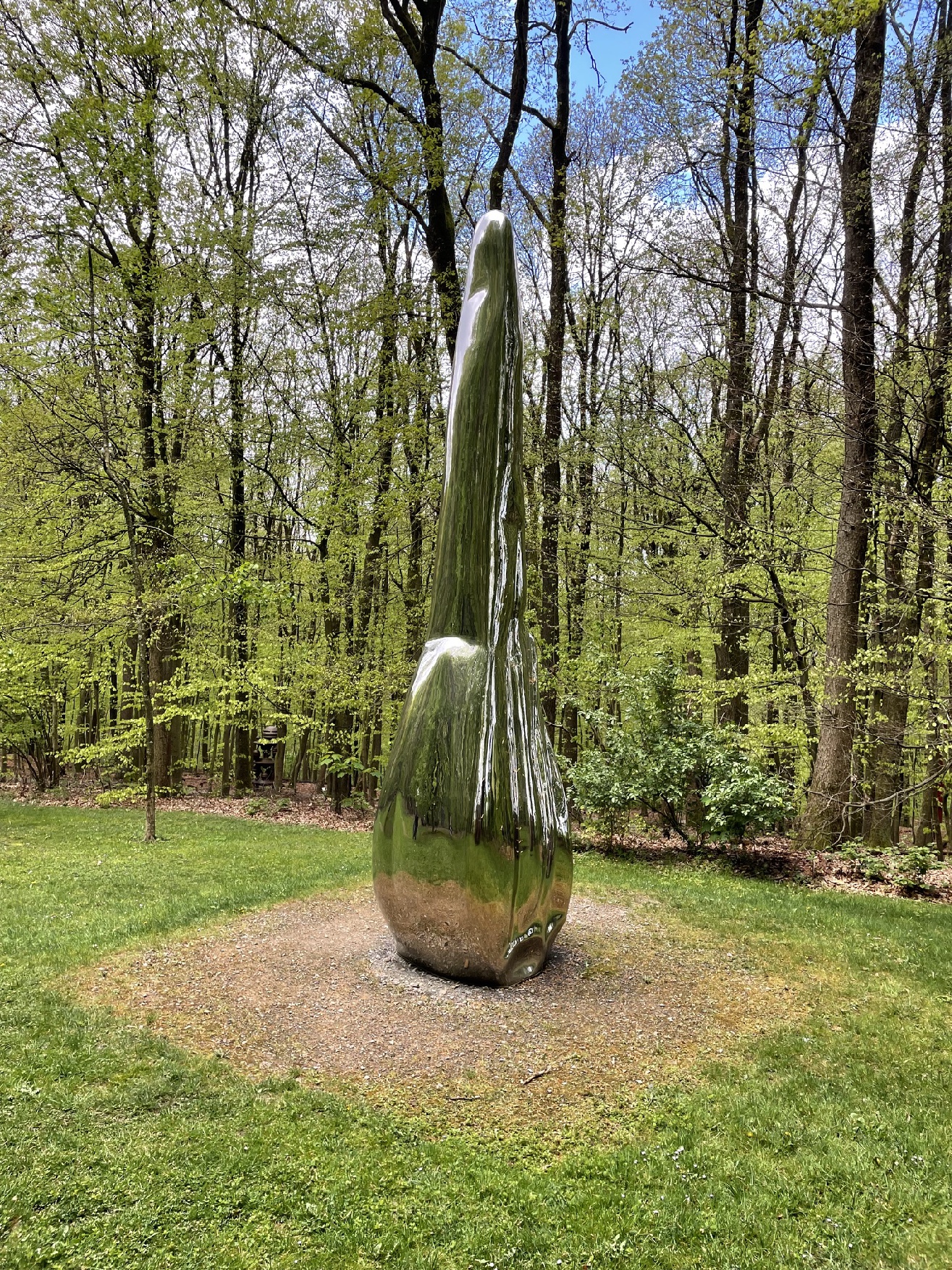
Not Vital, Tongue, 2010. Stainless steel. (Photo: Vladimir Dudchenko).
He describes his early search for materiality, with a particular interest in plastic and other new materials, as ‘almost punk’, directed against the piety of minimalism and landscape art. But it was not until he created Raleigh (1986), named after the British poet and explorer Sir Walter Raleigh, now permanently placed in the Liverpool docks, that he began producing public sculptures. The work is a pile of salvaged metal and granite bollards and two specially made cast-iron horns. The plan was not to exhibit it outdoors permanently, but in the end, it all worked just too well.
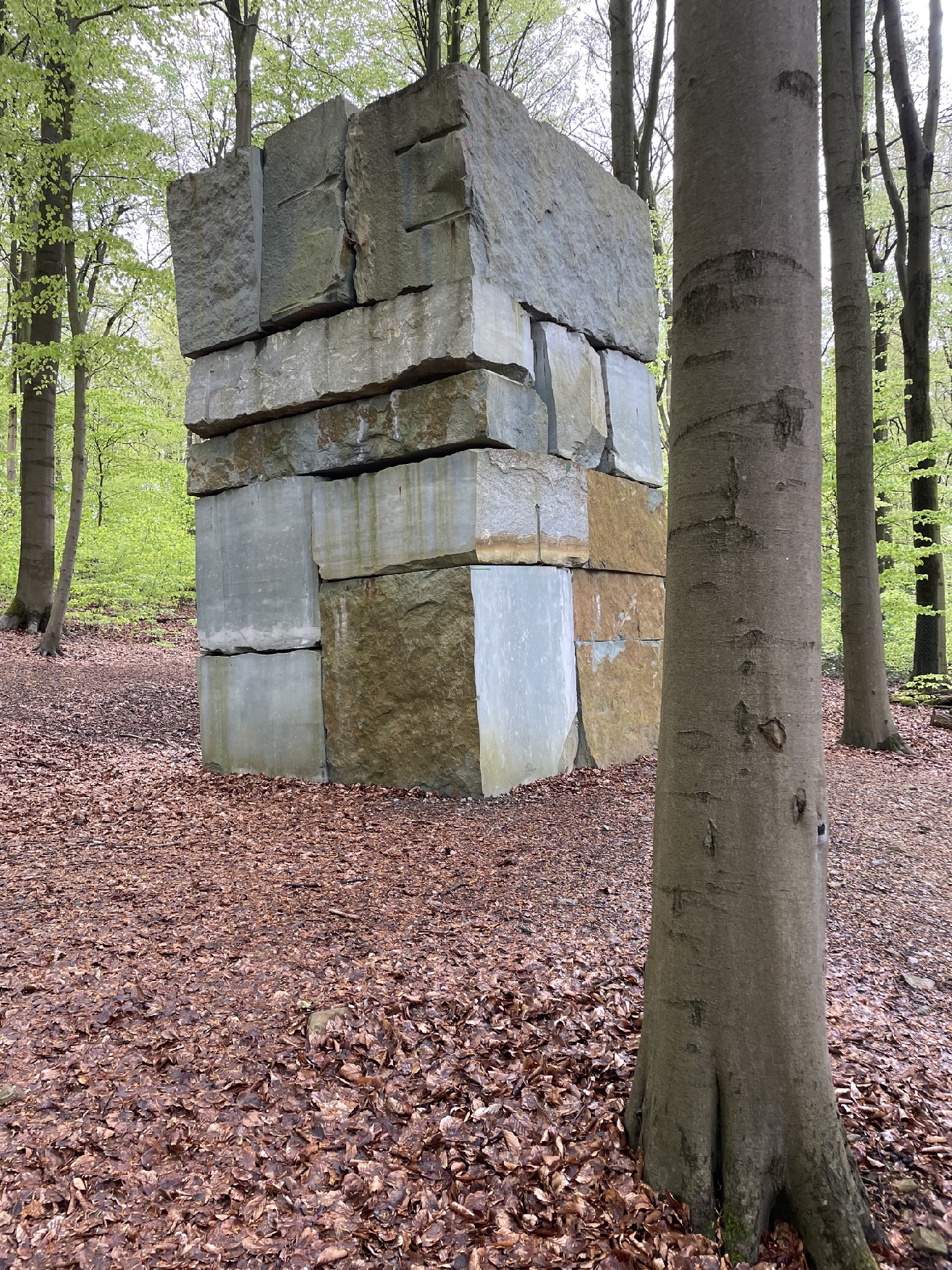
Sean Scully, Wall of Light Cubed, 2020 Anröchter stone (Photo: Vladimir Dudchenko).
When sorted and arranged, scraps become an alphabet. Diverse forms become fluid and start to work together. The individual chemical vessels become less articulated and more molded together. Until all individual features become redundant, only the overall fluidity remains – thus, his ongoing series Early Forms (the most recognizable one) is born.
In time, Cragg’s visual philosophy, manifested in unity of the diverse, has brought him fame, knighthood, Turner prize (1988), solo British pavilion show at the Venice Biennale, and other status exhibitions – and eventually, the possibility to ‘do it right’.
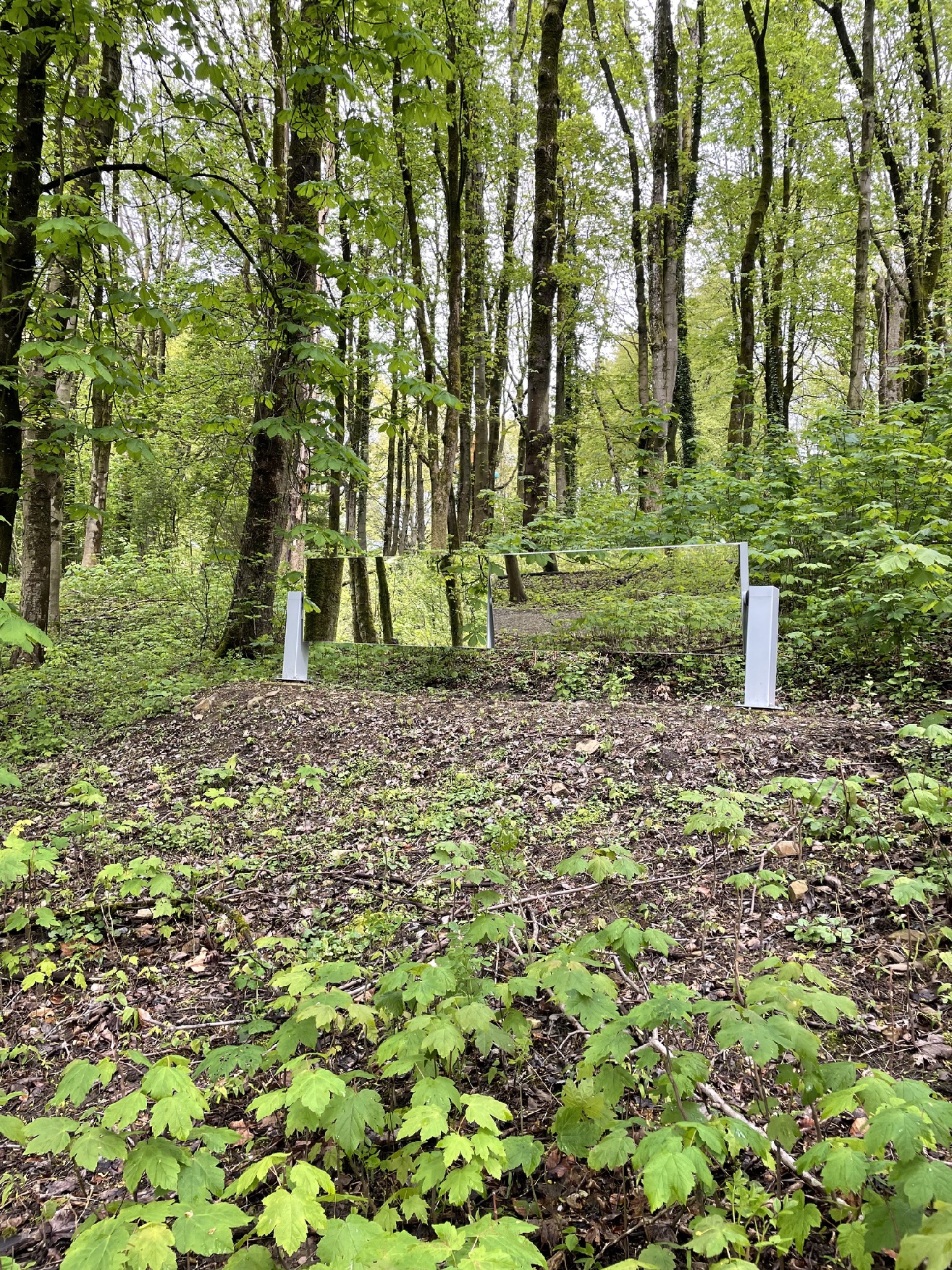
Mischa Kuball, rotating_mirror_horizontal. Various materials, 2023 (Photo: Vladimir Dudchenko).
…As for Rebecca Horn, she is magnificent in the three glass aquariums situated strategically at the different corners of the park. Called jointly Emotion in Motion, her moving sculptures act as a counter tone to the immobility of the outdoor structures. Spurting paint, waving branches — or shining the electricity arc of controlled aggression as in Rhinoceros (1989).
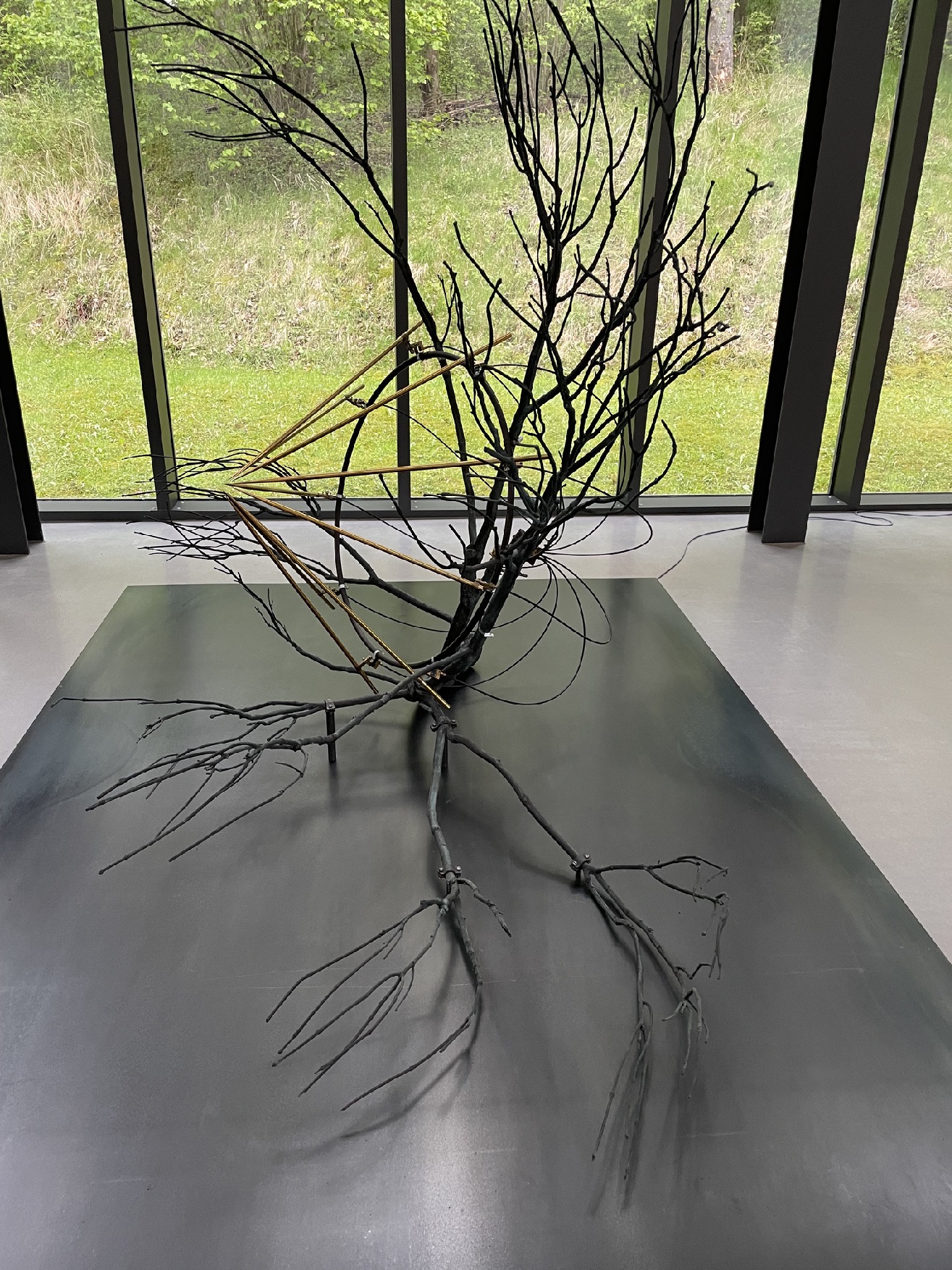
Rebecca Horn, Wheel of Time, 2016. Bronze, brass (Photo: Vladimir Dudchenko).
Yours truly was lucky enough to experience the park in various weather. While our small group was walking uphill, it started pouring, then hail came, and it felt like it was going to rain frogs next. It took just a glass of wine at the entrance café for the settings to change: the sun shining between cumulus clouds upon the backdrop of the blue sky! Then, in 15 minutes, rain again. Running jump into a Rebecca Horn pavilion. Then the sun. Together, the widest possible range of lighting. And still, it all works, whatever the weather conditions!
Interesting, how it all looks in the winter.
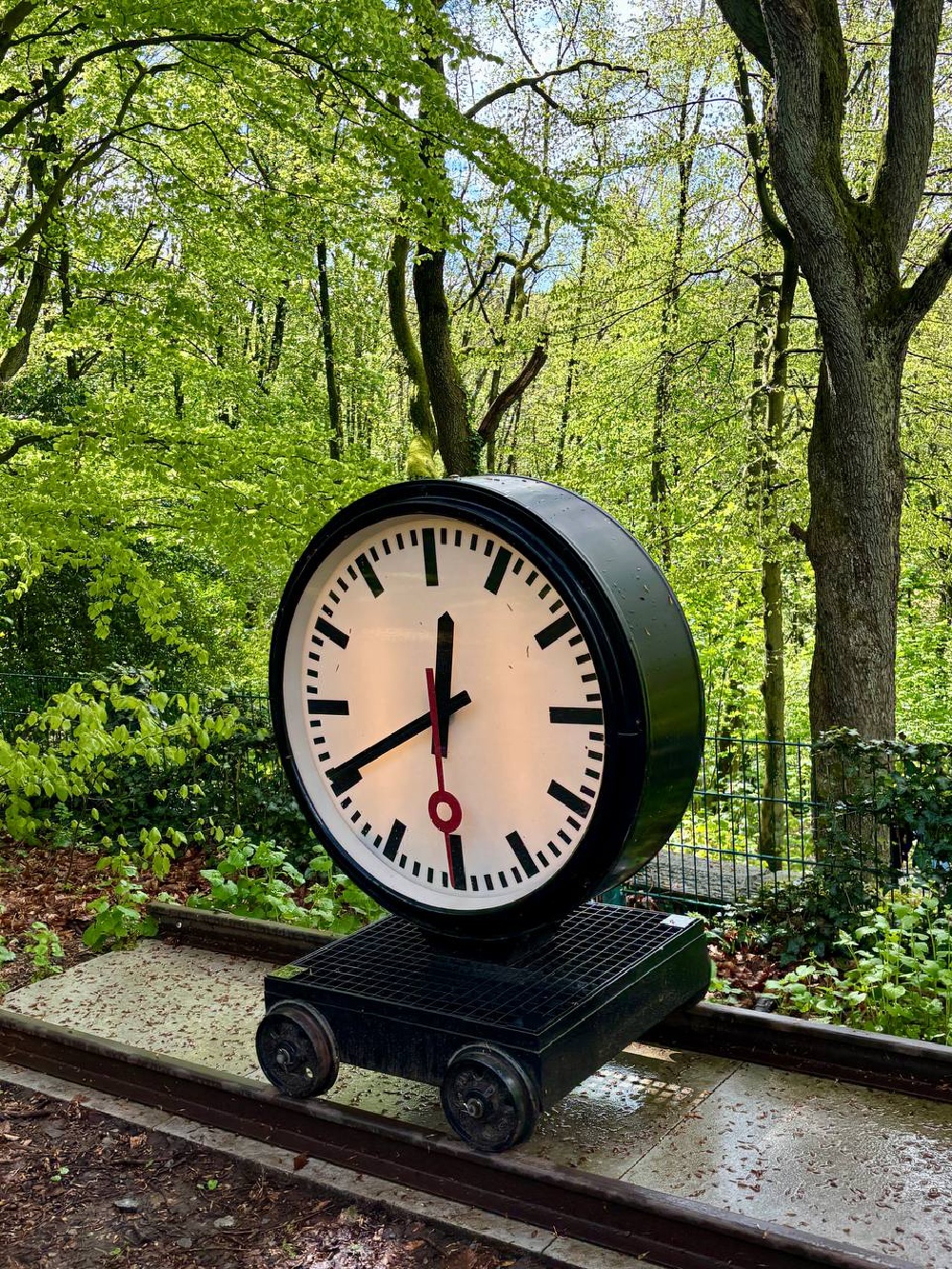
Bogomir Ecker, Odolop, 2012, Aluminum (Photo: Vladimir Dudchenko).


0 Comments