
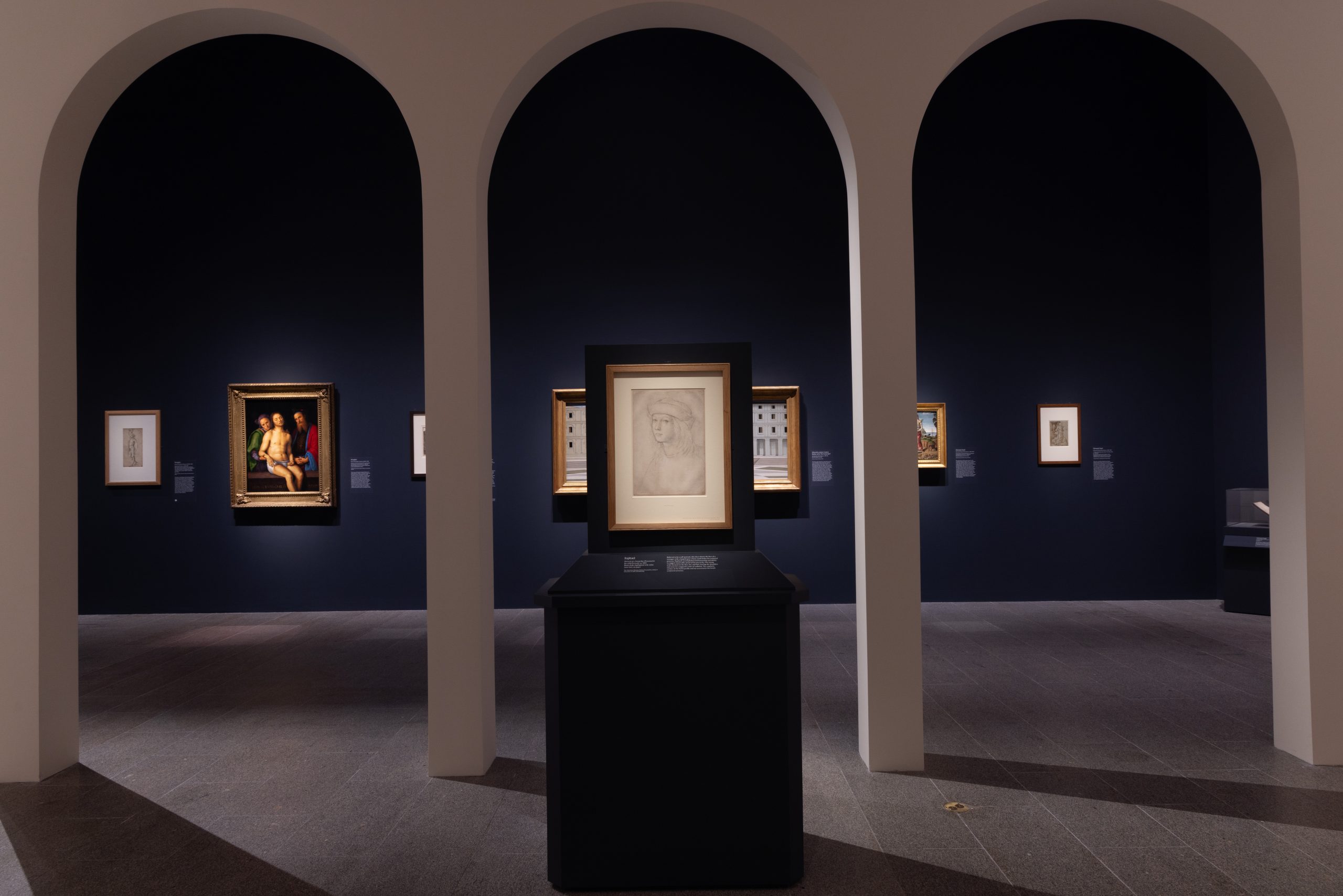
Installation view of Raphael: Sublime Poetry. (Courtesy: The Metropolitan Museum of Art.)
Perhaps, like me, you’ve heard about Raphael: Sublime Poetry, the much-acclaimed exhibition at the Metropolitan Museum of Art devoted to the great Italian Renaissance master, which has been on view since late March, but haven’t yet had a chance to see it. Recently, though, I carved out some time to see the exhibit in person. Now that I’ve seen it, I’d urge you all to experience it for yourselves, especially since it’s scheduled to close towards the end of this month, on June 28.
At the very least, it’s a sheer triumph of logistics. Apparently eight years in the making, the exhibition brought together loans from museums around the world, many of which sent paintings and drawings to the Met specifically for this landmark survey. The layout and design of the exhibit match its ambition, with many of its rooms designed and lit to feel like the cathedrals for which Raphael created some of his finest works.
Ultimately, though, the art’s the thing here. Historically, Raphael (1483-1520) had been considered one of the great Italian Renaissance masters alongside Leonardo da Vinci and Michelangelo. Unlike his two contemporaries, Raphael’s reputation has faded over the past century and a half, as tastes have turned away from the perceived classical perfection of his work toward art that is messier, more realistic, and more daring.
This new exhibit, then, is an attempt to rehabilitate that image—maybe to a fault. “One of the greatest influencers of all time” is how its introductory text describes Raphael. This embarrassing bit of pandering to contemporary parlance is wholly unnecessary given the extent to which the exhibit places Raphael’s vision in proper biographical and historical context, allowing us to make our own connections to the present day. (Even after having gone through the entire exhibit, I still don’t understand the “influencer” characterization, to be quite honest.)
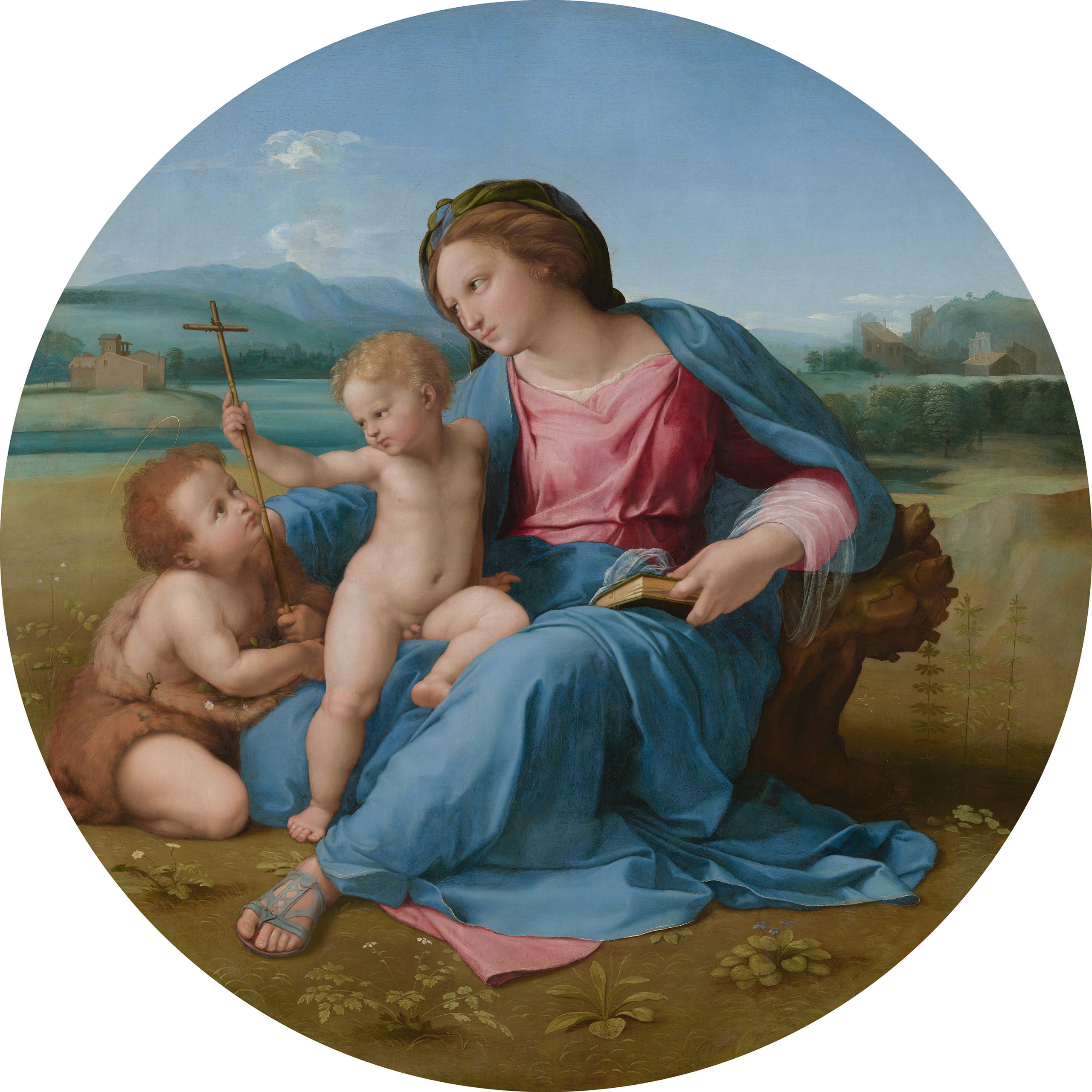
Raphael (Raffaello di Giovanni Santi), The Virgin and Child with Infant Saint John the Baptist in a Landscape (The Alba Madonna), ca. 1509-11. Oil on canvas, transferred from wood. (Courtesy: National Gallery of Art, Washington.)
For modern audiences, the challenge is not Raphael’s artistry but his subject matter, much of which is drawn from religious themes that no longer occupy the same central place in public life. Two sections of the exhibit are devoted to his “Madonna and Child” paintings, many of them the result of commissions by wealthy merchants after he moved to Florence. Though depictions of Mary Magdalene and the baby Jesus were common in his day, Raphael’s depictions stood out for their warmth and sensitivity. Fascinatingly, the exhibit includes an account book that details expenses incurred for the funeral of Raphael’s mother, who died of complications from childbirth when he was 8 in 1491. Perhaps, the exhibit suggests, this and the death of two of his siblings in infancy fed into the genuine maternal feelings these paintings exude, especially during a time when little was known about childbirth and mortality rates were high among babies and mothers.
That kind of psychological acuity, allied with the increased interest in anatomical authenticity Raphael picked up from Leonardo and Michelangelo, can be seen just about everywhere in Raphael: Sublime Poetry. A section devoted to his portraits demonstrates the kind of empathy he had for his subjects, capturing them in seemingly offhand poses that brought out their humanity. That kind of intimacy is evident even when he works on a grander scale, as in the “Raphael Rooms” frescoes in the Vatican (represented via digital projections in a separate room), the Sistine tapestries, and what he considered his final testament, The Transfiguration.
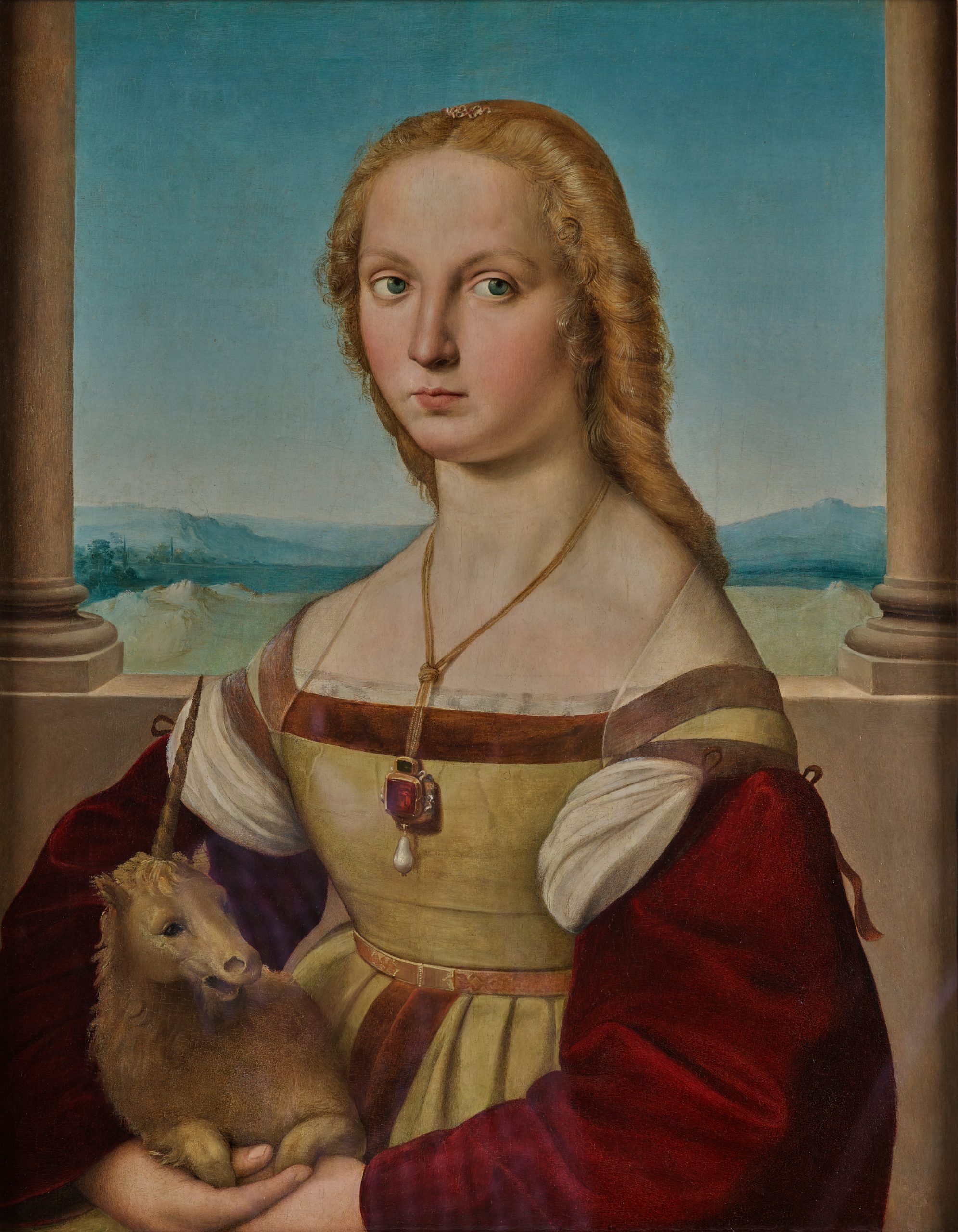
Raphel (Raffaello di Giovanni Santi), Portrait of a Lady with a Unicorn, 1505-6. Oil on canvas, transferred from wood. (Photo: Mauro Coen, courtesy: Galleria Borghese.)
Some of the larger works, of course, couldn’t be brought to the Met for this exhibit, since they’re specifically tied to the settings in which they were made. Curator Carmen C. Bambach, however, has worked around this potential limitation by arranging for a large selection of his sketches to be displayed, at times even given pride of place at the center of certain rooms. These drawings, or “cartoons” as they were termed at the time, offer arguably the most lasting takeaway from Raphael: Sublime Poetry.
Many of these sketches are breathtaking in their own right. In them, Raphael, using means ranging from pen and ink to metal-point, worked out ways to infuse his human figures with the kind of lifelike detail that would make them leap off the canvas. Seeing many of these spontaneous jottings up close, especially when juxtaposed with the larger works for which they were planned, allows us to appreciate the immense care and craftsmanship he brought to his work.
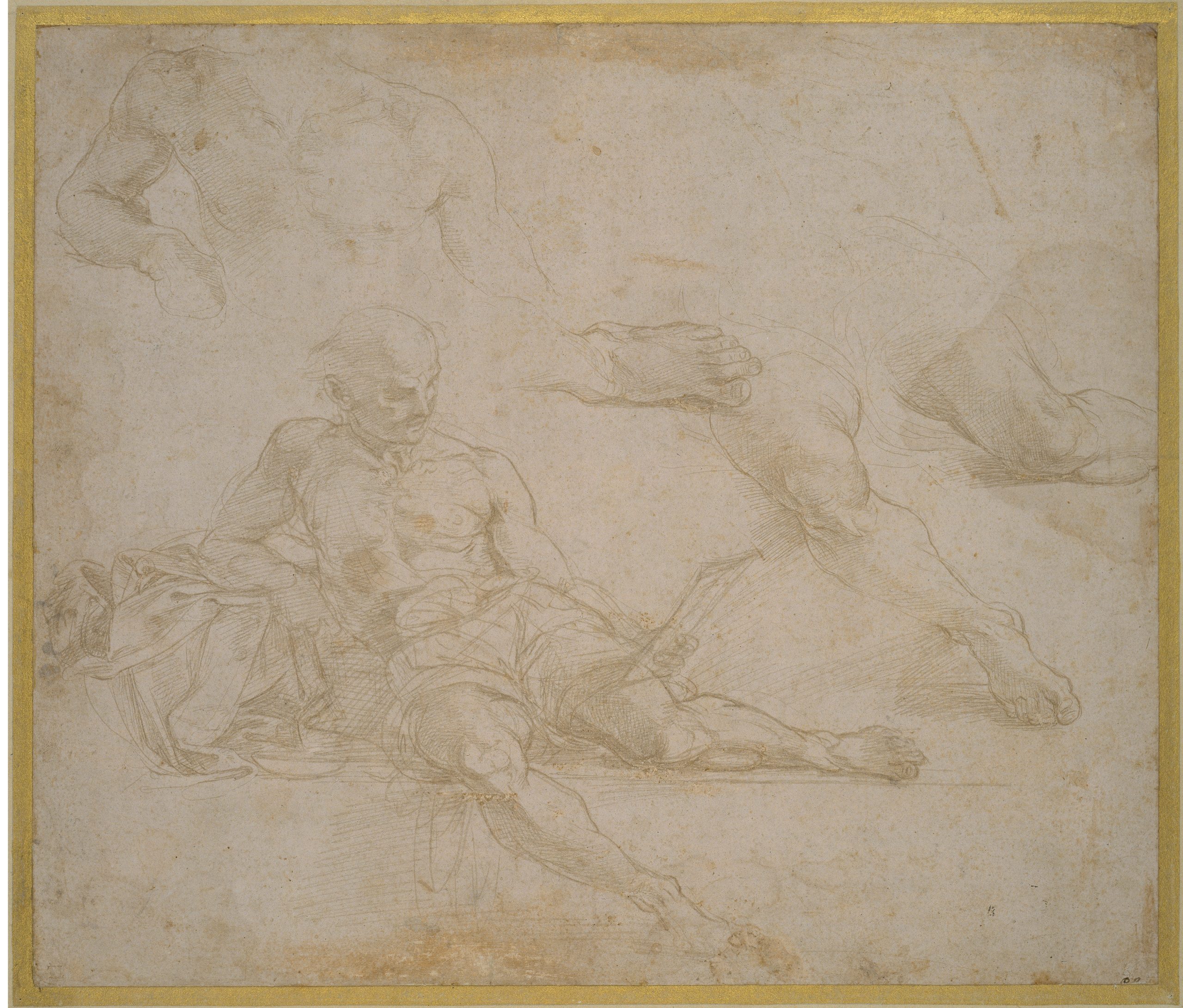
Raphael (Raffaello di Giovanni Santi), Studies of Pythagoras and His Disciples for the School of Athens, Stanza della Segnatura, ca. 1509-10. (Photo: Albertina Museum, Vienna.)
There’s plenty more to take in at Raphael: Sublime Poetry. Outside of his art, Raphael was also known for his collaborative nature, being one of the first to form his own studio and hire talented younger artists to help carry out his larger creations. He also took an interest in printmaking, working with engraver Marcantonio Raimondi to design prints that became widely reproduced. And he designed figures that were eventually enfolded in larger tapestries, including an “allegorical personification of an earthquake” that would become a part of a work woven in the workshop of Flemish artist Pier van Aelst.
Even more than his technical finesse and psychological perceptiveness, his versatility and sheer love of artistic creation come through most vividly in this exhaustive show. Even as the winds of artistic taste change from generation to generation, such creative exuberance, as Raphael: Sublime Poetry brilliantly reminds us, will never go out of style.


0 Comments