

“Japonisme — Cognitive Revolution,” Gagosian Exhibition View. (Photo: Natalie Urusov)
Takashi Murakami, a contemporary Japanese artist born in Tokyo in 1962, is widely known for his ability to bridge the historical and the modern. Fusing traditional Japanese techniques with the aesthetic languages of anime, manga, and global consumer culture, Murakami has consistently redefined what Japanese art looks like in the 21st century.
His recent exhibition, Japonisme — Cognitive Revolution: Learning from Hiroshige, held at the Gagosian Gallery in Chelsea, New York, showcases this duality. On view for three months, the exhibition featured 121 paintings that reinterpret Utagawa Hiroshige’s One Hundred Famous Views of Edo, as well as a dozen additional works exploring the European fascination with Japanese aesthetics, known as Japonisme. Murakami’s interpretation is not simply homage—it is what he calls “backcrossing”: a process in which one cultural lineage is reintroduced to its offspring, creating something new from shared roots.

Takashi Murakami, “Yoshiwara, early morning,” 2024-2025. Acrylic and glitter on canvas mounted on aluminum frame, 28 ¼ in x 18 ⅜ in. (Photo: Natalie Urusov).
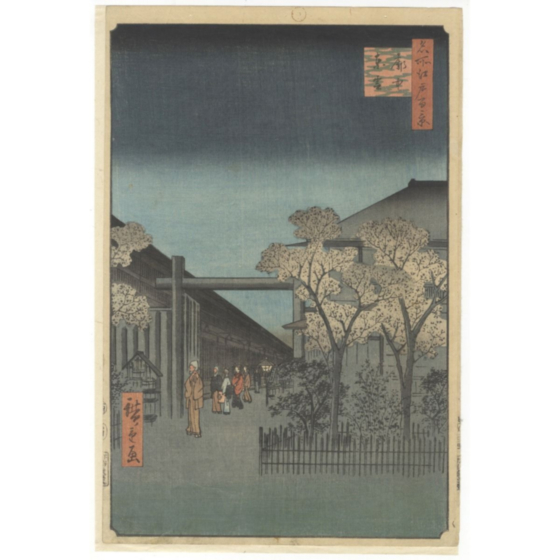
Utagawa Hiroshige, “Dawn in the licensed quarters” from the series One hundred famous views of Edo, 1857. Woodblock print, 14.2 in x 8.9 in.(Photo: Natalie Urusov).
Modernizing Hiroshige’s woodblock prints, Murakami utilizes vibrant and saturated colors as well as strong ombres to create a cartoon-like appearance to these duller originals. Shown below is a comparison between Murakami’s (above) and Hiroshige’s (below) versions of Dawn Inside the Yoshiwara. Distinct differences can be seen in the exaggerated blues of the sky, reds of the Japanese banners on the lower left and right, and the dramatic ombre of the tree leaves. Murakami uses acrylic paint on an aluminum frame, a modern and sleek composition in comparison to Hiroshige’s woodblock. If you look closely, you can see he adds sparkle elements on top of the paint to mimic a star-splattered sky.
The stylistic differences between Hiroshige and Murakami reflect broader shifts in Japanese art and society. The Edo Period (1603–1868) was marked by sakoku, Japan’s policy of isolation from the Western sphere. With little foreign influence, artists honed distinctly Japanese styles, particularly woodblock printing (ukiyo-e), which flourished as an accessible art form depicting beauty, nature, and urban life.
By contrast, Murakami’s art emerges from a postwar Japan shaped by American occupation, consumer capitalism, and mass media. His work is steeped in otaku culture—anime fandom, toy collecting, and hyper-consumerism—and reimagines Japan’s historical iconography through this lens. Within the Gagosian exhibition, familiar Edo imagery is interrupted by Murakami’s signature cartoon characters like Mr. DOB, shimmering surfaces, and glossy polish. Adding these commercialized emblems of pop culture, Murakami speaks to the shift from art as a practice to a product and commodity.
A key theme of the exhibition is the circularity of cultural influence. In the 19th century, Japanese prints like Hiroshige’s had a profound impact on Western artists such as Van Gogh, Whistler, and Monet, inspiring a movement known as Japonisme. European artists adopted Japanese approaches to composition, color, and negative space, incorporating them into Impressionism and Post-Impressionism.
Murakami reverses this gaze. Several works in the exhibition reference not only Hiroshige but also Western works that were originally inspired by him. In doing so, he reclaims the legacy of Japonisme and brings it full circle, demonstrating how cultural influence is not linear, but recursive. His “backcrossing” is a cultural and artistic method, remapping how we understand lineage, influence, and reinvention.
This concept is particularly visible in works that take from European masters, such as Whistler’s Nocturne series, which was itself modeled after Hiroshige’s nightscapes. In Murakami’s hands, Whistler’s subdued tone becomes an explosion of glitter and hyper-pigmented acrylics—echoing the same night, but filtered through different centuries and media.
In a world of borrowed inspiration, Japonisme — Cognitive Revolution doesn’t just present a new version of Hiroshige’s prints. It stages a conversation—between past and present, between Japan and the world, between art and industry. Murakami’s work is as much about looking forward as it is about looking back, and in doing so, he shows us that Japanese art isn’t static or nostalgic. It’s alive, evolving, and deeply embedded in the now.


0 Comments