
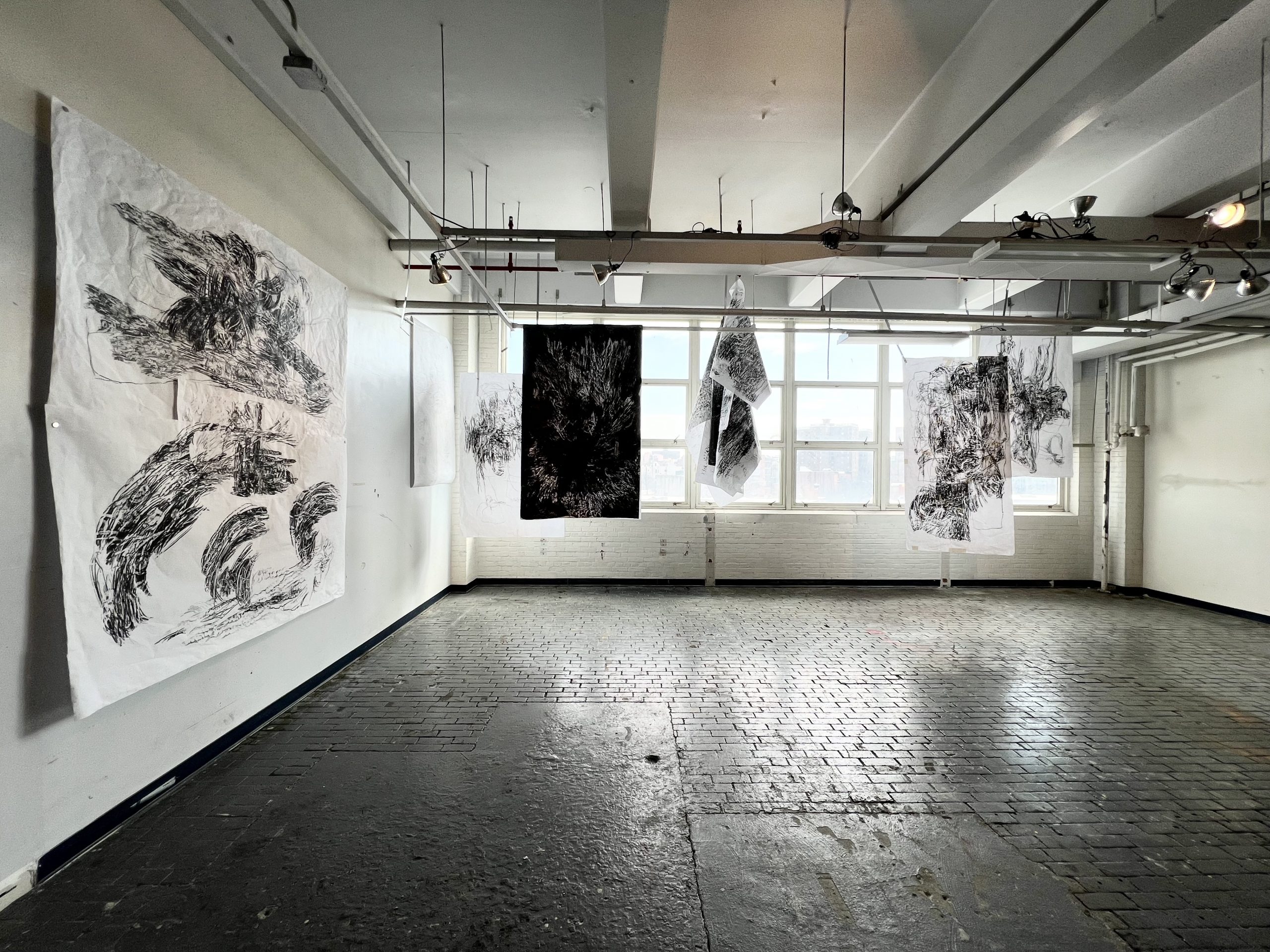
Veronika Georgieva, “Drifting Until Caught.” Installation view. (Courtesy: the artist).
This pop-up initiative of the three artists has re-purposed an industrial venue at the Brooklyn Navy Yard into an exhibition space. No walk-ins, by arrangement only (Skaya and Shanabrook have studios nearby, hence the location). Despite the underground setting, a well-deserved success, with hundreds of visitors.
The three have known each other for a long time, having collaborated in earlier projects. But the first glimpses of the installation immediately prove that they are visually dissimilar. Each artist employs a distinct approach, yet together they claim to pursue the same attitudes. Where are the similarities, then?
In the exhibition statement, the artists are described as hunters of transient states: “Engaging in a dense, physical dialog with their materials, they extract from them – like trackers pulling magical beasts from the forest – their secret meanings and latent narratives.”
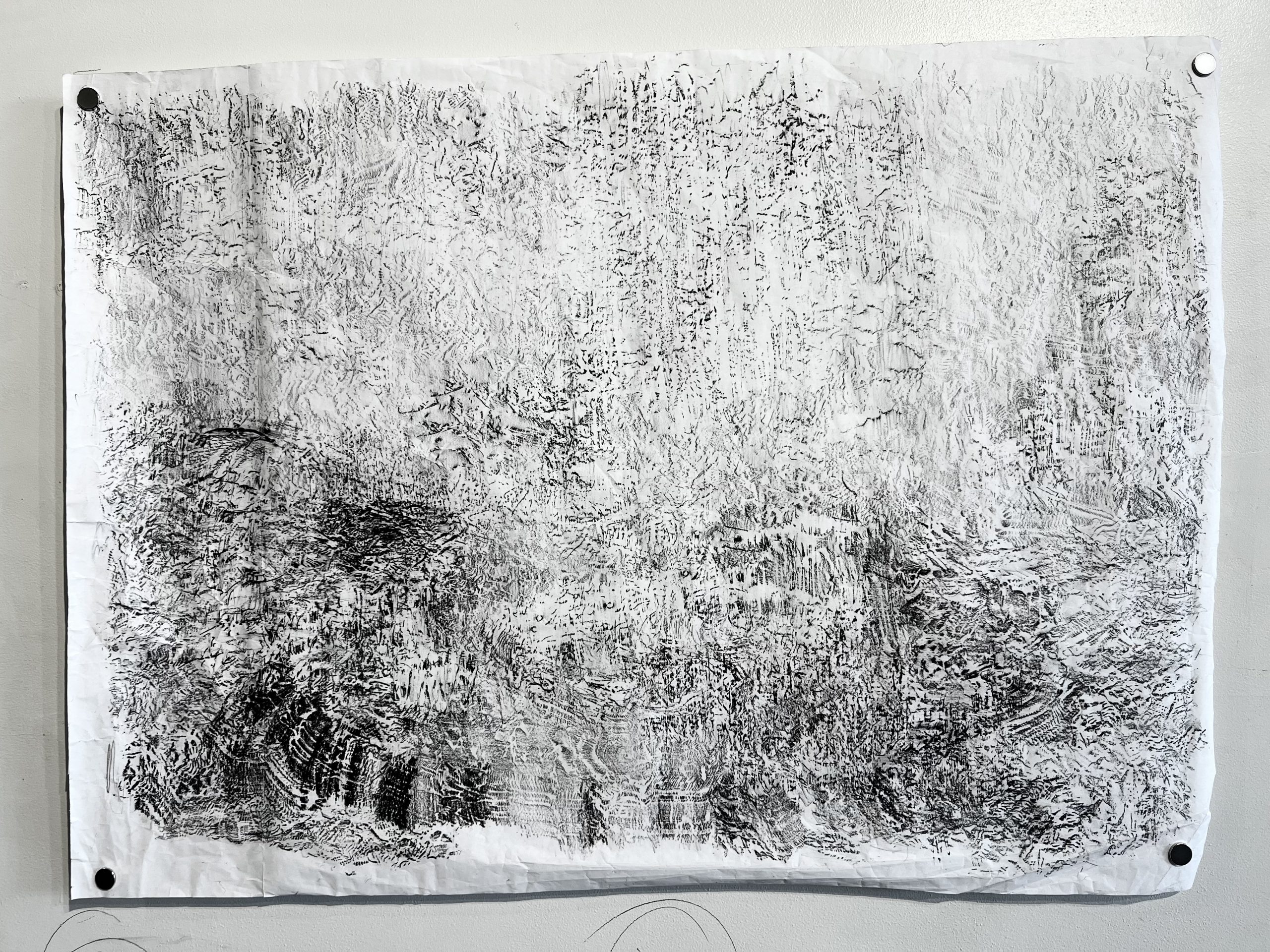
Veronika Georgieva, One Hand Clapping, 2026. Wax crayons on paper. (Courtesy: the artist).
It would be safe to say that all three are wavering between figurative and abstract – at least, in some of the works. Another thing in common is the tendency to bring said works outdoors, in the form of performances (Stephen j Shanabrook), video projections (Veronika Georgieva), or just canvases flapping in the wind (Shura Skaya).
What is more notable, they all share an interest in something that could be dubbed ‘objectivity of the method’. While creating more or less 2D works that can be hung on a wall and perceived as paintings on canvas (and other supporting materials) or drawings on paper, they rely on mechanical production, in which the resulting image is partly a chance encounter. Distortions are part of the game; they are the imagery itself. That is what the statement talks about.
Of course, the attitude has been long established in art history, from silk screens to early generative, to glitch, to vaporwave. Sure, the latter two are less about materiality. But it’s the little differences that matter, as John Travolta’s Vincent Vega character voiced it in Pulp Fiction. Let’s look into that in more detail.
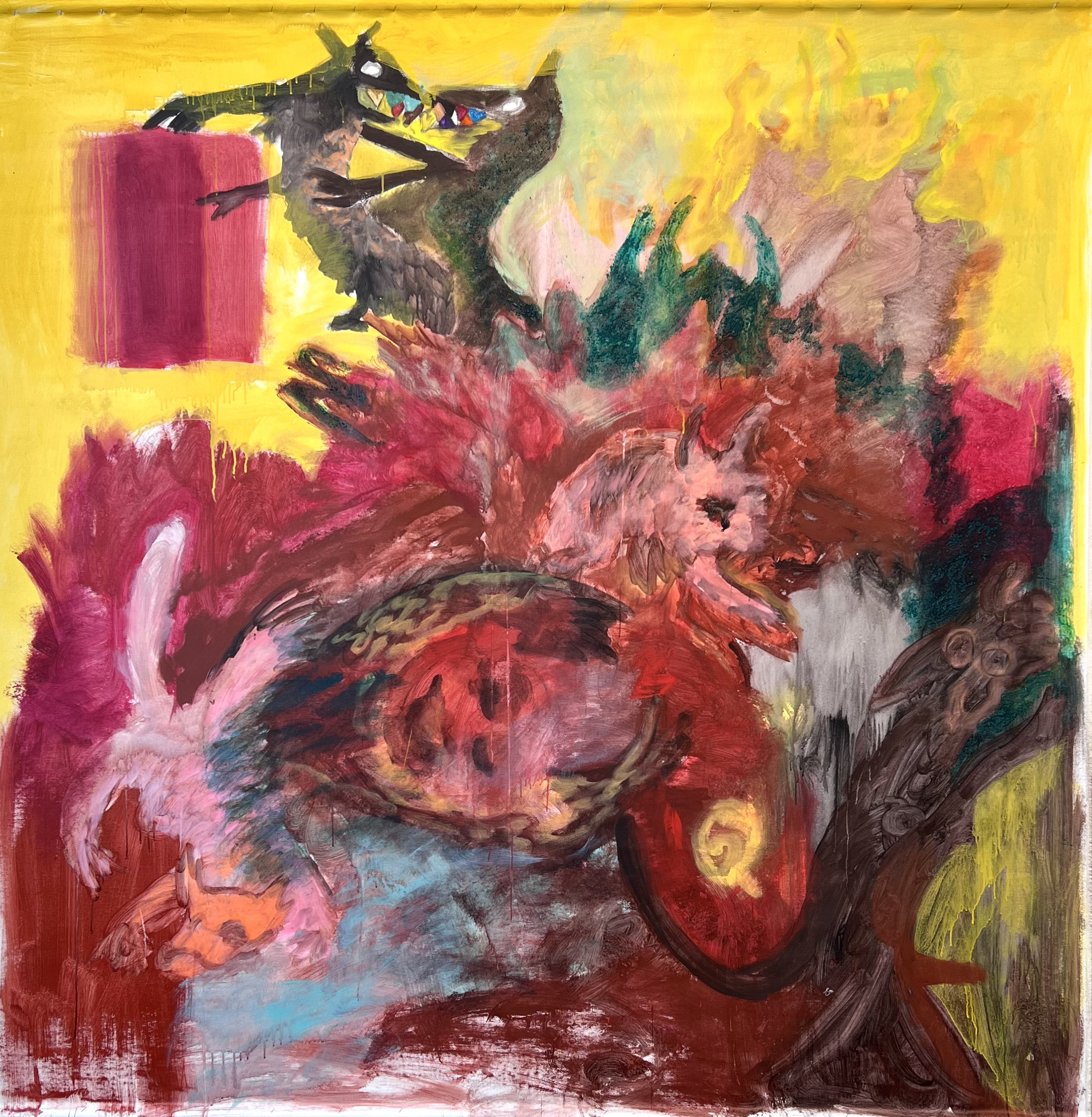
Shura Skaya, Dogs, 2025. Acrylic on canvas, 84in x 84in. (Courtesy: the artist).
Out of the three participating artists, Stephen j Shanabrook is the most physical in terms of image delivery. He commonly uses pieces of plastic that are squashed with a hydraulic press into nearly flat pictures. Mostly, figurative – like in the Trash Flowers series present in the exhibition. The artist used bouquets made from silk and food canisters as source materials. After pressing, they look molten together while preserving their physicality.
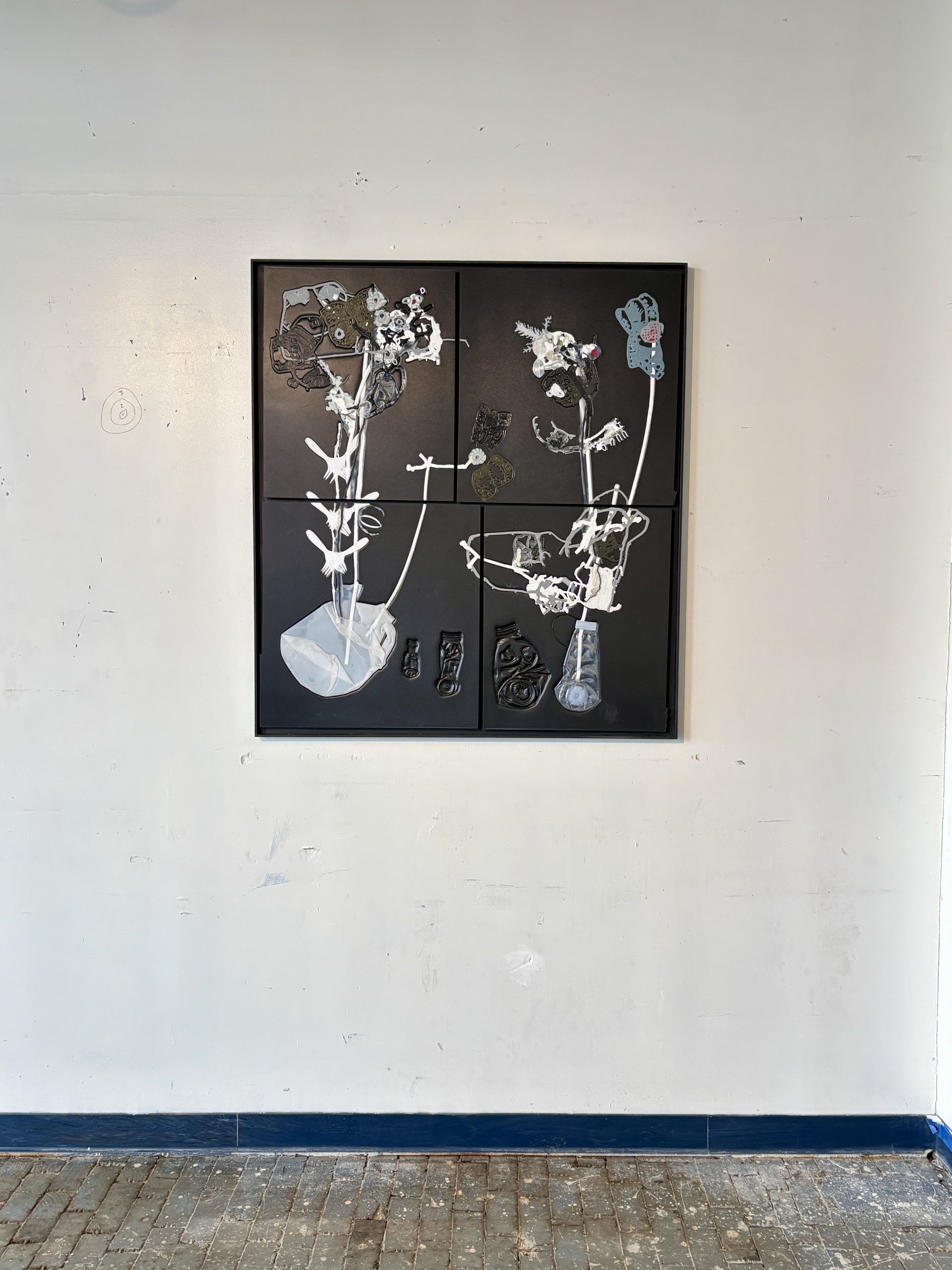
Stephen j Shanabrook, Space Flowers, 2025. Pressed upcycled plastic, 46in x 42in. (Courtesy: the artist).
In 2024, he has produced The Vanished Lost Version of “these colors don’t run” – a rendition of the US flag in pressed black-and-white plastic, the star section filled with a heap of beige skeletons, looking together like an amorphous blur. A hint at Jasper Johns – and a piece of political critique.
Sometimes, he ventures into the further expressionist visual territory, using discarded gas lighters, empty cans, and other items as assembly parts (Devil’s Fountain).
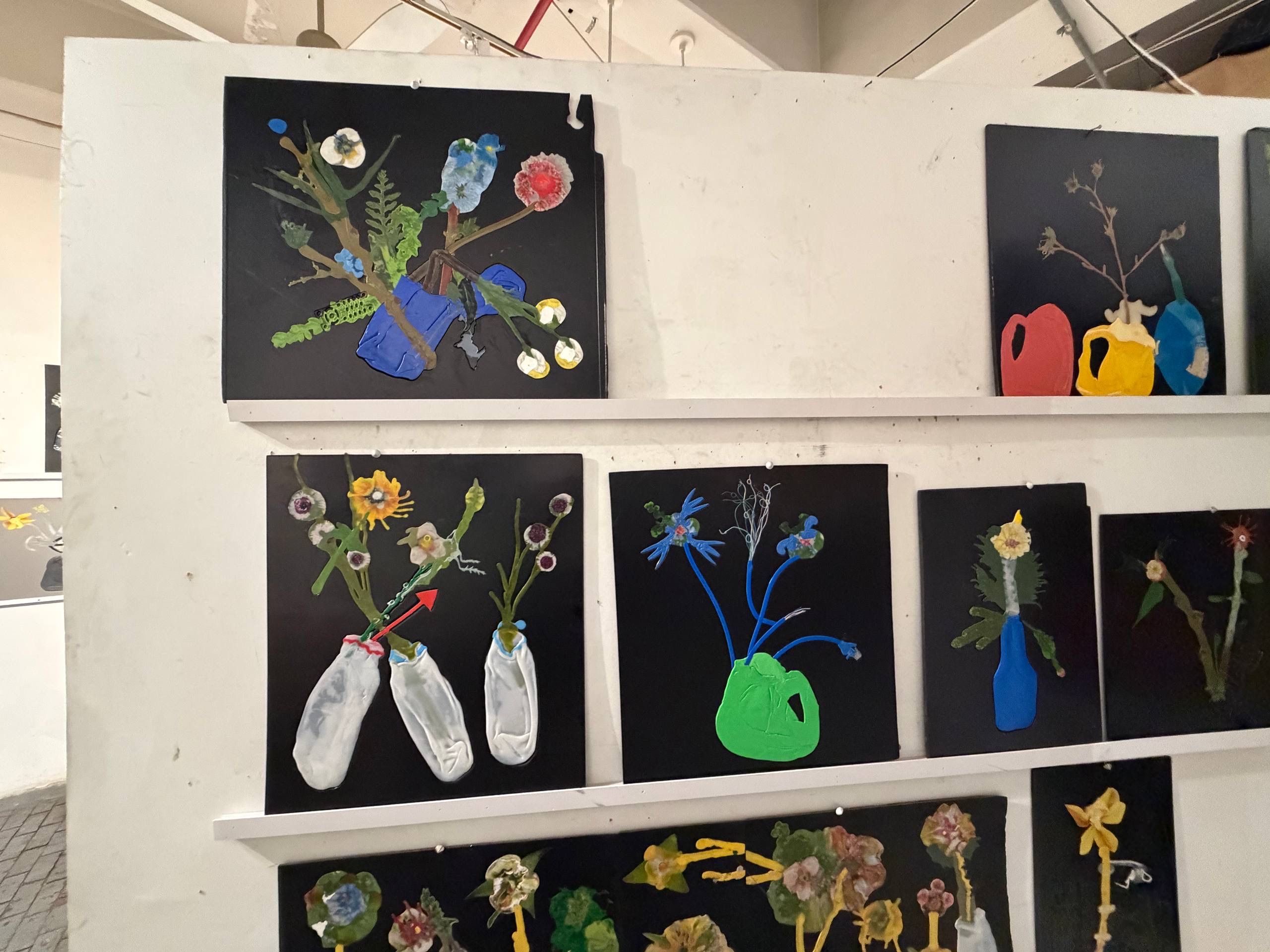
Stephen j Shanabrook, Trash Flower Series, 2023-2026. Upcycled plastic, various sizes. Installation view. (Courtesy: the artist).
Another favorite medium for Shanabrook is chocolate. Son of his hometown’s coroner, he has trained as a confectioner early in life, so presses the languages of macabre and delight together while speaking of the human condition. Such is the Suicide by Cop || Human Heart Pierced by Bullet, a realistic cast of the damaged organ in dark chocolate.
Sometimes he produces sets of pralines, like fancy gift boxes, representing different body parts of the dead: eyes, ears, internal organs, all together looking like a glittering collection of ex votos. This is the technique used in Evisceration of Waited Moments, American Morgue Chocolates Edition, and Halcyon Nest // Open and Closed Eyes from the Russian and American Morgue Chocolate Series. (It is easy to see that for Shanabrook, titling is an important part of conceptual re-purposing.)
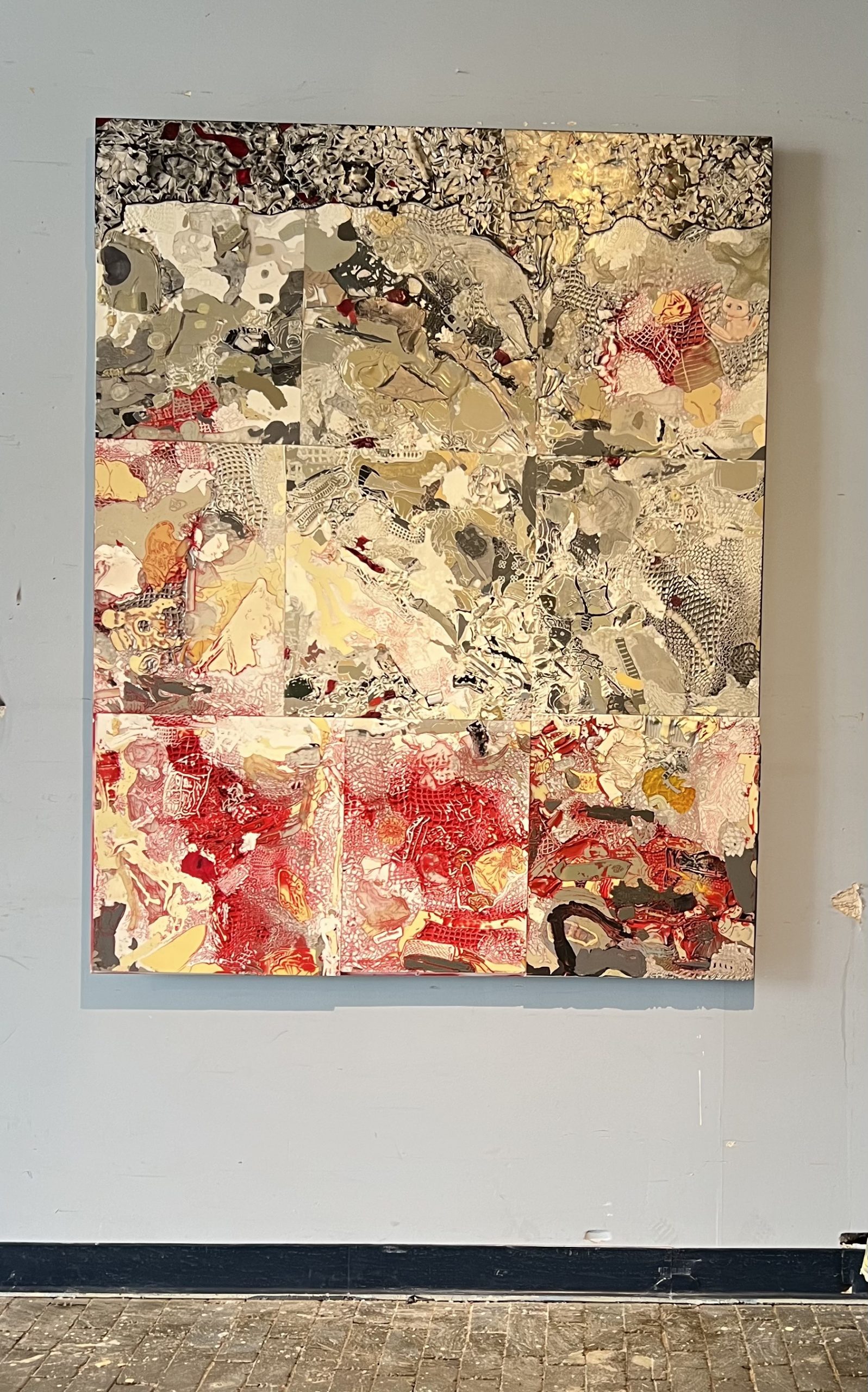
Stephen j Shanabrook, Ski Bunny, 2020. Pressed upcycled plastic, 66in x 52in. (Courtesy: the artist).
The search for new methods naturally leads the author to performance — disturbing in its essence. A series of such events centered on making a human cotton candy – vivacious on Instagram, probably difficult to wash off (Beaten To A Pulp on The Bed of Moss, 2017).
Shura Skaya takes a different approach to materiality. Her attitude can be described as a process of transgression of a painting’s plane, on the one hand, and its image, on the other.
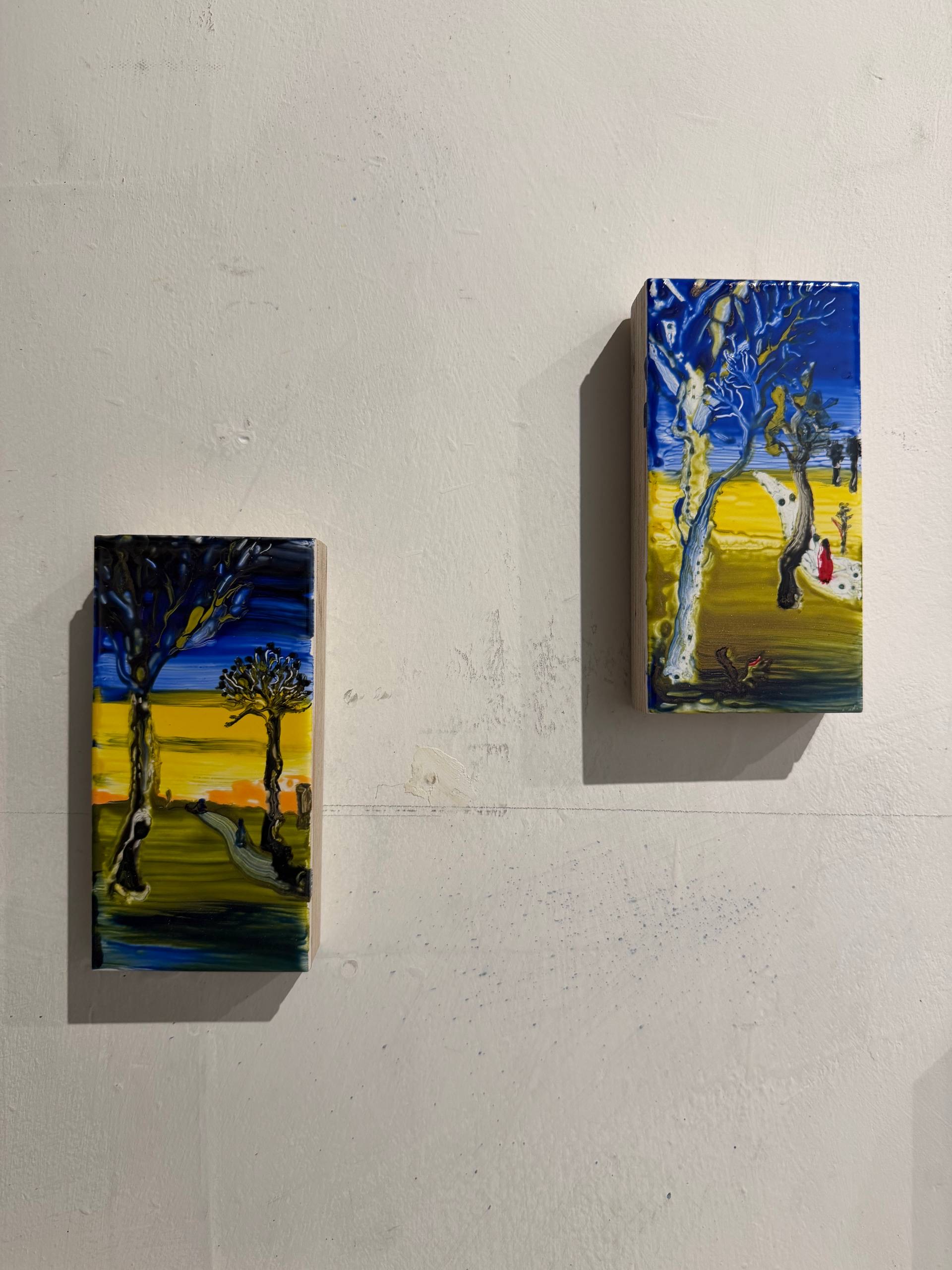
Shura Skaya, Sunsets, 2026. Porcelain paintings, 6in x 3in. Installation view. (Courtesy: the artist).
It can be illustrated by her Birds Watching, a large-scale acrylic painting/object that hangs freely from the ceiling in the center of the exhibition space, facing the window. It is a double-layered piece. One layer is a non-figurative acrylic on plain canvas. Covering most of it, another canvas, depicting multiple birds, waters flowing, rays beaming, done in a dreamy, partly abstract expressionist way characteristic of the author. The ‘back’ abstract layer is seen through the large holes cut in the ‘front’ – and it becomes a piece of sky (probably) in this tiered work. But these tiers can be shifted sideways, and then they sway like pendulums, destroying the illusion of unity and providing a whole different attitude: paintings are not screens into a different reality— they are objects in this world and can be manipulated.
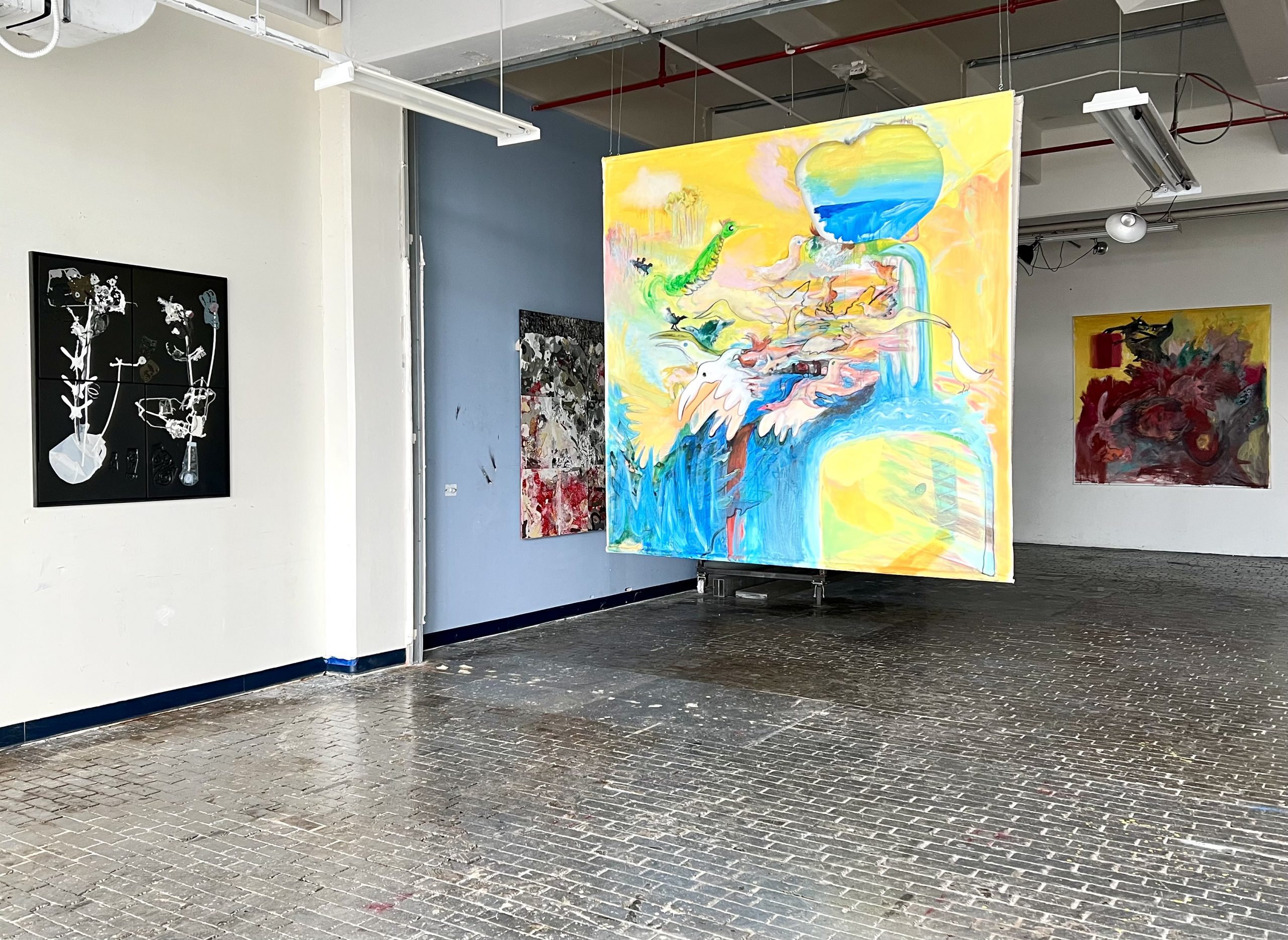
Shura Skaya, Birds Watching, 2026. Acrylic on canvas, 84in x 84in. Installation view. (Courtesy: the artist).
This is a recurring trend in the artist’s oeuvre. For example, her website shows a still from her film “Josephine and Her Elements #1” (2020), with the heroine jumping into the plane of a painting lying flat on a pond. It is about to be pierced with her sharp heels in just a split second.
Skaya’s smaller works, also present at the exhibition, are from her Porcelain Paintings series. Pebeo water-based paint for porcelain: the objects are baked after painting. This creates an opposition between the fleeting watercolor and the resulting firm object, which plays tricks on our perception.
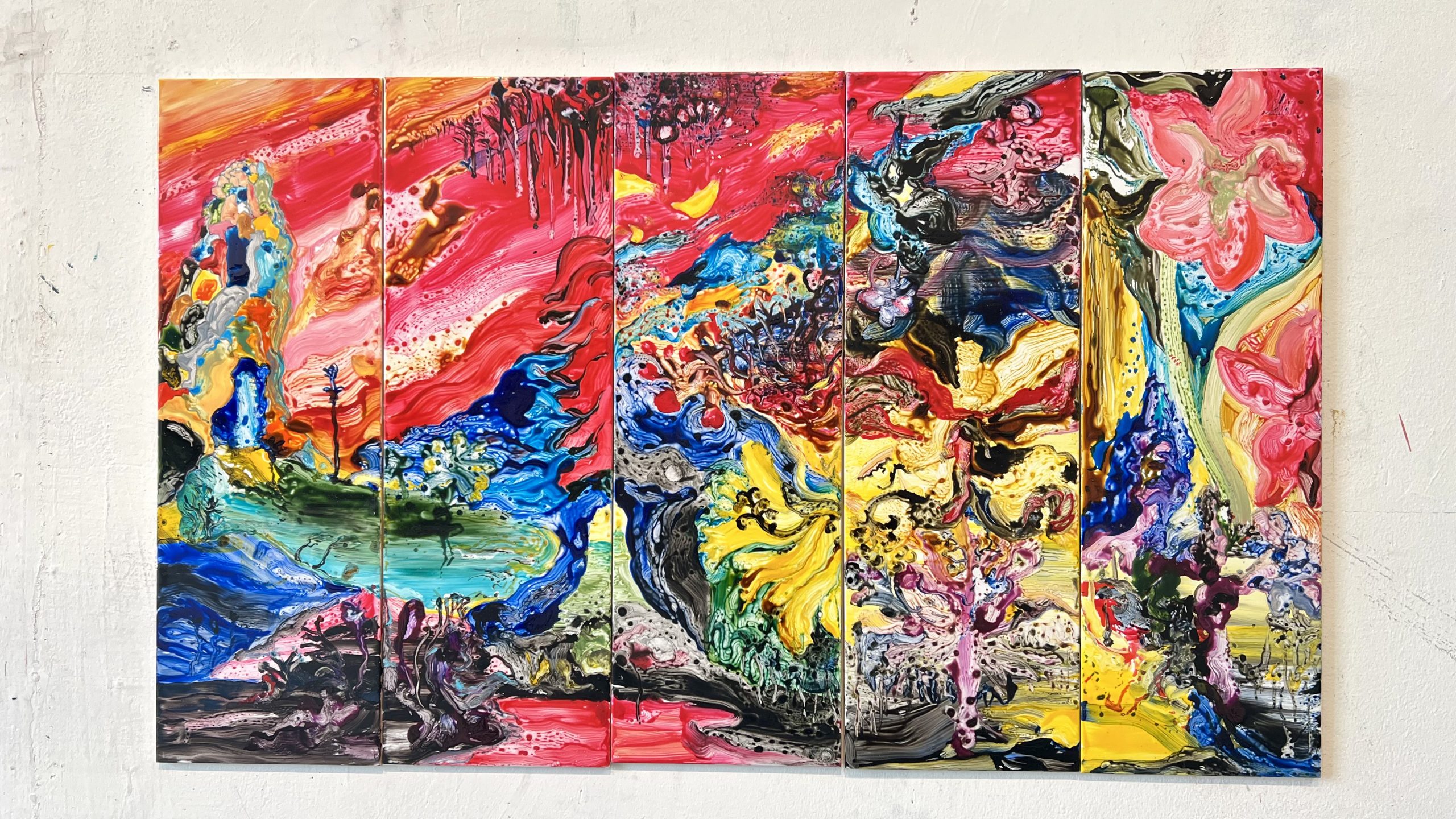
Shura Skaya, From Red to Blue, 2026. Porcelain paintings (Pebeo water-based paint for porcelain), 9 pieces, each 24in x 8in. ( Courtesy: the artist).
Taking pictures outdoors is important. The artist’s Instagram shows a mini performance ‘Spanking of the Queen and how it Misbehaved’, where a large painting on canvas is hung freely like a banner against the wall, and the wind begins to play with it, hitting, waving, and folding it in two.
Her outdoor installation, Garden Painting. Summer, Fall, Winter, Spring featured two large-scale pieces done with house paint on wood panels and mounted upright in a rural area. Then they are photographed during the season change, snow, and whatnot – becoming part of the landscape in the process of decay.
And of course, this brings Skaya to public art. Her piece “Four Elements” (2022), done for the Staten Island Hebrew Public School, is a set of tile-covered objects, loosely pyramidal, with tops cut off. With bright colors and dreamy motifs, they oppose the orthogonality of the concrete school building while offering its occupants something to climb upon.
Veronica Georgieva exhibits her latest series, Deep into the Surface. The technique of choice is frottage. The author needs real-world objects to serve as templates: these are loosely modernist cut-glass vases and, equally loosely, Oriental copper reliefs. All of that can be immediately recognized by a post-Soviet eye as something coming from childhood, the prized pieces of residential decoration. The motifs chase and obliterate each other, like deer emerging and vanishing again in the abstract woods.
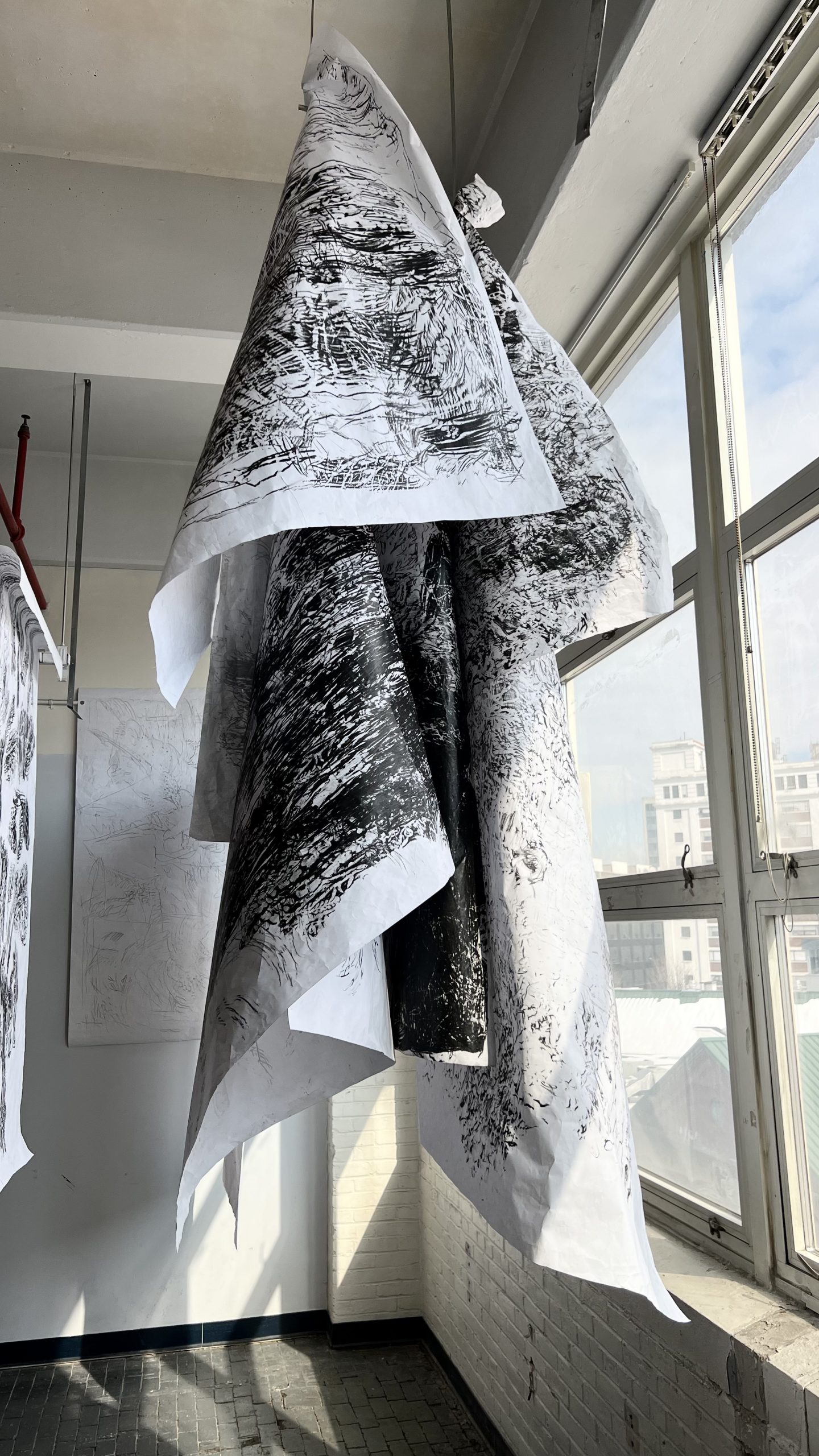
Veronika Georgieva, My Grandma Put Sunflower Seeds in Newspaper Cones, 2026. Wax crayons on paper. (Courtesy: the artist).
These charcoal shadings are traveling across vast white sheets like black and white Robert Longo’s reflections of reflections, put together as large maps of uncharted territories, consisting of scraps and addenda, rolled up for transportation, and here, at the exhibition, rolled down, hung from the ceiling, sometimes proper and sometimes by the corner like rags, in front of the windows, catching the light. Which can be perceived as a loose reference to the Unhappy Readymade (1919-1920) by Marcel Duchamp, the geography book strung with wires on a balcony and photographed in the process of decay.
In this and other series, Georgieva is captivated by mechanical reproducibility and aberrations.
This fascination be seen in her earlier series The Life of Others. As the artist’s website states, the images are “…made from slide film materials being scanned mechanically overlapping each other, up to 9-10 layers, until the scanner can’t fit any more slides. During the process, the scanner started to be confused, not knowing on what to focus, and it invented its own colors (no Photoshop used).” So here we glimpse a reference to Boris Mikhailov’s Yesterday’s Sandwich series, but where Boris was looking at possible juxtapositions, Georgieva marvels at mechanically reproduced errors becoming the whole point.
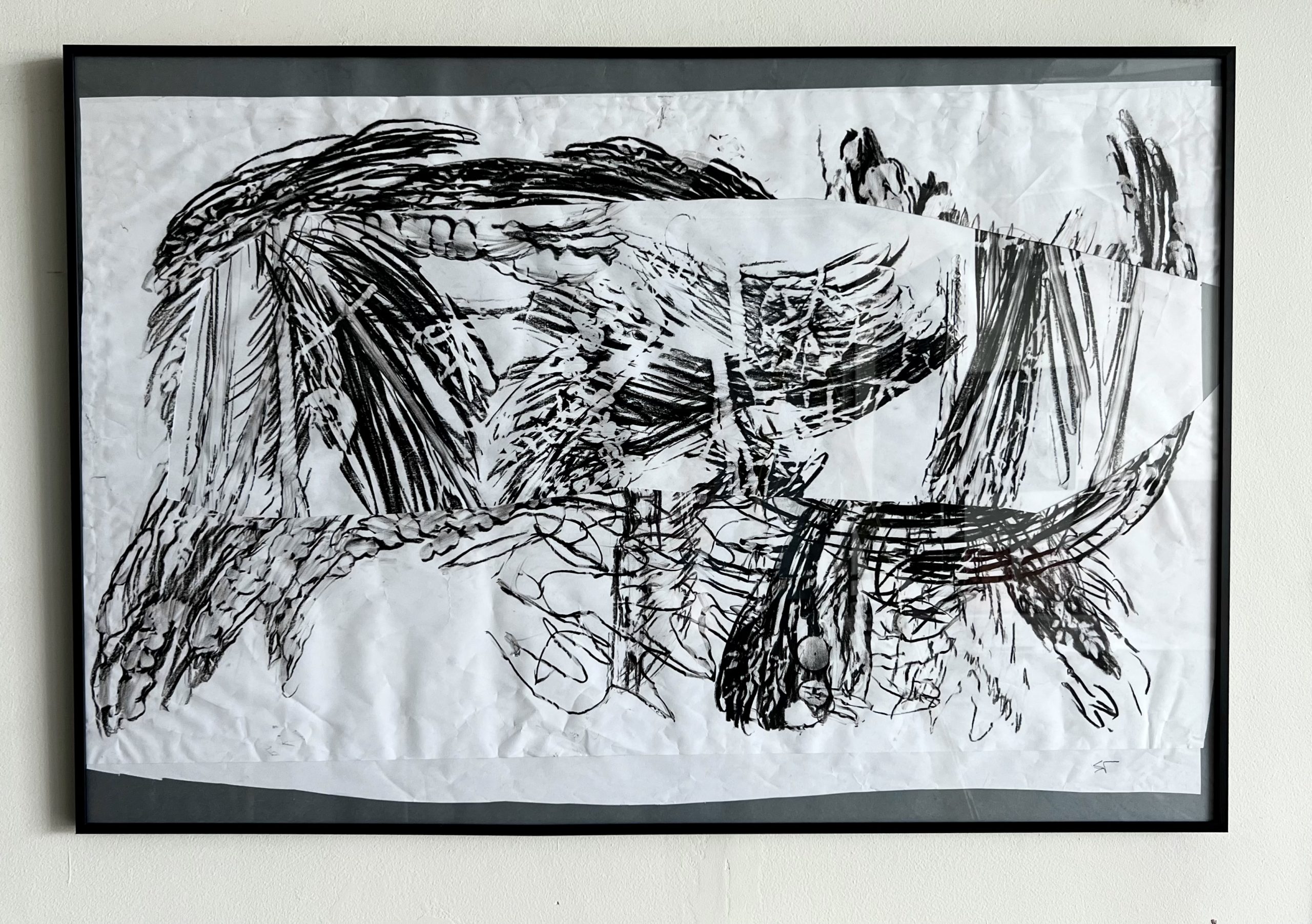
Veronika Georgieva, Wrong Glasses, Right View, 2026. Wax crayons on paper. (Courtesy: the artist.)
The same principle, but reversed, goes for the series Too Much Information. Georgieva states: “Those digital prints are inspired by repetitive gestures of Warhol’s silk screens. Warhol ran the process until the screens had no paint, so the images became increasingly washed out. What is happening here is the opposite: slides layered on top of each other until the image is almost gone, until it turns into blackness. The images are disappearing not because there is not enough “paint”/information, but because it is too much information, too many layers of information & memories.”
One can also consider Zhang Huan’s Family Tree (2000), in which hieroglyphs are painted on the artist’s face until it becomes pitch-black. Surely, Georgieva’s mechanistic approach is a link to (time-proven) conceptual practices. But the important part is this shimmering on the border.
Veronika Georgieva also gladly ventures out: for example, her Memory Lane, the public art project for AURORA FESTIVAL in front of the Dallas Museum of Art, featured an 8-channel video installation on four semi-trucks, with 300 x 500 cm projections on each (2015).
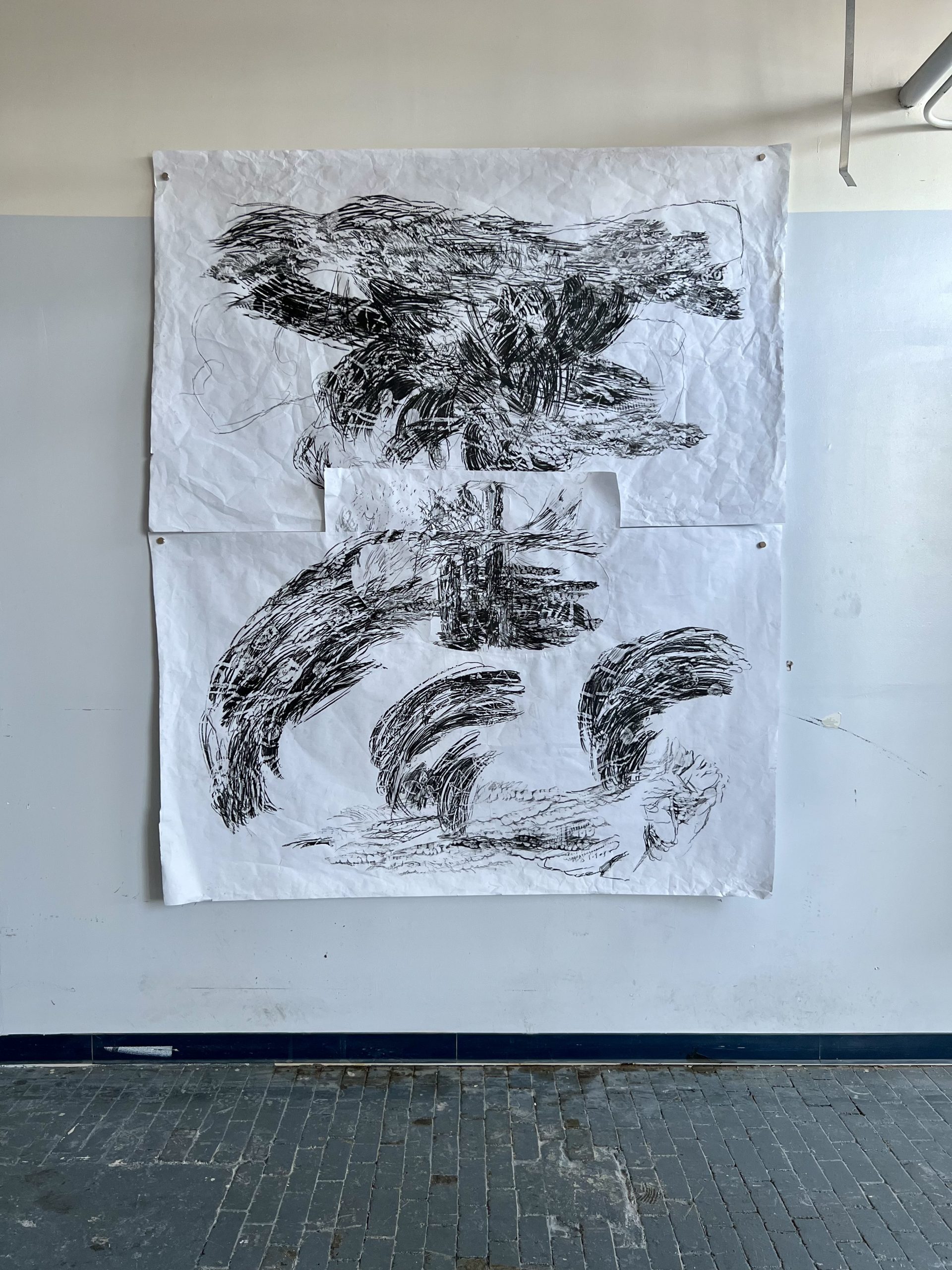
Veronika Georgieva, Unknown Wind to Familiar Grass, 2026. Wax crayons on paper. (Courtesy: the artist).
…This game of finding similarities can go on forever; it’s not the point. Let’s just imagine the three friends and collaborators drifting through the ocean-bordered megapolis on an intellectual stroll.


0 Comments