
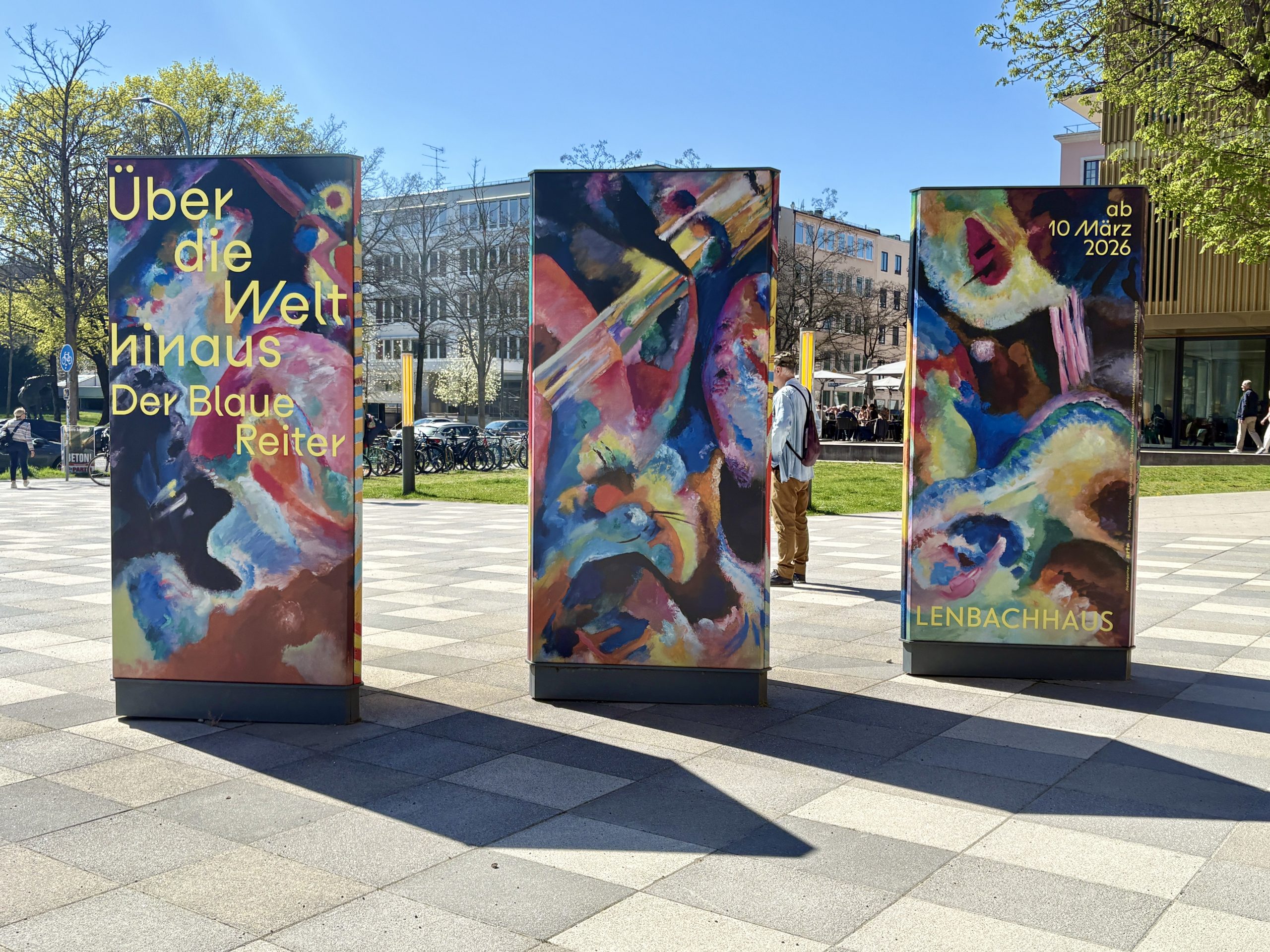
Caption: Exhibit advertisement outside the Lenbachhaus und Kunstbau München (Photo: Natalie Urusov).
The Blue Rider movement was centered in Munich, coalescing around two exhibitions held between 1911 and 1912 and organized by the editorial collective Der Blaue Reiter. Among the artists featured was Gabriele Münter, Wassily Kandinsky’s former partner. In 1957, on Münter’s 80th birthday, she donated over 1,000 works from the Blue Rider movement to Lenbachhaus, establishing the museum as a stronghold of German Expressionist art.
WHAT: Beyond the World. The Blue Riders
WHEN: March 10, 2026 – September 5, 2027
WHERE: Lenbachhaus, München
Franz Marc’s 1911 Cows, Red, Green, Yellow serves as the visual emblem of the exhibition. The painting depicts a yellow cow leaping joyfully before two others rendered in green and red. This burst of energy and movement reflects the movement’s spiritual aspirations, articulated in Kandinsky’s manifesto Concerning the Spiritual in Art. Kandinsky associated the color yellow with eccentricity and joy, an idea that seems to also animate Marc’s composition. Echoing this, the exhibition design features vivid blue walls and matching benches, where visitors can flip through an array of art books.
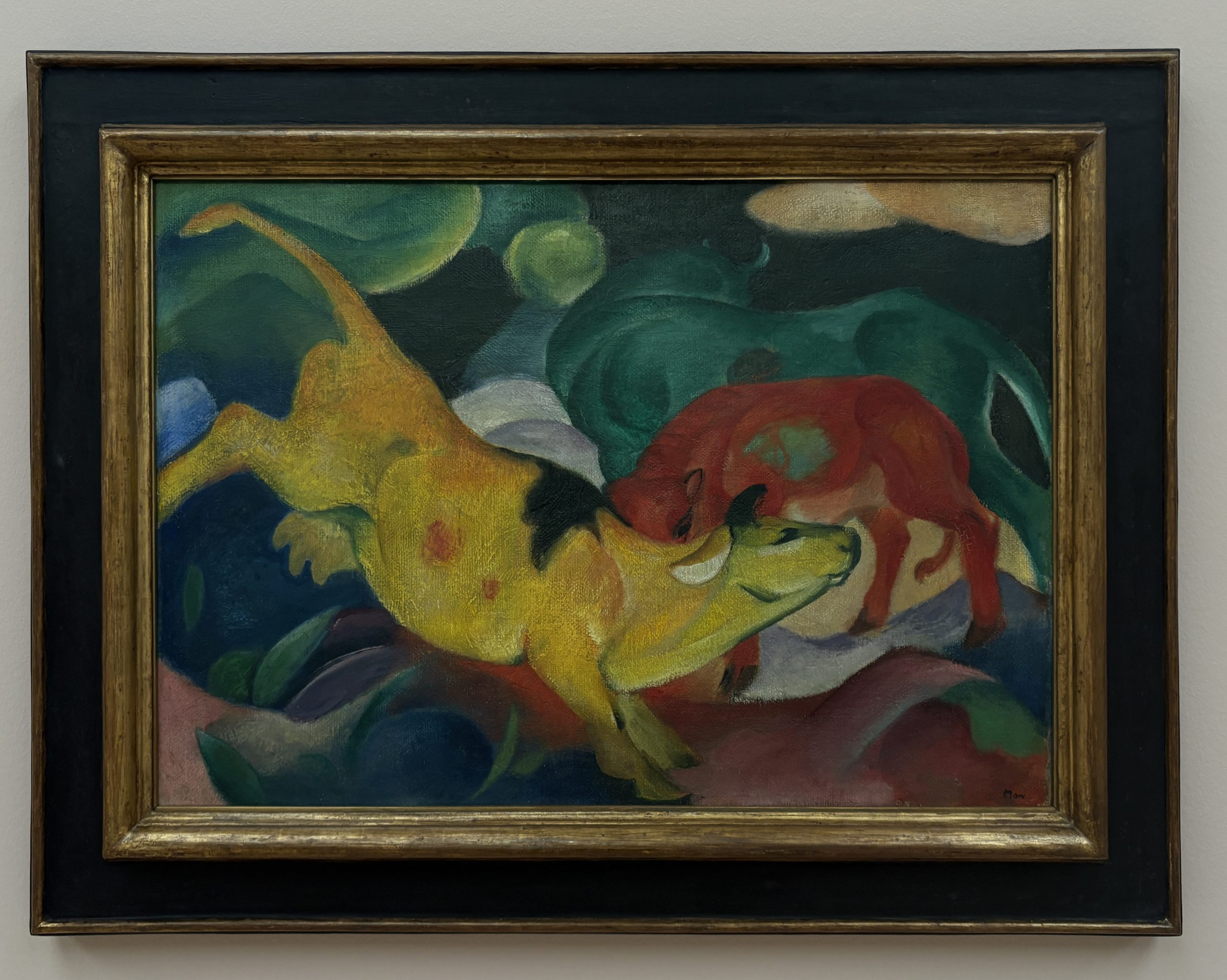
Caption: Franz Marc, Cows, Red, Green, Yellow, 1911. Oil on canvas. 62 cm x 87.5 cm. Städtische Galerie im Lenbachhaus und Kunstbau München. (Photo: Natalie Urusov).
Moving through the exhibition is a largely chronological experience, beginning with “The Dialogue of Forms,” a section devoted to the cross-cultural inspirations behind the Blue Rider Almanac of 1912. The group drew heavily from Slavic folk art, children’s drawings, reverse-glass painting, and woodcuts. As noted in the exhibition text, this range of influences “illustrated an anti-academic, open-minded, international, and tolerant vision.”
In his glass painting All Saints’ Day I, the Moscow-born Kandinsky clearly draws on Russian folklore and imagery, as evidenced by the roosters, onion domes in the background, and the garb of the village people. The exhibition then traces the founding of the Neue Künstlervereinigung München (NKVM) in 1909, an association that first brought many of the Blue Rider artists together. Subsequent rooms explore key thematic influences: the German countryside, urban scenes, children’s motifs, and the performing arts. Alexej von Jawlensky’s Portrait of the Dancer Alexander Sacharoff is hard to miss, with its pasty white-blue background in contrast to the magenta walls.
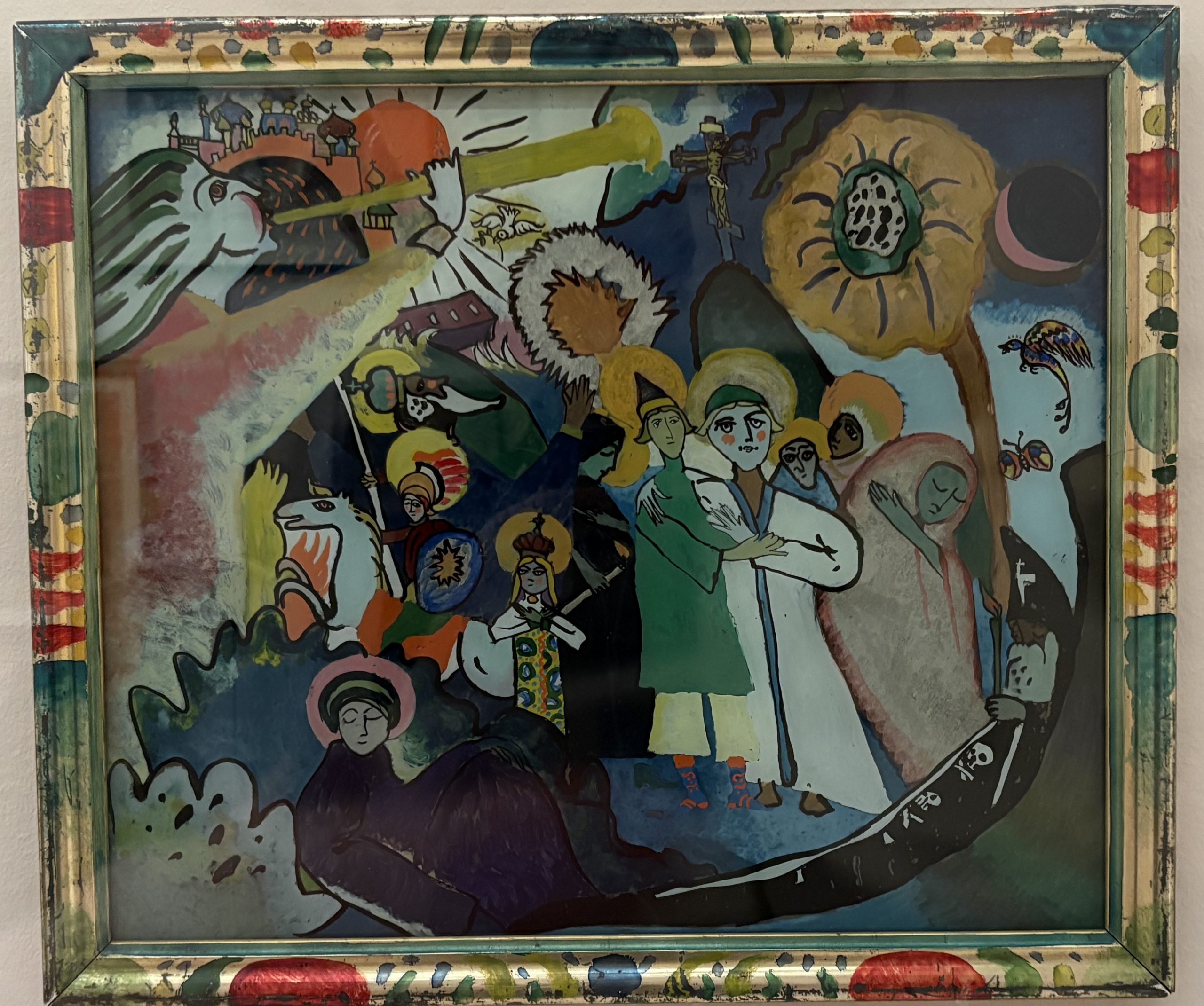
Caption: Wassily Kandinsky, All Saints’ Day I, 1911. Glass painting, 34.5 × 40.5 cm, Städtische Galerie im Lenbachhaus und Kunstbau München. (Photo: Natalie Urusov).
The exhibition concludes with a sobering reflection on the suppression of German Expressionism under the Nazi regime. Accompanying more works by the Blue Riders are inventory lists of “degenerate” art confiscated from museums in Germany, including works designated for seizure by Lenbachhaus director Franz Hofmann.
An amalgamation of a tumultuous chronology, spiritual inquiry, and vivid colors, “Beyond the World. The Blue Riders” invites viewers to discover the connection between the external and internal influences and highlights more than just the faces of the movements. As TZ writer Simone Dattenberger aptly observes, the “paintings shine like colored galaxies,” a sentiment echoed in the exhibition’s immersive and thoughtful design. Visitors would do well to conclude their experience in the museum courtyard or at Ella, the Lenbachhaus café.


0 Comments