
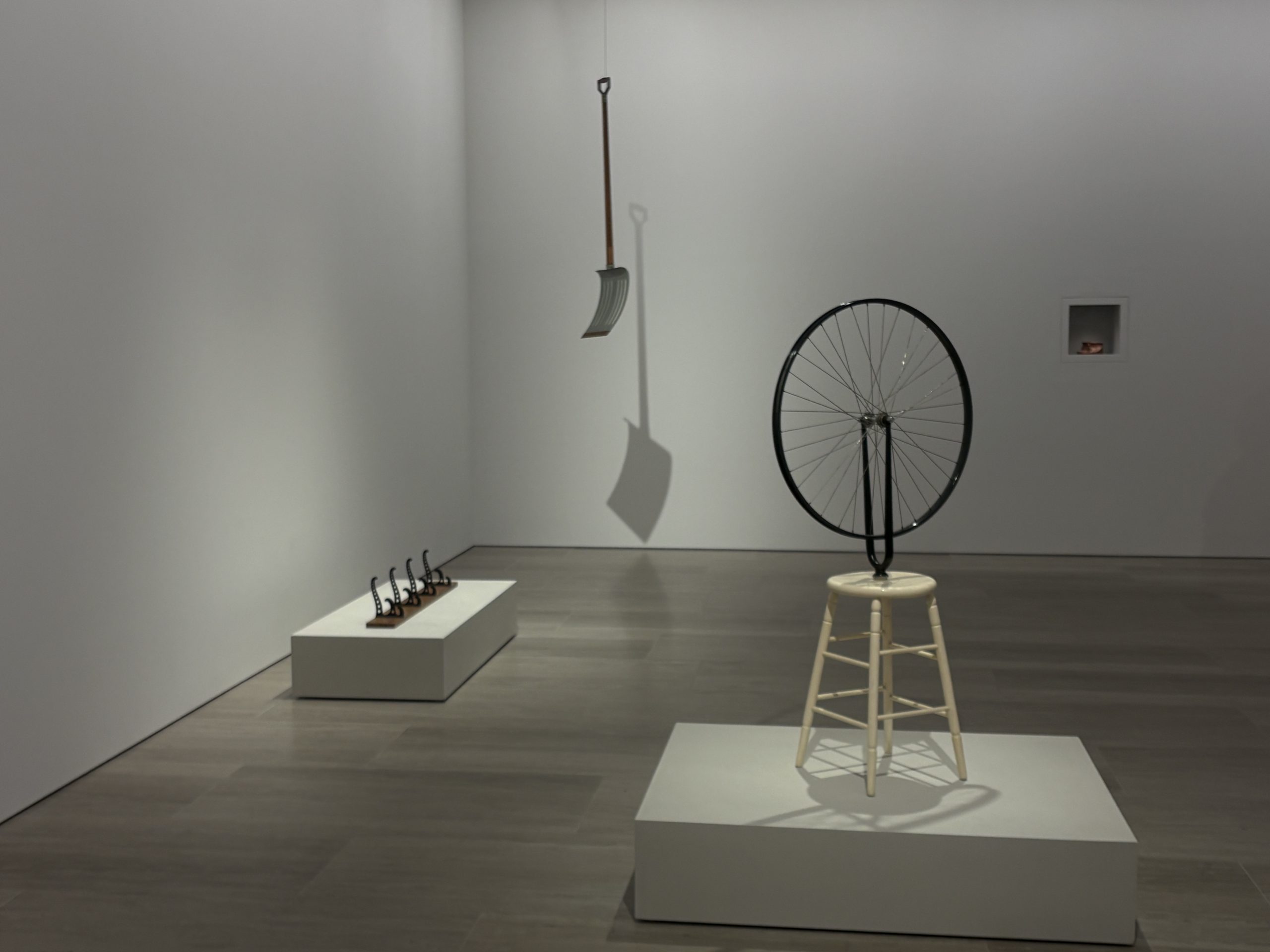
Caption: Marcel Duchamp, Exhibition view at Gagosian. (Photo: Natalie Urusov).
On April 25, 2026, Gagosian revealed their new gallery location at 980 Madison Ave with an exhibit dedicated to Marcel Duchamp and his American heir, Robert Rauschenberg. The space is a barren white box, a minimalist backdrop perfect for Duchamp’s structural readymades. It is worth noting that Duchamp first exhibited his readymades in the same building, 61 years ago.
WHAT: MARCEL DUCHAMP; ROBERT RAUSCHENBERG: IMPORTANT EARLY WORKS FROM CY TOMBLY COLLECTION
WHEN: April 25–July 31, 2026
WHERE: Gagosian, 980 Madison at 76th Street, New York
Among the works featured is the infamous Fountain, a urinal that Duchamp signed “R. Mutt.” Although the 1917 original has been lost, a 1964 authorized edition, produced in collaboration with the Italian dealer and collector Arturo Schwarz, is on display at Gagosian. This piece, like the other readymades, is a manifestation of Duchamp’s focus on the meaning and intent of art rather than solely its aesthetic features, establishing him as the father of conceptual art.
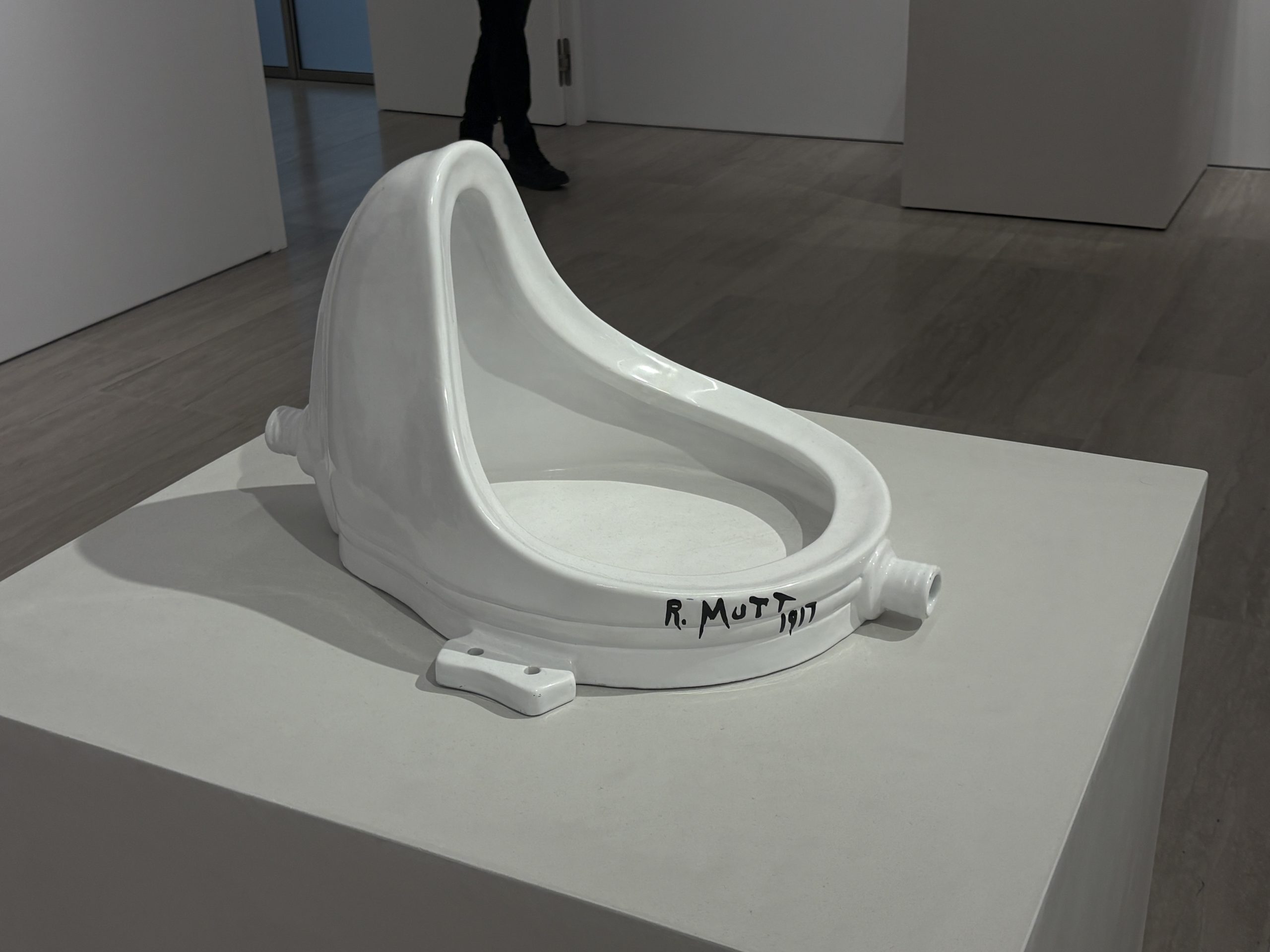
Marcel Duchamp, Fountain, 1917, Gagosian. (Photo: Natalie Urusov).
In a smaller room adjacent to the main exhibition space, six of Rauschenberg’s early works are on display. Duchamp’s readymades paved the way for Rauschenberg’s “combines,” assemblages consisting of everyday objects. Untitled (1961) is made of metal, wire, a tin can, an electric cord, a light bulb, and a stool.
The six works shown come from the personal collection of Rauschenberg’s close friend and fellow artist Cy Twombly. The two met in 1951 at the Art Students League of New York and went on to travel together through Italy, Morocco, and Spain. That Twombly held on to these pieces for decades speaks to their significance, not just as art objects but as artifacts of one of postwar America’s most creatively charged friendships.
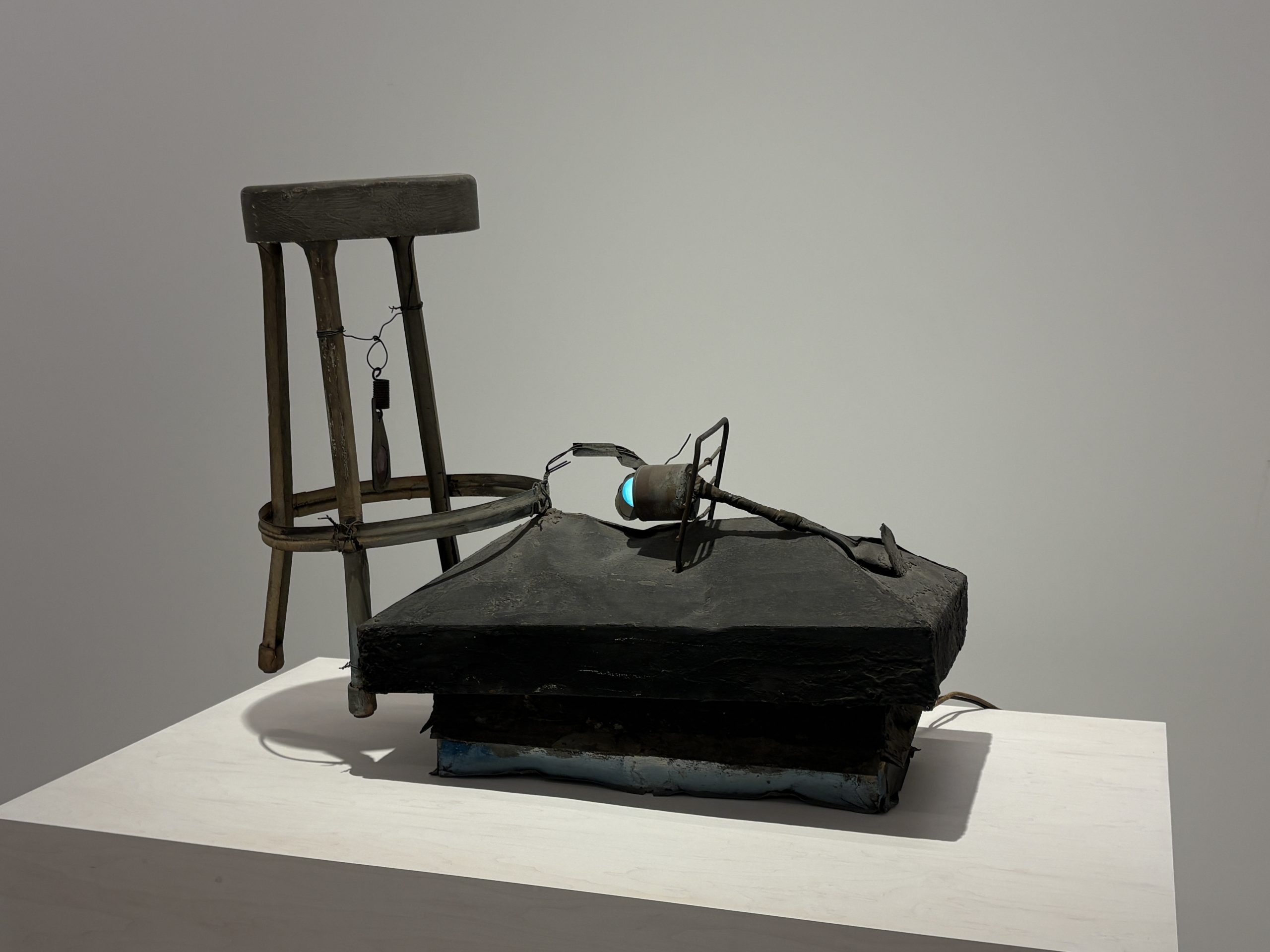
Caption: Robert Rauschenberg, Untitled, 1961, Gagosian. (Photo: Natalie Urusov).
Taken together, the two exhibitions trace a direct line through the history of conceptual art. Duchamp dismantled the idea that art must be handmade or beautiful; Rauschenberg carried that disruption into postwar America, proving that a stool and a light bulb could hold as much meaning as any painting. Gagosian’s decision to open its new flagship with this pairing feels less like a programming choice and more like an argument about where art came from, and why it still matters.
The Duchamp exhibition runs through July 31, 2026, and the Rauschenberg show through June 27. Both are free and open to the public at 980 Madison Avenue.


0 Comments