
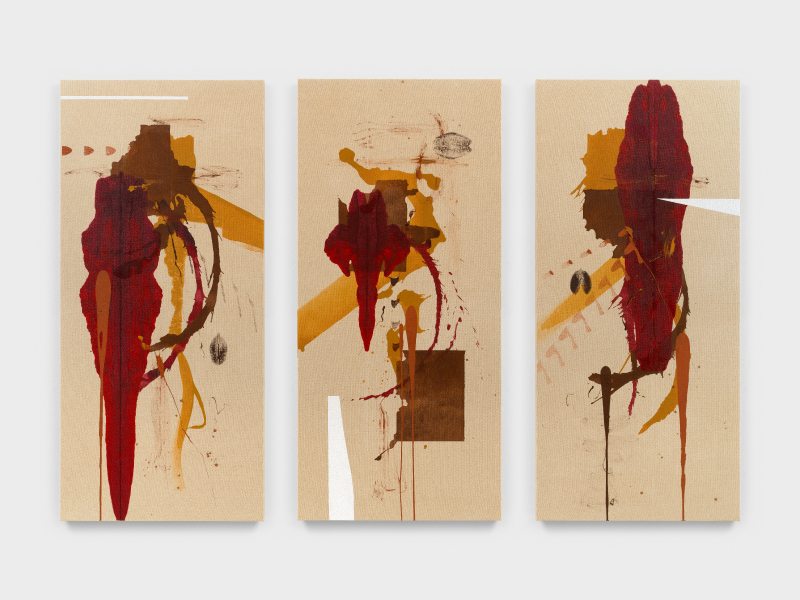
Elizabeth Neel, Real or Imagined, 2025. Signed and dated on verso acrylic on canvas, 78 x 36 x 1 1/2 inches (each)(ELN25.029). (Courtesy: the artist and Jack Shainman Gallery, New York; Photo: Dan Bradica Studio).
Elizabeth Neel’s paintings move between past and present, perception and knowledge, exploring natural forms through a dynamic language of abstraction. Working with a wide array of tools—brushes, rags, rollers, and monoprinting techniques—alongside borrowed visual materials such as images, texts, X-rays, and architectural plans, Neel constructs layered compositions of gesture and color. The works often appear spontaneous, yet beneath their immediacy lies a careful balance: method within madness, and a quiet order within chaos.
WHAT: Elizabeth Neel, In the Guts of Living
WHEN: February 20 – April 4, 2026
WHERE: Jack Shainman Gallery, 46 Lafayette Street, New York, NY
Her exhibition In the Guts of the Living—a title drawn from W. H. Auden’s poem In Memory of W. B. Yeats—introduces a new series of monochromatic works. In these paintings, Neel reflects on how knowledge is filtered through contemporary culture and how form itself can summon echoes of the past. Though more restrained in palette than her earlier work, the paintings retain the sense of invention and open possibility that defines her practice.
The granddaughter of the renowned painter Alice Neel, Elizabeth Neel maintains an artistic practice deeply engaged with the world around her. For Fine Art Globe, the artist spoke about her upcoming exhibition, the dynamics of chaos and control in painting, and the enduring influence of artistic inheritance.
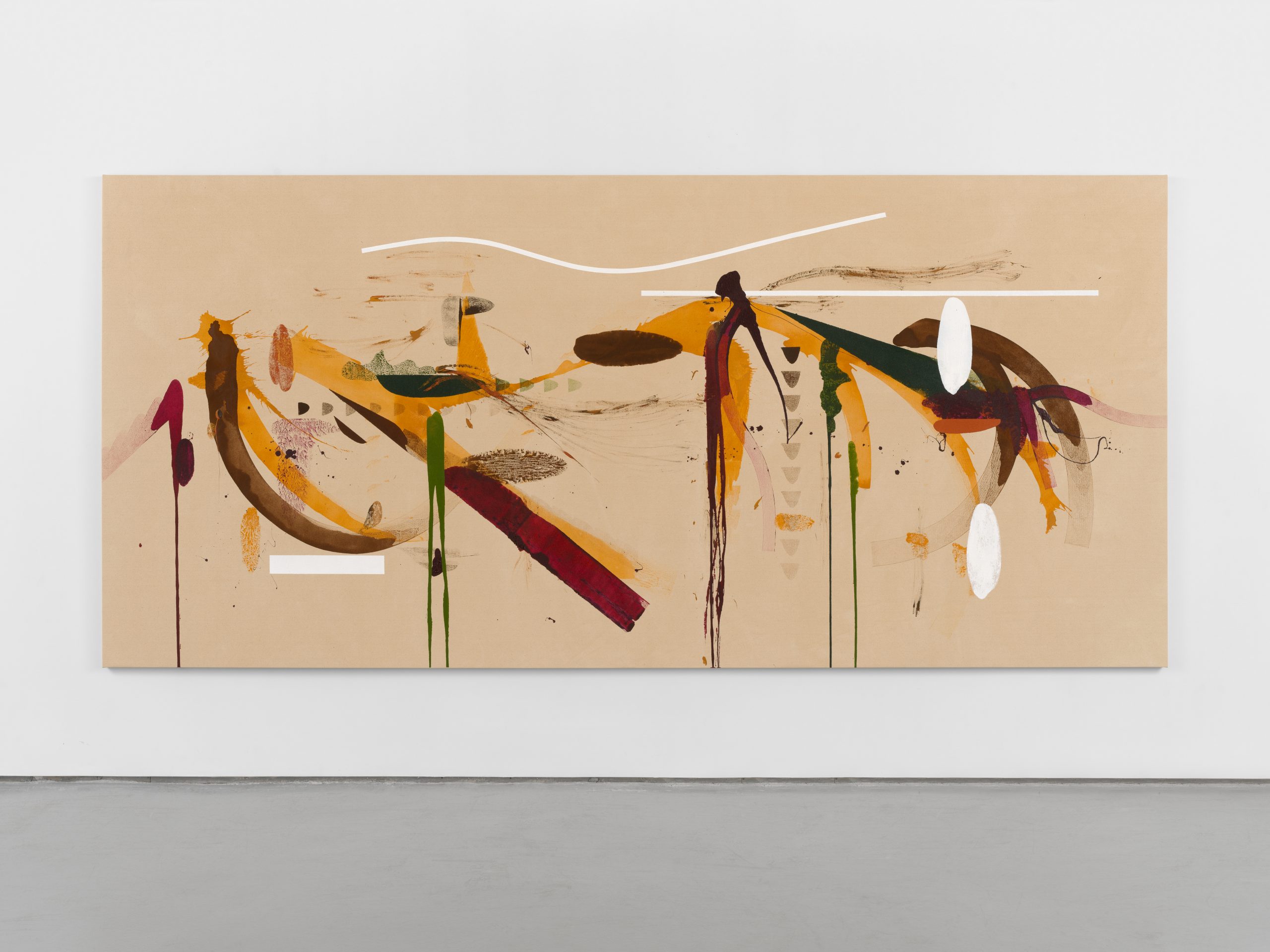
Elizabeth Neel, How to Live, 2026. Acrylic on canvas 78 x 169 x 11/2 inches. (Courtesy: the artist and Jack Shainman Gallery; New York. Photo: Dan Bradica Studio).
As the granddaughter of Alice Neel, you grew up surrounded by art and that world at a very young age. You speak so warmly of her and of your relationship with Alice. Looking back now, do you think you always knew this was something you wanted to pursue? What kind of inspiration did you take from her work and life as an artist?
As a child, I admired Alice’s paintings and her extraordinary tenacity, but I knew almost nothing about the “art world.” I grew up in Vermont, far away from all of that. Alice was not successful for most of her life and received recognition so late that the concept of fame was not ingrained in my childhood. It was the paintings and her personality that mattered to me. Being true to oneself, to one’s work, and the bravery required in that approach are the inspirations I still take from her.
Your work is obviously quite different and distinctly your own. When do you think you found your identity as an artist?
I found it in 2004. It was a eureka year for me when I finally had my own studio with the space to paint. The weight of painting in terms of art history can be paralyzing, and it was the most maligned medium during my early education, so I felt I had to face it head-on. I started working on a small scale on paper with acrylics to save space and money. Working that way completely opened the floodgates, and I began taking risks in my approach. Those risks became part of what is now my practice.
I’m always curious about an artist’s process and practice. How do you first begin working on a piece? Is it something that evolves as you go? Can you walk us through your process?
My relationship to each piece requires an evolution. The process is additive rather than reductive. Each mark suggests the next until I decide that the composition and the content are in a condition of productive dialogue. Painting is a language, and in that way, it has limitations. My goal is to harness those limitations in unexpected ways so that a poetic field of associations can emerge.
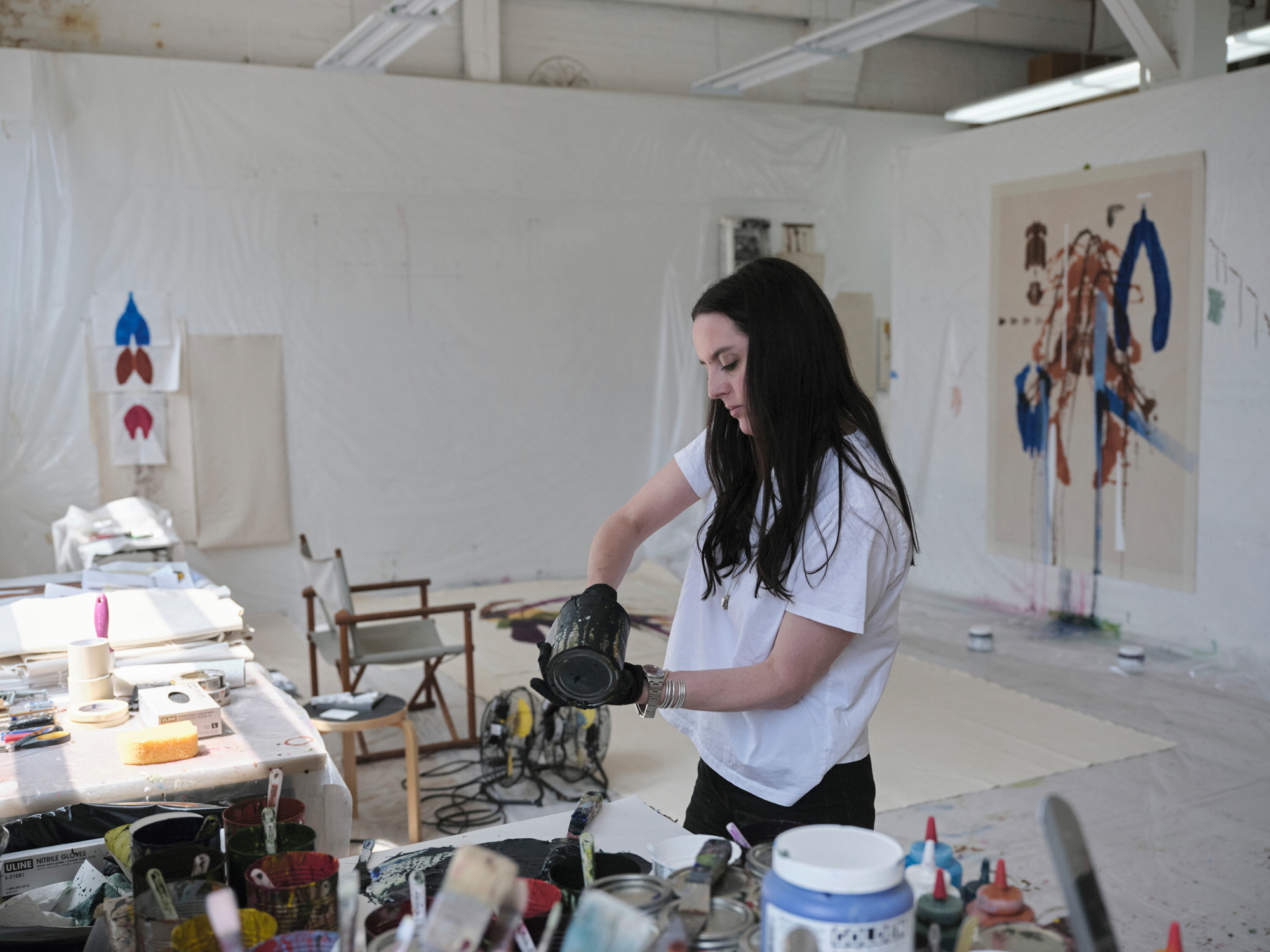
The artist in her studio. (Photo: Brad Ogbonna).
There is so much metaphor in your work. Does the meaning behind the art come first, or does the artwork arrive first, and the meaning follow?
My particular knowledge of the world is inseparable from my particular process of making. There is a reverberating cycle of influence that generates the metaphors and meanings.
Congratulations on your first solo show with the gallery—that’s very exciting. Tell us about In the Guts of the Living and what you hope to convey with this exhibition.
Thank you. This body of work was made to convey my experience of life in the present, inseparable from both the past and regenerative notions of the future.
What drew you to W. H. Auden’s poem In Memory of W. B. Yeats, from which the line “In the Guts of the Living” comes?
The poem summons the texture of natural processes, creative acts, and life and death on the page in both lush and economical ways. It seduced me immediately.
This will be the first time you’ll showcase monochromatic work. What led to this decision? Color is usually so prominent in your work.
In October, my father-in-law passed away. I needed to contend with the often contradictory rituals of loss, the visualization of medical information, and the tropes of mourning. The “monochromes” were made with a color called Mars Black and seemed an important way to connect the Auden poem to my own life in painting terms.
There seems to be an overarching theme of control and chaos throughout your work. Where do you think this comes from?
I wouldn’t say it’s control over chaos as much as the dynamic between what we can control and what we cannot. Sometimes in life it isn’t clear which is which. Humanity establishes limits for itself in all sorts of ways in order to survive, but at the same time we revel in pushing up against that kind of practicality. To some degree, I am re-enacting that dynamic in every painting.
What is your greatest wish as an artist? Having witnessed your grandmother’s work and legacy, what do you hope your own legacy will be?
I paint to make people think and ask questions of themselves and of one another. I believe art can be an antidote to both the shortage of empathy and the numbness of inattention from which this world suffers so desperately. I’m not sure I care about a legacy as much as a series of meaningful encounters between viewers and my paintings.
Where do you find the most inspiration as an artist? What are your ideal surroundings for creative work?
I find inspiration in the natural world, as well as in a vast array of images, texts, and films. I also find it in the conversations I have with other human beings. But when I work, I prefer to work alone.


0 Comments