
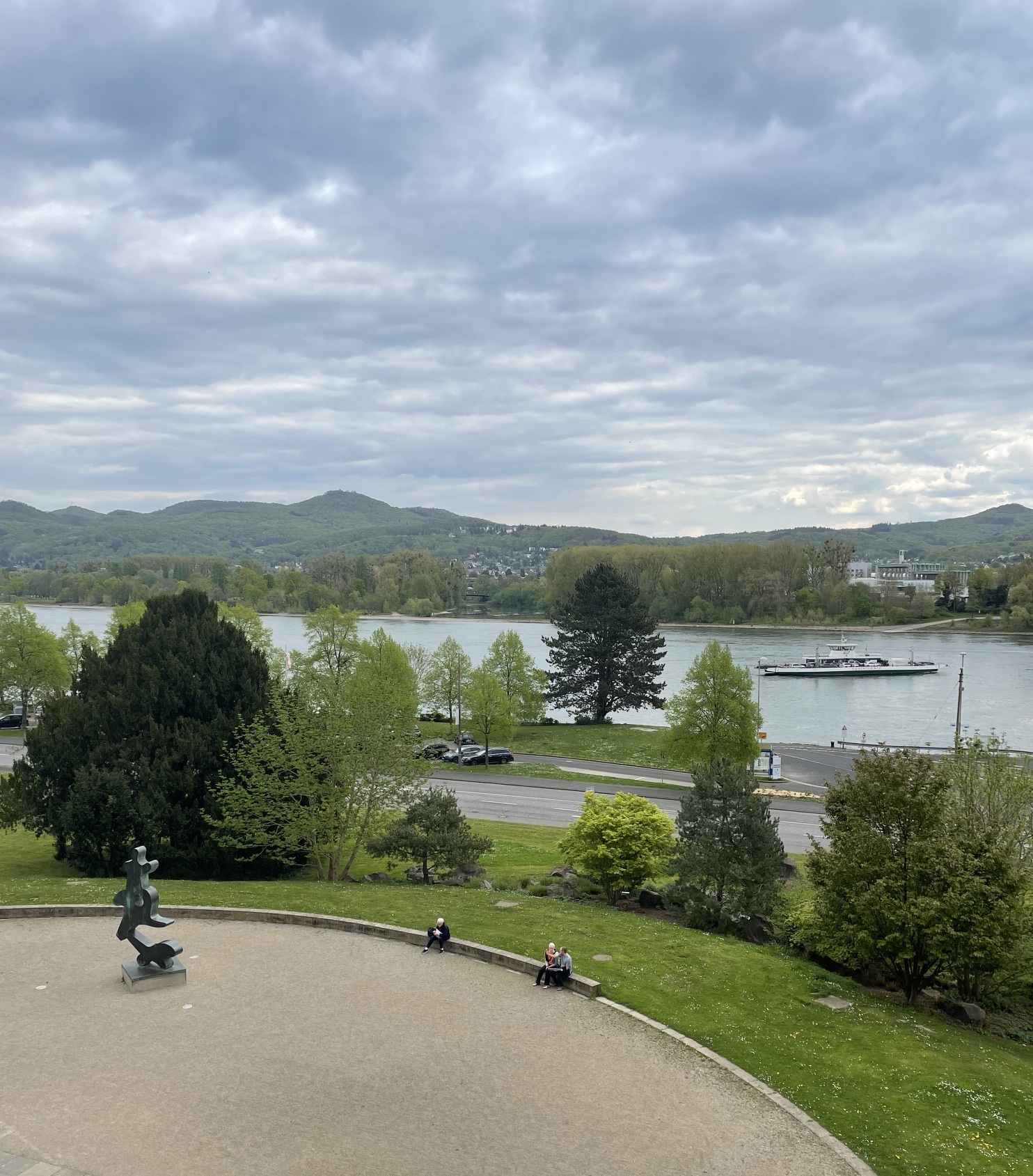
View upon the Rhine from Rolandseck’s upper terrace. (Photo: Vladimir Dudchenko).
In the world of visual arts, several German post-war luminaries have become something on the brink of everyday personae. The classics. Gerhard Richter (b. 1930) is the one with smeared paintings. Günther Uecker (1930-2025) is the one with nails. And so on.
It takes new dedicated exhibitions and an inquisitive mind to actually re-educate yourself again and again, to understand the search that drove these people fifty or sixty years ago, and its ongoing relevance. To brush away the embedded cliché perceptions. Singular pieces in museum collections often do not help, as they would normally show the peak of form taken out of context.
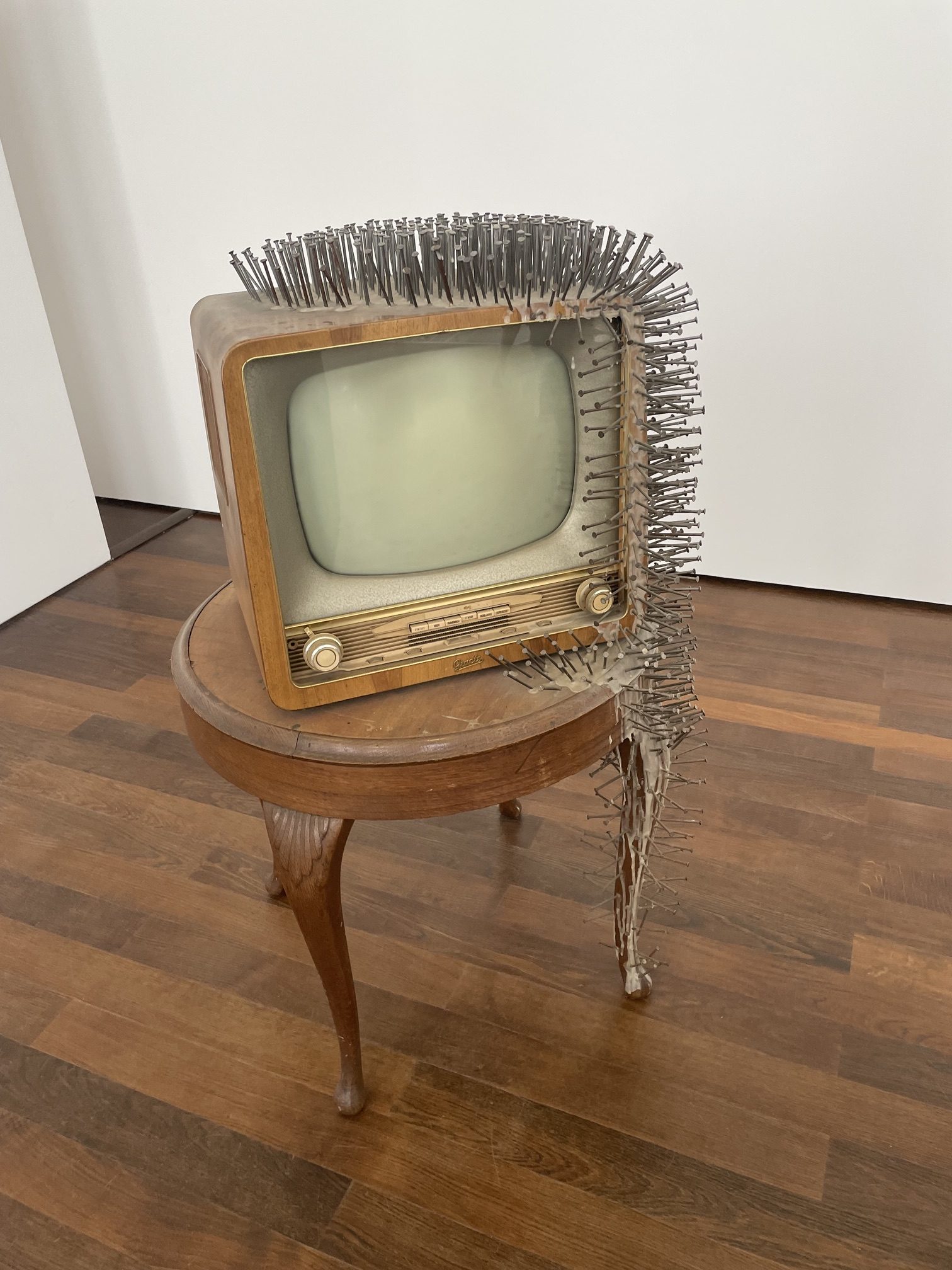
Günther Uecker, TV on Table, 1963. Nails, white paint, wood glue, TV, round wooden table. (Photo: Vladimir Dudchenko).
It is the good fortune of those residing in or visiting the German capital that Neu Nationalgalerie has an ongoing exhibition by Richter called ‘100 Works for Berlin’, on long-term lease from his estate. This show offers an in-depth view of his career, with the earliest works dating back to 1963, and touches on many of the important themes in his multifaceted oeuvre. His younger friend and colleague Sigmar Polke (1941-2010) recently had an exhibition at the Schinkel Pavillon called “The Local Forest Floor. Higher Powers Commanded: ‘Show us Polke!’” (2024-2025), with 40 works from private collections on display. As for Uecker, he had a comprehensive solo exhibition this year at Arp Museum – Bahnhof Rolandseck, called ‘The Vulnerability of the World’; for the artist, who passed away in 2025, it was the last one he worked on personally. It included about 45 works from all decades of his career, showing that it was not about the nails, which were always just a means.
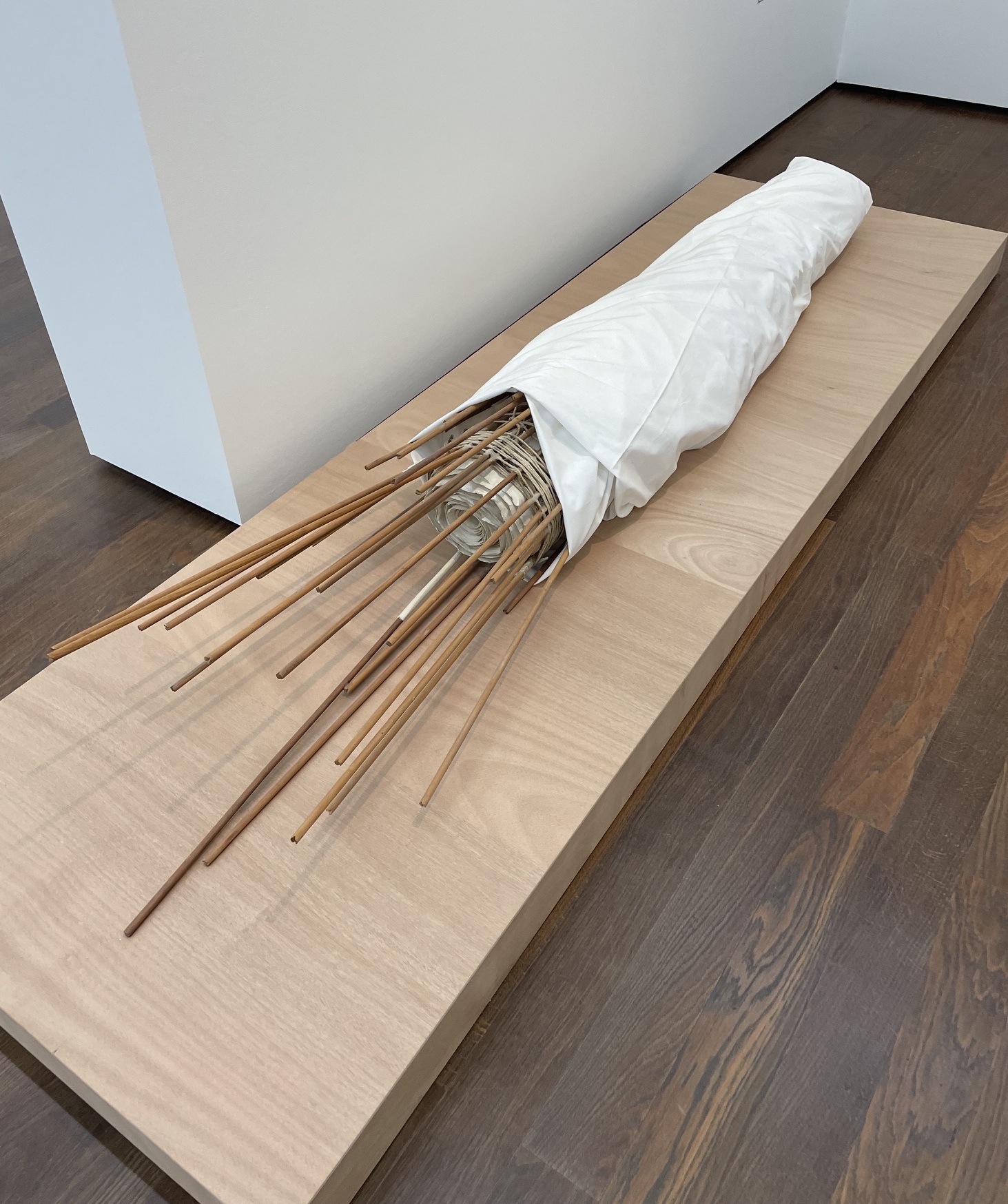
Günther Uecker, Secret Sculpture, 1982. Paper, wooden arrows, string, cloth (Photo: Vladimir Dudchenko).
The three artists were friends; they all originated from Eastern Germany, and subsequently emigrated to the West. Richter was the last to flee in 1961, right before the Wall went up. He was an established Socialist Realism painter in the DDR, but made a point of educating himself anew. His earlier works were mostly destroyed, and his meticulous online catalog makes no mention of what he did before emigrating.
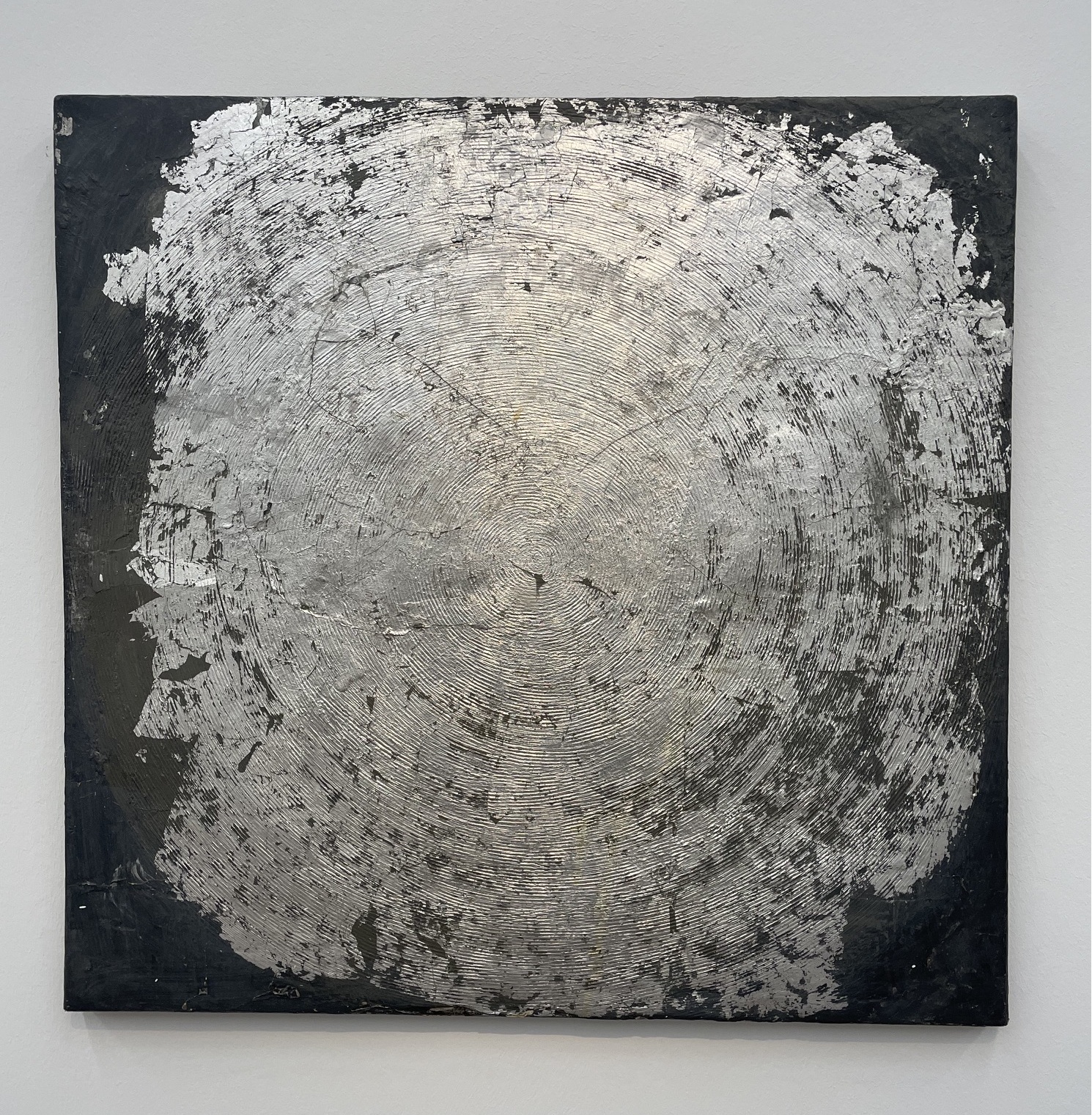
Günther Uecker, Silver Spiral I, 1957. Silver leaf on oil on cardstock (Photo: Vladimir Dudchenko).
Uecker, on the other hand, had already finished his studies by then; an abstract painter around 1955-1957, he, like many others, was looking for ways to overcome the two-dimensionality of canvas. To achieve that, around 1957 he started working with nails (sometimes painting them over).
Florian von Donnersmarck’s feature film “Never Look Away” (2018), based on Gerhard Richter’s biography, includes a hilarious scene depicting life at the Düsseldorf Academy around the time Richter joined it. It shows the crazed search for a signature ‘artistic device’ that would set these aspiring artists apart. Uecker is depicted as a jovial village craftsman, deciding that hammering nails will become ‘his thing’. With all its disrespectful fun, the part is an oversimplification. No big surprise that Richter had eventually distanced himself from the movie. Vane and fame-hungry as may be, he and his friends were the first generation to actually acknowledge Germany’s guilt in WW2 and look into the past of the parents’ generation. East Germany vetted all NSDAP members, including school teachers, who, like Richter’s parents, had to become Nazi Party members in the 1930s (with the exclusion made for Gestapo pros in the secret police, Stasi). On the other hand, West Germany supported itself on denazified high-ranking professionals, who previously had careers during the Third Reich, and after a formal procedure, became successful in the Federal Republic, too.
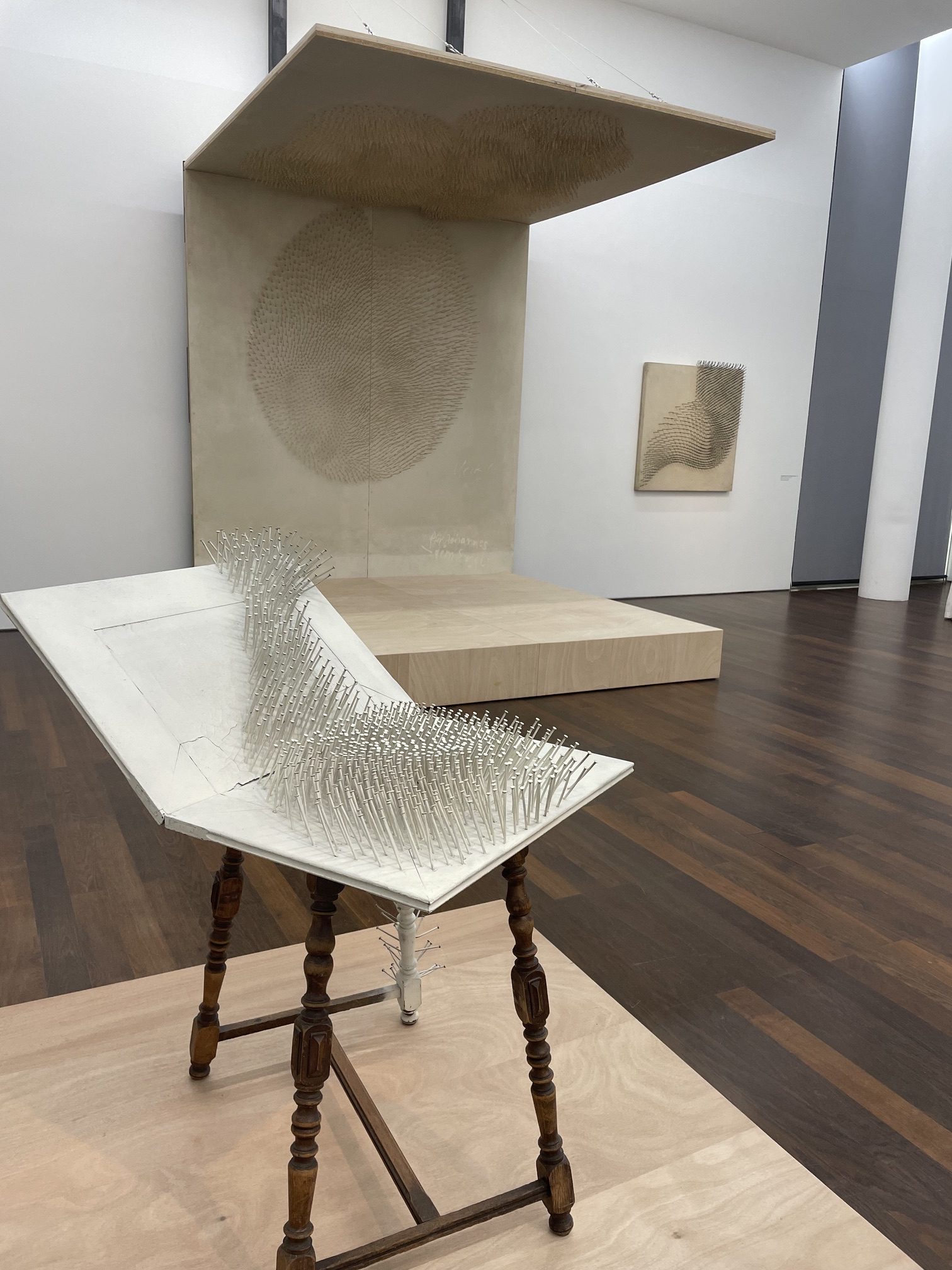
Günther Uecker, installation view, 2026. (Photo: Vladimir Dudchenko).
In 1957, Heinz Mack (b. 1931) and Otto Piene (1928-2014) formed ZERO Group, with Uecker joining in 1961. Piene described it as “a zone of silence and of pure possibilities for a new beginning”. The neo-avant-garde group used light, kinetic art and new technologies, drawing an international following with associated members including Arman, Yves Klein, Lucio Fontana, Piero Manzoni, Pol Bury and Jean Tinguely, among others. The group had published three issues of the self-styled magazine; the 1963 poem manifest by Heinz Mack, Otto Piene, and Günther Uecker that stated: “Zero is silence. Zero is the beginning. Zero is round. Zero spins. Zero is the moon. The sun is Zero. Zero is white. The desert Zero. The sky above Zero. The night.” (here and elswehere in the text quoted from the exhibition catalog, Günther Uecker. Die Verletzlichkeit Der Welt. Arp Museum, Bahngof Rolandseck, Verlag der Buchhandlung Walter und Franz König, 2026).
Gerhard Richter, meanwhile, formed a group in 1963 with Sigmar Polke, Konrad Lueg, and Martin Kuttner that would propagate Capitalist Realism (ironically opposed to Socialist Realism). Another name used was German Pop Art. Konrad Lueg, who later became a successful gallerist under the name Konrad Fischer, first introduced his friends to American Pop Art, and they began working on their own version. The characteristic interest in the surface, in the immediately visible, became embedded in their later attitudes; for one, Richter became a methodical researcher of the nuances between the abstract and figurative. And one of the first artists to show the work of memory through painting.
These searching and feverishly working aspiring artists formed the scene in Düsseldorf, collaborating on multiple occasions. At some point in the late 1950s, Günther Uecker came to know Johannes Wasmuth (1936-1997), who, like many of the like-minded young peers, looked to find a way to change the world with the help of art. Wasmuth founded a non-profit organization, initially informal, to raise money to build kindergartens for disadvantaged children. To do so, he asked artists to donate works to be displayed publicly and then sold. The initial fundraising exhibitions took place in front of the post office on Königsallee in Düsseldorf. This helped him achieve his goal and gain wider recognition for the new art.
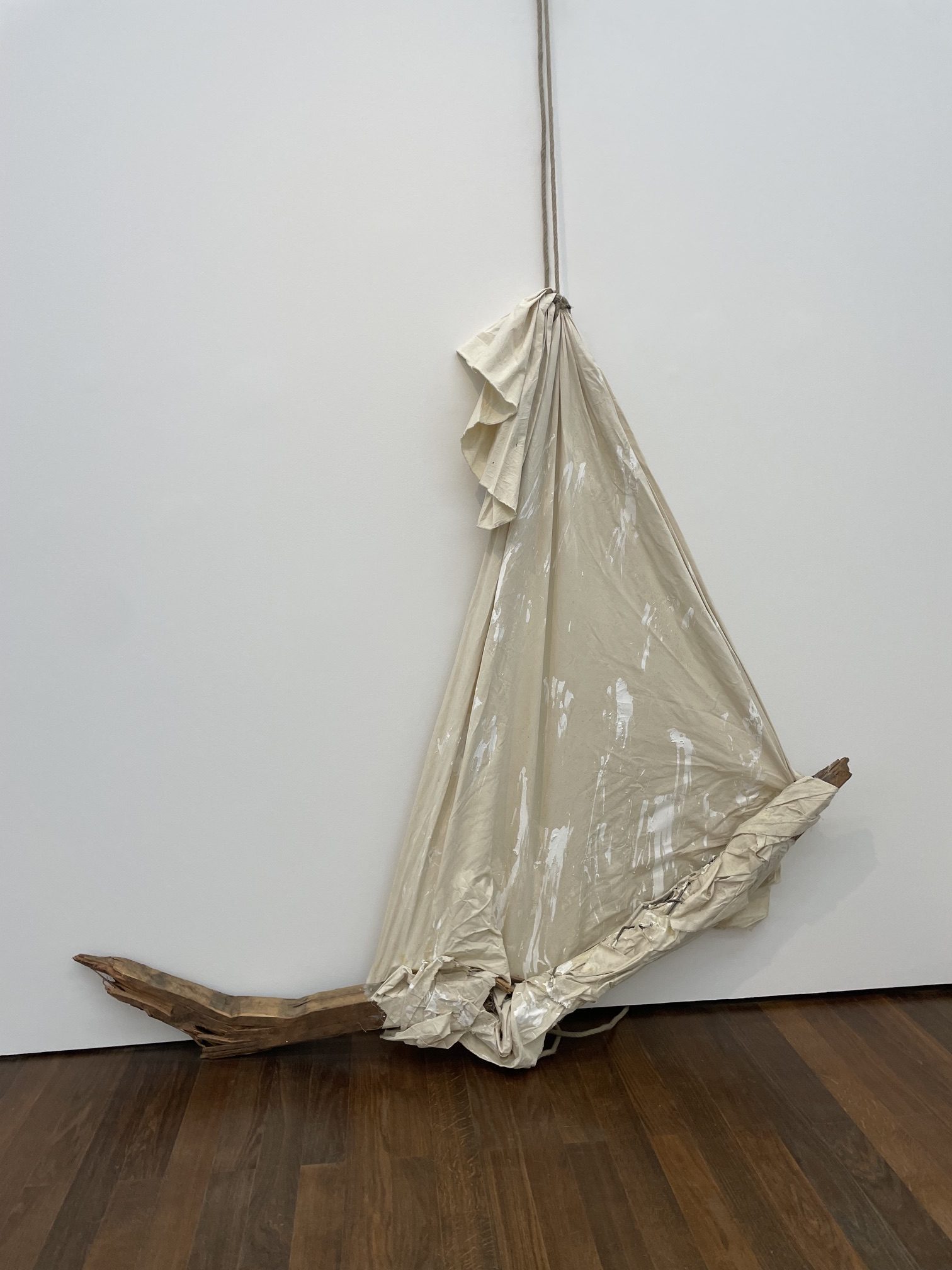
Günther Uecker, Untitled (I Think of Germany; Fracture), 1995. Muslin, paint, trunk broken into two parts, nails, cord. (Photo: Vladimir Dudchenko).
Later, Wasmuth moved to Bonn (1 hour away by train, then the capital of West Germany), to gain more exposure with policymakers. There he tried several business initiatives, like starting an art gallery and a publishing house focusing on editioned work. Eventually, he found an abandoned, dilapidated train station called Bahnhof Rolandseck. It was, and still is, a short train ride from Bonn, about 20 minutes, in Remagen, a small town on the Rhine founded by the Romans some two thousand years ago; only several thousand people live there now. So close to Bonn, yet it is in the other Bundesland. Wasmuth rented this closed 19th-century station in 1964 to create a home for new art, with a heavy emphasis on performing practices. Thus was founded what we now know as the Arp Museum, and what became a point of attraction for young artists in the region and beyond.
The inaugural show at Rolandseck included a performance by Uecker called “The Stairs” (1964), also documented on film. The artist literally hammered his way into the building, one nail at a time, marking each step or stair all the way up the corner tower where Wasmuth has moved, while most of the place was nowhere near clean. To make living there more bearable, Uecker decided to build Wasmuth a bed. It is called “A Bed for Waking” (1965), a bright white chamber of space surrounded by darkness, resembling stately royal beds in form but made of light planks and nails, firming cloudy images above the head. At the bedchamber inauguration party, Rosalka Rother (1913-1997), a staunch supporter of Wasmuth and Hera of the place, cooked a spicy meal and served it in junk-filled rooms.
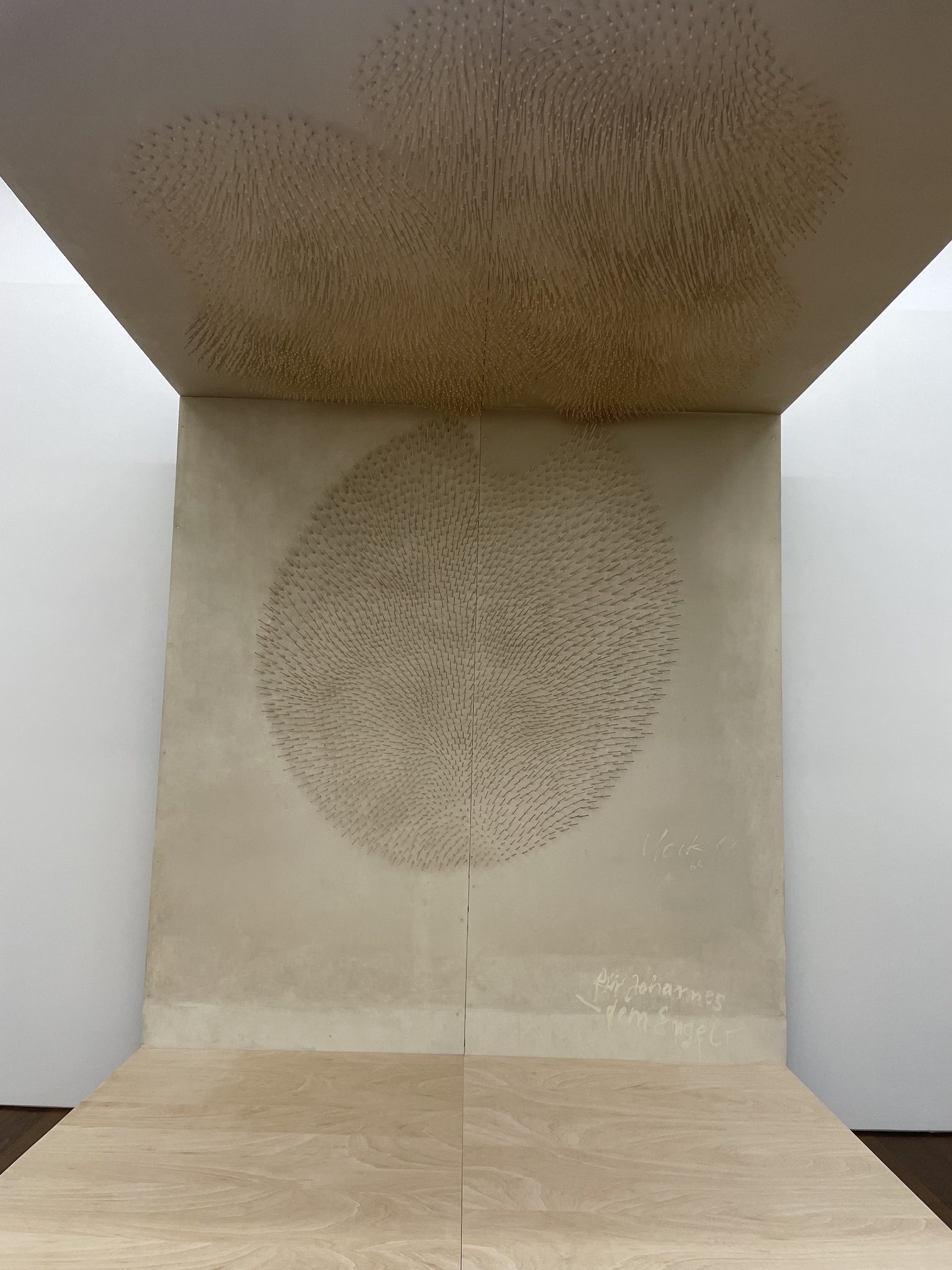
Günther Uecker, Bed for Waking, 1965. 2 Parts, nails, wood, paint. (Photo: Vladimir Dudchenko).
Uecker describes the party thus: “After hours of trying, Simone Bergmann and I finally succeeded in dancing through a tabletop when it splintered, much to our delight. We readied a carriage for a journey in the outbuilding. Then we rolled it out and set it alight, pushing it to the slope in front of the station and letting it roll down into the Rhine. In that same moment, the piano crashed down to the forecourt from the upper terrace and made the most ghastly noise; all the harps in the world sounded at the same time as the instrument shattered and the strings were torn free in the din of passing trains. Richter and Polke felt they were experiencing space travel. They went into Wasmuth’s bedroom; we came too, and they filled the vast old claw-foot bathtub with water. Richter and Polke rowed with big wooden spoons as if compelled. The tub shifted and tore free from the drainage pipe, meaning they were now rowing across the sea. <…>
“This was when Rosalka fled to her room in the kitchen and emptied the medicine cabinet, because she was intending to take her own life. We were very worried about her and called the ambulance, which took her away. She was treated in a psychiatric clinic for some days and survived the disaster, which was the transformation of a train station into an art venue.”
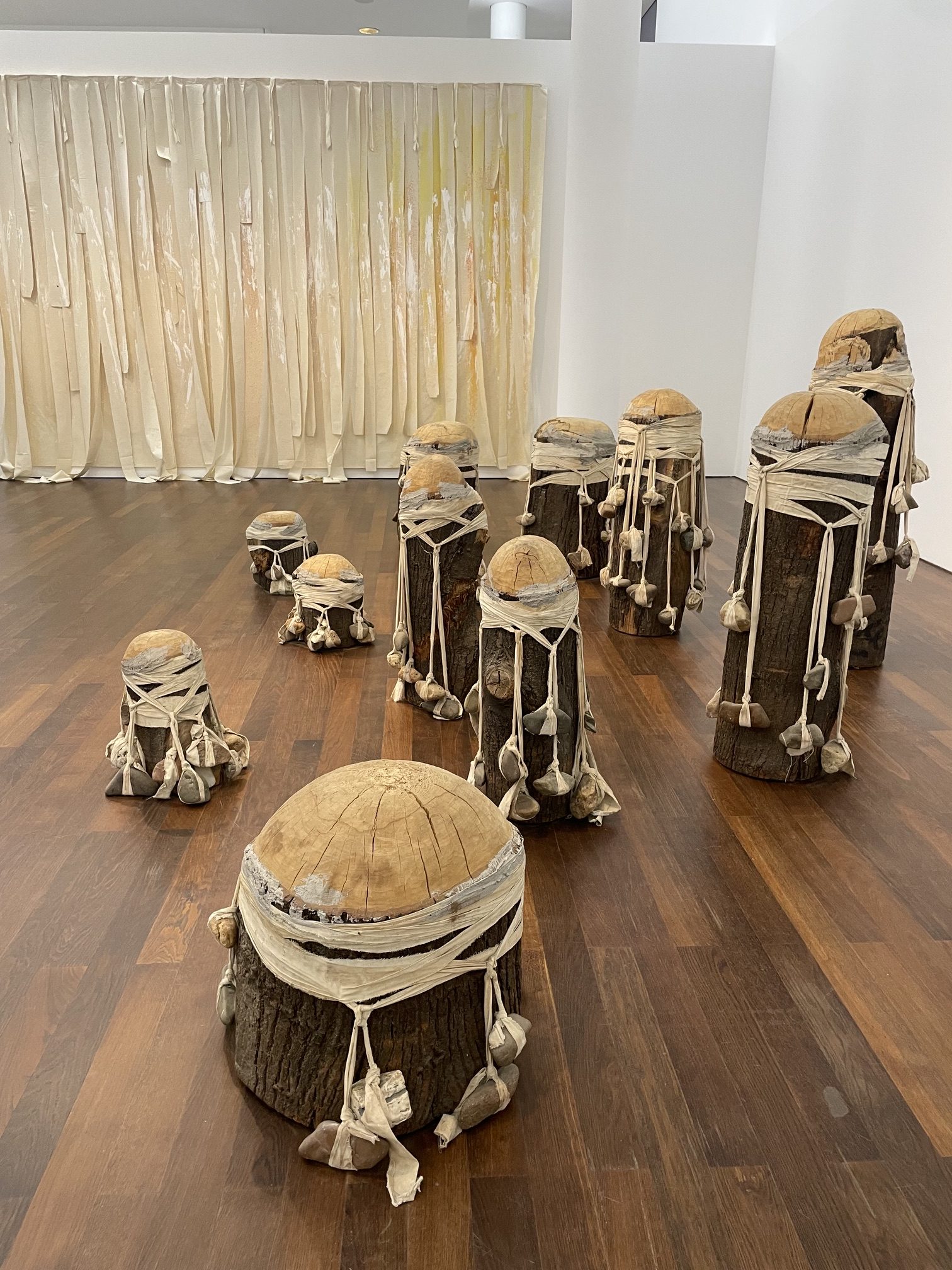
Günther Uecker, Forest, Hanging Stones, 1989/90. 12 parts, stones, linen strips, ash, wood glue on tree trunks (Photo: Vladimir Dudchenko).
This is the same venue where Uecker decided to hold his retrospective (which was to become posthumous). Now called ‘the place with the most beautiful bar’, it was transformed into the Arp Museum in 2007, when a new modernist building was built upon the hill, overlooking the river valley below and connected with the old train station by an elevator. Hand (Jean) Arp himself had nothing to do with Remagen, but Wasmuth was friends with him and the family since the late 50s. After Arp’s death, his widow and Wasmuth created a foundation, which received part of the estate and related rights; at some point, the foundation and Bundesland Rhineland-Pfalz brought the museum project to life.
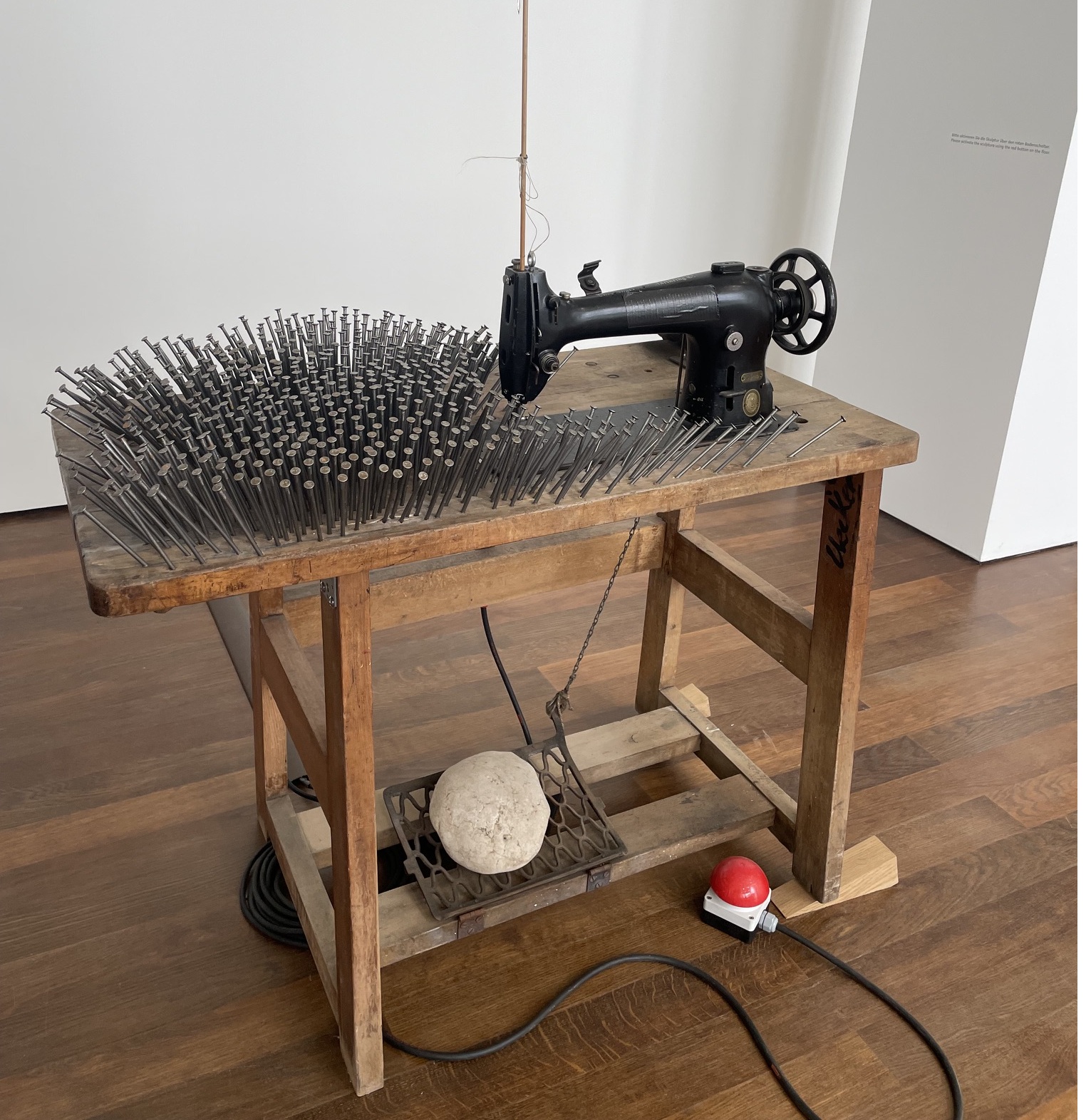
Günther Uecker, Dancing Needle for Pina Bausch, 2019. Sewing machine, nails, stone, thread, sewing needle. (Photo: Vladimir Dudchenko).
The exhibition itself shows Uecker in all of his techniques and media – it comes as a shock how diverse they were – but what is more important, it delivers his poetic and meditative take on the human condition. Uecker was a war child, aware of violence and fragility. Somewhat Dadaistic in attitude, Buddhist in some of the repeating practices, serenely hammering away until he was 95 years old. At some point, he said: “The theme of my artistic work is humans’ vulnerability before humans.”
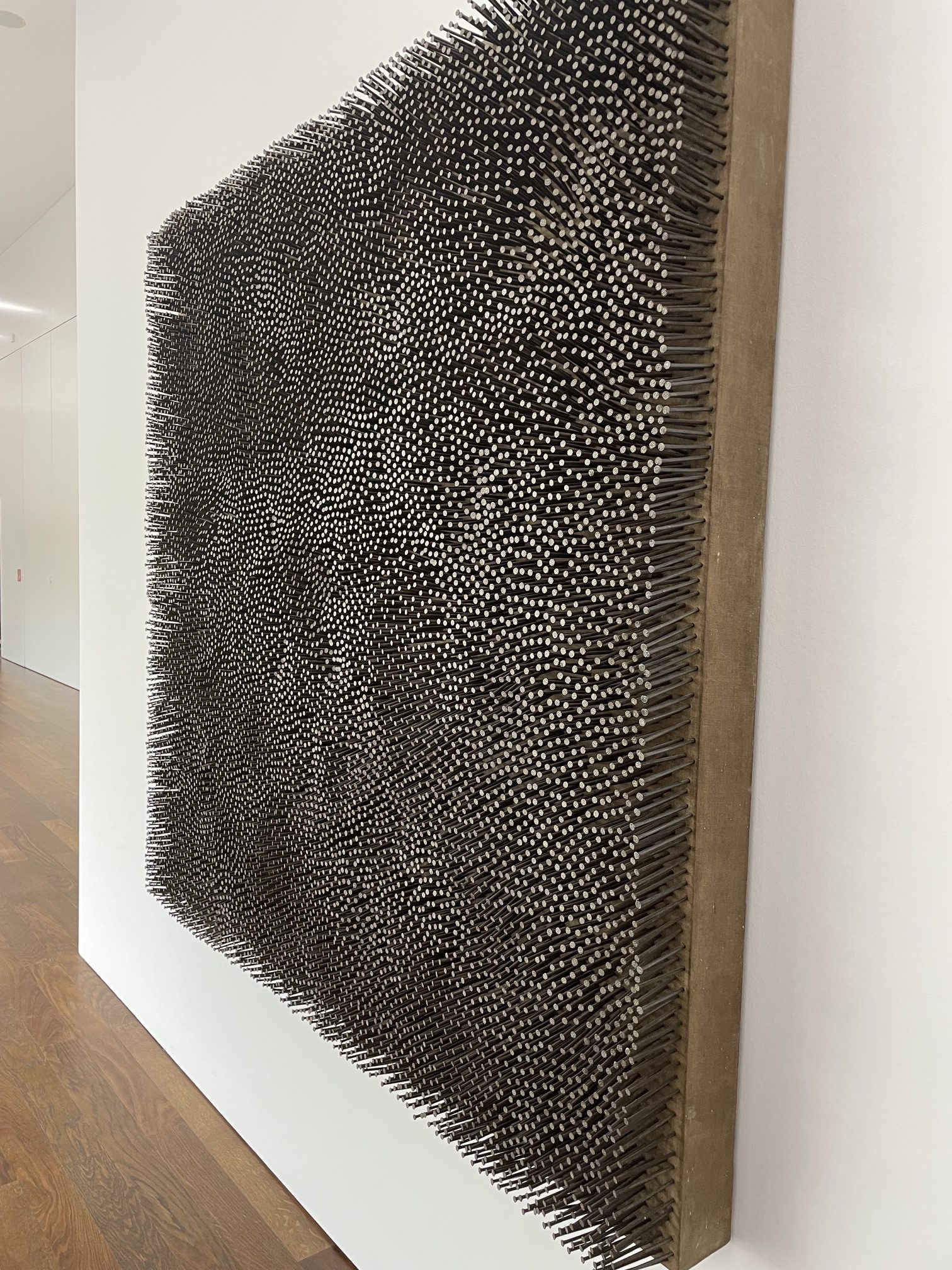
Günther Uecker, Field, 1975, installation view. Nails on wood. (Photo: Vladimir Dudchenko).
His nails visualize electromagnetic fields or clouds, grass fields in the wind, or seaweed moved by the underwater currents. But also they may be distorting the everyday, as in the “TV on the Table” (1963): “A nail needs to be hammered in here in order to generate resistance, so that art can seep into the banality of life”.
He has worked with all sorts of sharp objects, like shooting arrows at canvases in performance acts (“Arrow Picture”, 1971). Or binding together wooden spikes into roughly picture-like structures and painting them over (“Injuries – Connections”, 1982). He has also built mobile pieces, some resembling his ZERO co-member Jean Tinguely’s, some much more simple and arresting at the same time: a large round pile of sand with a frame with some cords circling above it, drawing a never-ending mechanical stone garden pattern (“Sand Mill”, 1969/2914). Painted different sorts of non-figurative paintings, starting with the early “Oval (Grey)” (1957) and ending with the nearly monochrome “Rainbow” (2020) in white and blue shades.

Günther Uecker, Sand mill, 1969/2014. Sand, wood, ropes, electric motor. (Photo: Vladimir Dudchenko).
Also in that show, the museum’s terrace hosted a repetition of his “The Aachen Flowerbed” (1969), where Uecker used ivy saplings as nature’s nails, driving them into a bed of sand in a geometrical grid. Then they started to grow, changing during the exhibition.

Günther Uecker, Installation view. (Photo: Vladimir Dudchenko).
Can’t really be museum-preserved. Still, a decisive point in his attitudes toward art and life.


0 Comments