
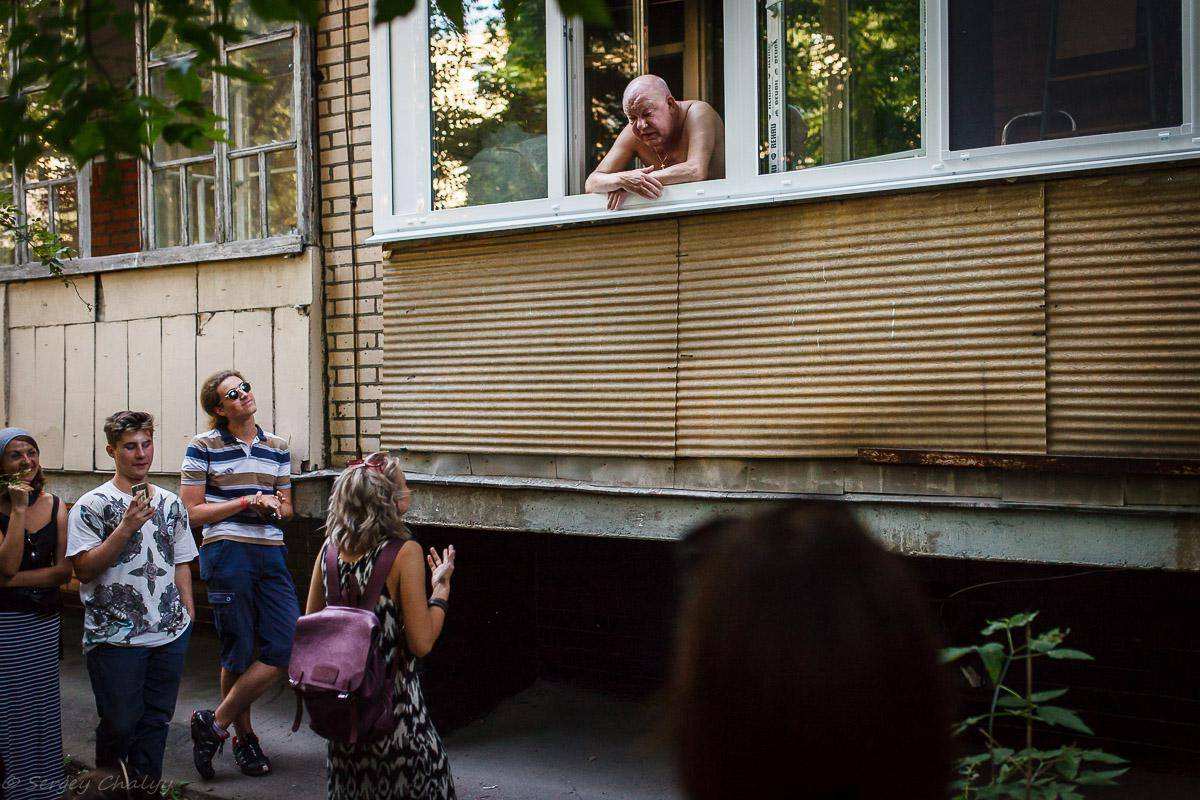
Vsevolod Lisovsky, “Implicit Impacts,” 2016. An immersive performance where actors and audience move through urban spaces, exploring invisible connections and how unseen forces shape human interaction. (Photo by I.Korina).
You buy a ticket to the theater — and end up on a train. Instead of a stage, there are carriages. Instead of a two-hour performance: two days of movement, pauses, and changing landscapes.
Vsevolod Lisovsky’s piece Through. Slipping Through Possibilities turns theater into a journey, making space and time its primary materials and leaving the audience to assemble their own performance from fragments and chance encounters.
Sometimes the director himself becomes a character in someone else’s show. During 100 Days — a project tied to Napoleon Bonaparte’s brief, meteoric return to power — Lisovsky announced he would approve any performance proposed by anyone. What followed was a torrent: several hundred performances a day for one hundred days across Moscow (and a handful in the mountains of Bulgaria). They happened whether anyone was watching or not. The aim was never to impress spectators but to act upon reality itself. One participant declared her intention to marry Lisovsky as her performance. The wedding took place on December 31, 2020; the marriage lasted a year and a half.
To call Lisovsky’s works “theater” is simply to use the nearest available word. His practice systematically removes all the usual elements of theater. His is a theater with no costumes, no text, no language, no walls, no schedule, and no actors. A squat, a commuter train, a passerby, a trolleybus, or a paternoster lift can all become part of the performance.
Lisovsky studied history at Rostov-on-Don University and later lived in the legendary artist squat, known as the ‘House of the Actor.’ (Perhaps it was from these atoms — history + squat + art + actors — that the molecule of his future practice took shape.) After a detour as a TV producer, he arrived at the theater at the age of 45. His first show, Akyn Opera, won Russia’s highest theater honor, the Golden Mask. Immediately afterward, he began dismantling the theater from within — moving it outdoors, onto trolleybuses, and into open fields. It was a brief era when such radicalisms could still be rewarded, and it led to his appointment as artistic director of the experimental platform Transformer.doc. Over the course of eleven years, approximately forty projects were created. But gradually the political climate darkened.
During his street performances, Lisovsky was detained by police at least ten times. Until 2022, this had no serious consequences; however, it was later classified as “discrediting the armed forces” and “resisting the police.” Lisovsky was imprisoned for thirty days. He ultimately had to stop working in Russia and leave the country.
He now lives and works in Germany. There, he has already created a new project, Pain, revived his earlier hit The Bacchae, and — together with our collective, MishMash — is developing a new work, ÜberZauberBerg (Over Magic Mountain). The project is open to anyone willing to experience it as part of our BuschKunstTheater movement — a genre that no longer fits inside the theater at all.
But let’s hear it from Vsevolod himself.
MishMash: Once, you moved from Rostov-on-Don to Moscow and ended up doing theater. Now you’ve had to move from Moscow to Germany. Back then, you called yourself a barbarian and said: “The key character in any mythology is the barbarian — the outsider who comes, sees something, and completely misinterprets it.”
How do you feel in that role now?
Vsevolod Lisovsky: As you get older, the whole problem shifts. When you’re young and move somewhere new, you feel like Anacharsis — that curious Scythian who left the wild steppes for Athens and tried to adapt. It’s about identity changing with geography. Now I’m more interested in time and subjectivity than in a place or identity.
From what I’ve seen, the resistance of society — the pressure of the environment — is roughly the same everywhere. If you live somewhere long enough, you build strategies to soften that pressure; that’s what we call identity. But identity, while protective, also limits your agency — your ability to act on the world. So, it’s equally difficult to remain a subject anywhere. The main enemy isn’t place—it’s time. First, there’s simply less of it; your planning horizon shrinks. Second, the era itself is changing, and I have no desire to adapt to it. In short, I no longer want to be a small king of the earth — I want to be a master of time. I want to learn to influence historical processes.
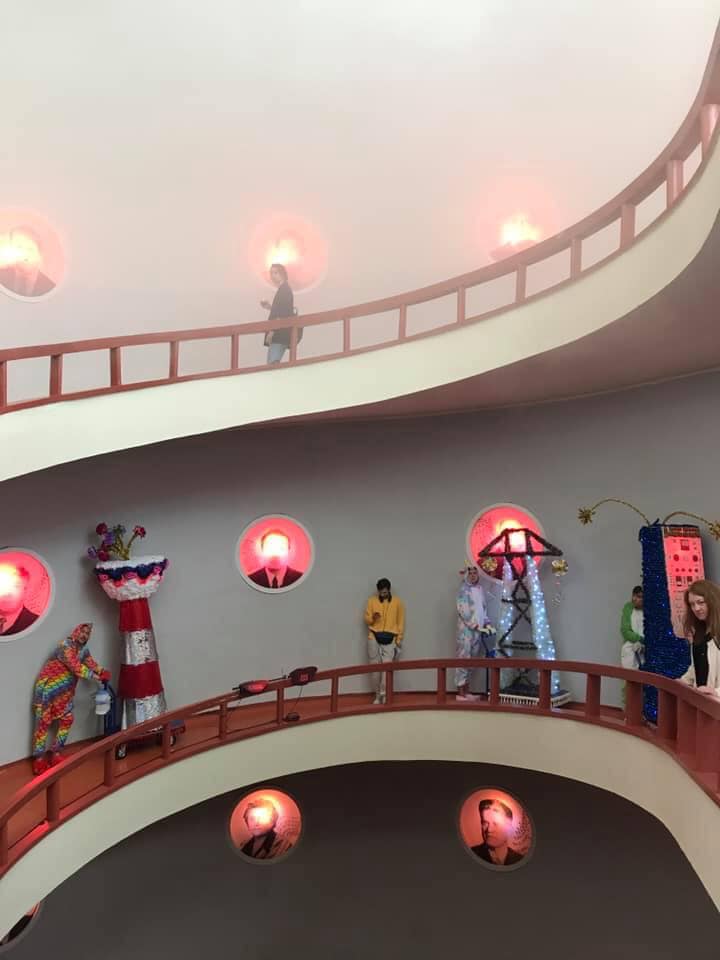
“GES-2 Opera,” 2019. Site-specific performance that transforms Moscow’s former hydroelectric power station into a living stage. The scenography, designed by Irina Korina, integrates the building’s architectural elements—such as its spiral concrete ramp and paternoster elevators—into the performance space. These features not only serve as physical structures but also as metaphors for the cyclical nature of industrial work and the passage of time. (Photo: I.Korina).
MishMash: You now live surrounded by a foreign language— but you’ve been fighting language in theater for years. Before, that was a choice. Now it’s life’s condition. When you remove one form of language — text, speech — do you have to replace it? Can a universal language exist, or must it always be reinvented?
Lisovsky: Language has become too powerful. It began as a bridge between the perceived world and the world of ideas — the super-reality. However, over time, it evolved into a self-aware, subjective, and independent entity. It is now increasingly difficult to approach the truth through language; language itself distorts reality. Even its simplest communicative function is breaking down. We can’t agree on anything — privately or politically. Ideological discussion has become pointless. So I try, as best I can, to cut off a few smaller heads of that Hydra.
MishMash: The Transformer.doc manifesto stated: “Here we’ll do the impossible — things that go against economic, physical, theatrical, artistic, and common-sense laws.”
How infinite is the impossible before it becomes institutionalized?
Lisovsky: That’s simple. The impossible is infinite. Once one impossible thing becomes possible, move on to the next.
MishMash: You often turn the viewer’s journey into the stage itself. The road becomes the scene; the viewer becomes a participant; the people and birds around them — the actors. In Russian literature, there’s even a genre for this — The project is open to anyone willing to experience it as part of our BuschKunstTheater movement — a genre that no longer fits inside the theater at all. The Blizzard — from Pushkin and Tolstoy to Sorokin: a drift through fog, opacity, and the unresolved. And there’s the Moscow Conceptual School — Collective Actions and their Trips Out of Town — a kind of psychedelic inner emigration from Soviet rigidity, and today from fake comfort and everyday lies. Do you feel connected to these traditions, and how does that translate in your new environment?
Lisovsky: Definitely connected. But here’s the paradox: on one hand, I belong to the “cultural worker” tribe. On the other hand, I feel no true connection to culture, because culture deals in metaphors and images — a second reality. I don’t want a second reality. It only moves me further from the super-reality. That’s why I try not to create images but events
MishMash: Why is discomfort — which your audience inevitably experiences — such an important artistic tool?
Lisovsky: It actually upsets me when people say, “Thank you, I enjoyed it.” I want to reply, “We don’t know each other well enough for me to give you pleasure.”
My audience is the disoriented, the frustrated, those with nothing to lose. In that state, a person is ready for change — ready to initiate it and take responsibility for the consequences. When you work with events, you never know where they’ll lead. Consumerist civilization expects engagement with reality to happen through joy. But ignoring and stigmatizing pain cuts perception in half.
MishMash: You don’t just put the audience through discomfort — you use your own body as raw material in Pain, your new opera created in Germany. Was it really born out of pain?
Lisovsky: Yes — from gout and migraines, to be precise. When one strikes, you begin listening to the pain, trying to decode it. When it pulses, it’s like Morse code — as if someone is sending you a message through the thick cotton layer of visible reality. That’s where the idea came from: to turn pain into communication, to objectify it.
Normally, we only know about someone’s pain from their words. In this project, we use a neural interface that turns pain into sound and image — you can actually see its dynamics on screen. The goal isn’t only to bring pain out of the zone of silent denial but to study the social relations it generates. For instance, everyone ends up feeling sorry for Uwe Möllhusen, the musician who has to prick me with a needle. He’s such a kind person, yet we make him do this.
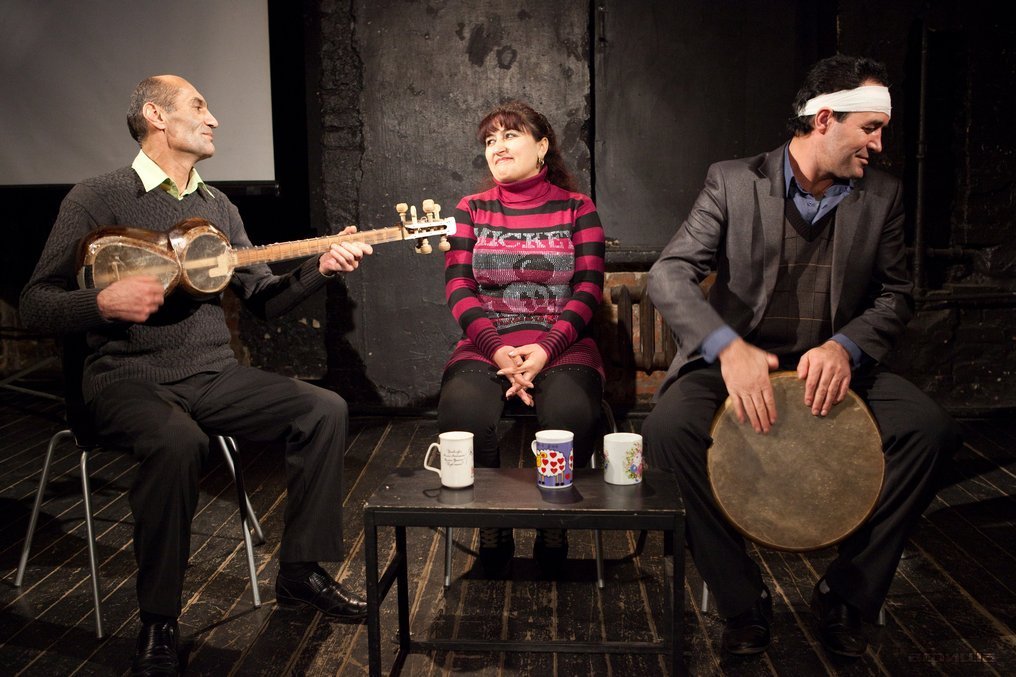
Akyn opera. Pamiri Tajiks, 2011. Professional folk musicians who work in Moscow on construction sites and at car washes — perform their traditional music and tell stories about life and changing fortunes. (Photo: Afisha).
MishMash: Let’s talk about the future — about ÜberZauberBerg.
Lisovsky: The Magic Mountain has always been a tuning fork for me. I return to it at different moments in life to see how it resonates. For me, Germany is, above all, Thomas Mann’s country. For years, I’ve been thinking about how to approach this novel.
Here in Germany, I realized the book could become a weapon in my personal war against language and narrative. What if you remove the plot entirely and leave only triggers for existential experiences? I believe it would become even stronger. I’m happy I could share these vague ideas with you, and that you found them worth pursuing — and that artists Ilya Voznesensky, Olga Petrunenko, Oleg Eliseev, and Andrey Monastryrsky have joined us.
The project’s structure is simple but radical. We don’t show or tell the viewer anything. We only invite them to perform specific actions in specific places — to have an existential experience and relate it to what the novel describes. We’re not sure it’s even a “theater performance.” We use the term only because it’s the closest one available. In contemporary art, there might be distant parallels; in theater, it may be a new genre entirely. We also don’t know how this kind of author–viewer relationship fits into market logic. So we won’t be charging money. The only cost is the viewer’s effort. What we’re about to present is just the first stage. It will continually expand with new elements by new (and returning) authors. We don’t know how long this expansion will last. Potentially — forever.
MishMash:
We’re already working on an online instruction manual that anyone can use — and soon this EVENT, rooted in a specific place but unlimited by time, will begin to exist here in Berlin.


0 Comments